The last few months have made the difference between models that finish a single task and models that can stay with a problem for days feel more consequential.
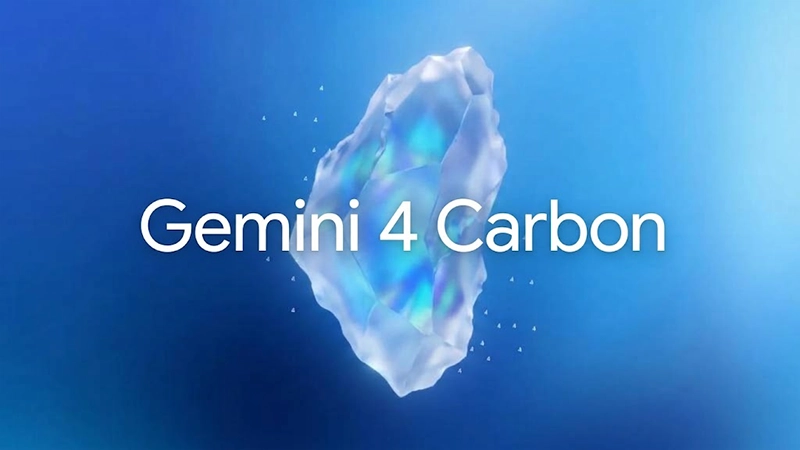
Most systems still lose the thread once a workflow stretches across multiple sessions, contradictory signals, or large amounts of existing code. Google's 'Gemini 4 Carbon,' announced two weeks after Argon became widely available, is aimed at that narrower but more demanding category of work.
Carbon is positioned as the company’s strongest model yet for sustained agentic workflows and cybersecurity.
It is designed to keep working through dead ends while root-causing subtle bugs across large codebases and lower-level systems, then produce patches that address the actual cause rather than a surface symptom.
The same capacity shows up in full-stack web development, where output quality improved enough for a sizable gain on public arenas, and in scientific and multimodal tasks that require holding long contexts without collapsing into generic answers.
On internal measures it more than doubled Argon’s success rate at generating secure code. The Chrome team separately reported that Carbon produced high-quality patches more than ten times better than another lab’s large frontier model on the same class of work.
Cybersecurity is the area with the clearest reported separation.
Carbon scored 88.2% on SEC-bench Pro for finding real vulnerabilities in existing software, 54.8% on ExploitGym for validating which ones can actually be exploited, and 71.0% on CWE-bench for producing working root-cause fixes.
These results were measured without guardrails.
The same testing also showed zero successful prompt-injection attacks on the Gray Swan indirect injection benchmark, an improvement from Argon’s already low 0.7% rate.
Alignment changes run in parallel: unsupported claims dropped roughly twofold versus Argon, the model is more likely to flag missing or contradictory information and ask before proceeding, and overreach or under-delivery on multi-step plans both declined.
High-severity misalignment alerts in live coding environments fell by nearly 80%.
Independent ranking places Carbon first on the updated Artificial Analysis Intelligence Index v5.0 at 59, one point ahead of Claude Opus 5.5 and two points ahead of GPT-6 Astra.
Claude Fable 5.1 sits further back on the same index.
The lead is not uniform. Carbon ranks second to Opus 5.5 on Artificial Analysis's coding-agent index and trails on a few specific software-engineering benchmarks where Astra or Opus still lead.
It shows larger relative gains on long-context reasoning, scientific tasks, and the cybersecurity suites where published numbers for the other models are available. Cost per complex task lands lower than Opus at standard pricing and closer to Astra, while the introductory token rates match Argon's at $2 per million input tokens and $10 per million output tokens before rising to $4 and $20.
Access remains limited by design.
Google frequently uses chemical elements like argon and carbon as internal and external designations for specific frontier model variants and architectures within the Gemini family.
These periodic table themes typically represent different generations, tiers, or specialized engineering builds of the technology.
While the overarching brand name "Gemini" draws from astronomy and mythology, Google's engineering teams lean into scientific and elemental codenames to track major developmental milestones and version iterations under the hood.
Ultimately, using elemental names reflects Google;s view of AI models as fundamental building blocks that can be configured into larger, more complex systems. Just as basic elements combine to form the physical universe, these core model variations serve as the foundational infrastructure powering a wide range of products, developer tools, and everyday applications across the entire Gemini ecosystem.






















































































































































































































































































