 A report by the Adobe Digital Index (ADI) shows that Google Chrome has surpassed Microsoft's Internet Explorer (IE) in the U.S. in combined desktop and mobile markets for the first time. The report says that Chrome and Android browsers are winning 31.8 percent, compared to IE's 30.9 percent market share.
ADI's market share calculation represents the share of visits from each browser for "the average U.S. website." ADI uses data from consumer-facing sites in the entertainment, retail, financial, travel and media markets.
ADI's report shows Mozilla's Firefox taking is taking a dive to nearly 20 percent from the amount of market share it holds in 2013. Without a mobile presence, Firefox owned only 8.7 percent of the market in April.
To analyze the browser market and audit its growth for the last six years, ADI aggregated anonymous data from consumer facing websites spanning an number of industries, tracking the browser usage of 17 billion visits to 10,000 websites in April, and more than 1 trillion visits dating back to 2008.
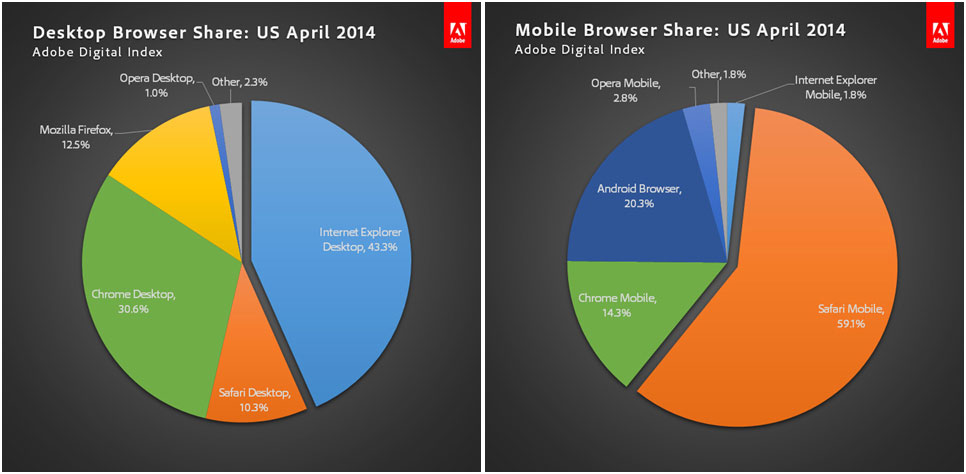
However, Microsoft only lost its position because mobile growth is growing exponentially. IE that was first introduced in August 1995 as part of the add-on package Plus! for Windows 95, is still a popular desktop browser, owning 43 percent of the market. Chrome is falling behind IE by more than 10 percent as the #2 most popular desktop browser in the U.S..
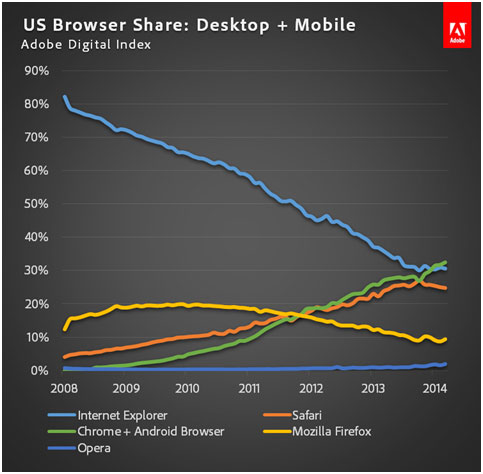
While Chrome is the leader in the browser market (35 percent), mobile growth has helped propel Apple's Safari to the number three position. Safari that occupies the list with 25 percent of the combined desktop and mobile market share, owns more than half of the mobile market share (59.1 percent).
In the mobile segment, Safari is followed by the Android browser with 20.3 percent and Chrome Mobile with 14.3 percent market share. Adobe noted that Apple's dominance is limited to mobile as its desktop popularity falls short of IE, Chrome and Firefox.
ADI claims that Google's browser popularity is the result of users wanting a consistent experience across their devices. Chrome that surpassed Firefox in the late 2011, provides integration and syncing in all of its platform, improving user experience to a great height.
With the overall browser market is split almost evenly between Google's browsers, Microsoft's IE, Apple’s Safari and Mozilla's Firefox, Adobe's Principal Analyst Tamara Gaffney said that marketers can no longer focus their development efforts on a single browser.
"Today, the market is fragmented," said Gaffney, "There are four big players, and there is a certain portion of the digital audience using each of them, depending on which device is in use at any given time."