 The app-based transportation network and taxi company, Uber, faces an ever-growing flow of competitors. But out of the already powerful and well-funded rivals, Uber is now facing one of its biggest investors, Google.
The search giant Google has long been interested in the automotive industry, and on its own, it's developing a driverless car of the future. But Google is also starting to put interest in getting into the ride-sharing business, creating a direct competition with the market leader Uber.
Uber and Google have been allies since the search giant company invested $258 million in Uber in 2013 and got a seat on its Board of Directors. David Drummond, Google's executive who sits on that Uber board seat, has recently informed Uber of Google's plans to get into the market itself.
Google Ventures' investment to Uber was one of Google's largest investment deal ever. Out of $300 million a year fund that the company is giving out yearly, 86 percent of it is was put to Uber. Google also put even more money into Uber's next funding round that was held less than a year later.
At that time, Google's investment was predictable since both has the same interests. At that time, there were no signs that the companies would become competitors more than they are allies, since they both benefit one another.
Uber is the only third-party company that is listed as a transportation method in Google Maps. With Uber's biggest expense being the drivers and Google working on a self-driving car, it was often speculated that the two companies would partner up, or Google would just acquire Uber.
But apparently, Google came up with an idea on its own.
Google and Uber: Friends and Enemies
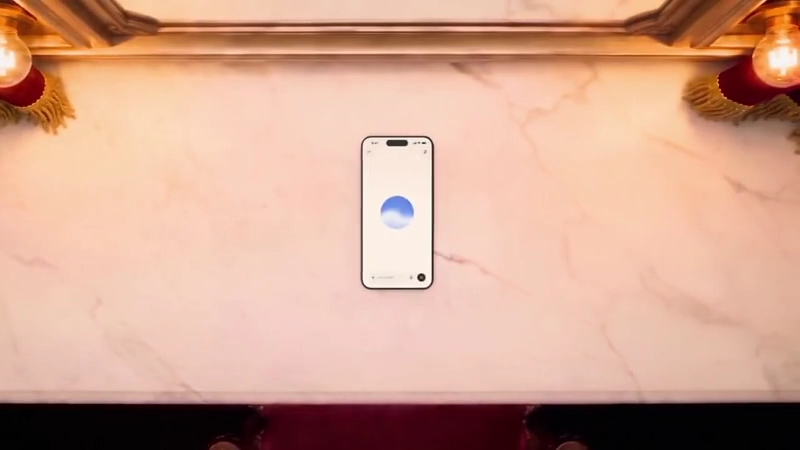
Having much of its funds delivered to Uber, Google eventually wants a piece of the action. David Drummond that was put on Uber's Board of Directors, told the Uber board that Google was working on a ride-sharing app of its own. Uber executives were said to have seen screenshots of what appears to be a Google ride-sharing app that is currently being used by Google employees.
Google having a ride-sharing app already in development is rather surprising, considering that Google's self-driving car project is still under development.
Seeing in Uber's side, the company is not going to stay quiet and let the search giant occupies its market. And for that, Uber is certainly won't give up its throne that easy. Uber welcomed the search giant already prepared. The company has opened a robotics research facility to work on building self-driving. This has made Uber entering Google's territory.
To help putting the project into reality, Uber hired "more than 50 senior scientists from Carnegie Mellon as well as from the National Robotics Engineering Center." The Uber-CMU partnership focuses on the development of "key long-term technologies that advance Uber’s mission of bringing safe, reliable transportation to everyone, everywhere," said a post on Uber's official blog post on February 2nd, 2015.
Uber that is entering the self-driving car industry is developing the core technology, the vehicles they're going to deploy, and other associated infrastructures to make the project work. On the other hand, Google that approached the other way around, already has the hardware to do so, but lacks the software to compete.
People assume that a self-driving car is a product of tomorrow that customers will buy as an alternative to today's conventional cars. But Google has never been very good at selling physical products; its strength has always been in software, and provisioning others.
Since the majority of fares to Uber goes to pay the driver, with Google's driverless car, Google should be able to charge dramatically less than Uber and still make a profit. That big price advantage won't exist if Google tries to sell cars to consumers directly. So Google needs something to introduce its self-driving car technology, but at the same time minimizing lawsuits and preventing errors, by owning its own fleet of vehicles.
But competing directly with Uber in ride-sharing business is an uphill start for Google. Uber had a huge head start with a lot of drivers and a lot of vehicles, with a lot of achievements. Google that starts with zero driver and zero passenger, is seen as a big disadvantage.
However, Google is a company that is known to sit on a a large amount of resources. It can afford funding its own development of self-driving cars while at the same time developing software and expertise in the field. Once Google is ready, it can beat Uber with a much lower price.
Google’s entrance into the ride-sharing market would also leave Uber without a partner in the future where self-driving cars are predicted to roam the streets. To compete in a long-term, Uber will either have to develop the technology itself or form an alliance with a company that can if it wants to offer autonomous vehicles within its fleet. Well-known vehicle manufacturers such as Mercedes, Audi and Tesla have said they are developing driverless cars as well.