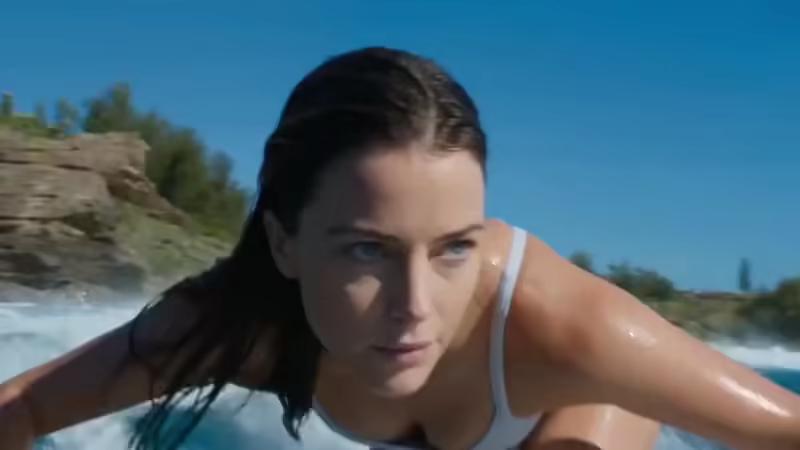
In the ongoing war among AI models, the competition intensifies with players pushing the boundaries of what models can do from text prompts, images or reference footage.
Companies like OpenAI with Sora, Google through Veo, Grok with Grok Imagine and others have poured resources into multimodal systems aiming for photorealistic motion coherent storytelling and broad creative control yet ByteDance has emerged as a formidable contender through its Seedance series which quickly demonstrated exceptional prowess in delivering high quality results that rival or surpass many established alternatives in practical creative workflows.
The original Seedance 2.0 gained attention for its unified multimodal architecture, which supports text, image, video, and audio inputs within a single system.
The model can generate synchronized audio and video content while maintaining character consistency, realistic motion, detailed lighting, and coherent camera movements across multiple scenes.
According to ByteDance's technical paper, Seedance 2.0 supports clips between 4 and 15 seconds in length, native output resolutions of 480p and 720p, and multimodal references including up to three video clips, nine images, and three audio clips.
Now, 'Seedance 2.0 Mini' builds on these capabilities with a stronger focus on efficiency.
Meet Dreamina Seedance 2.0 Mini: Built for quality and speed, at lower cost.
- ~30% lower cost than Dreamina Seedance 2.0
- 2× faster than Dreamina Seedance 2.0 Fast
- Comparable output to Dreamina Seedance 2.0 Fast
Launch offers:
- Pro users (existing & new subscribed before… pic.twitter.com/jIDZs4TlPl— CapCut (@capcutapp) June 15, 2026
Seedance 2.0 Mini is a streamlined version of ByteDance's Seedance 2.0 AI video generation model, developed to lower costs and accelerate production while maintaining much of the quality that established the original model as a leading contender in the rapidly evolving AI video market.
According to ByteDance, Seedance 2.0 Mini reduces generation costs by approximately 30% compared with the standard Seedance 2.0 model.
Despite its focus on efficiency, the model retains key capabilities, including text-to-video and image-to-video generation, as well as reference-based controls that help preserve character identity and visual consistency across multiple outputs.
Its lower operating costs and faster inference speeds make Seedance 2.0 Mini particularly well suited to workflows that depend on rapid experimentation, high-volume production, and frequent iteration.
These advantages are expected to appeal to independent creators, small production teams, marketers, and e-commerce sellers who often need to generate and refine multiple concepts before selecting a final version.
Community feedback around Seedance has consistently identified generation costs as a significant barrier to broader adoption, making the introduction of a more affordable variant an important addition to the ecosystem.
Seedance 2.0 Mini is available through ByteDance's own Dreamina platform and is integrated directly into CapCut.
Users can access the model across CapCut's AI Lab, AI Generator, AI Video, Video Studio, Design Studio, and Edit Pilot tools on mobile, desktop, and web platforms.
By embedding AI generation within existing editing workflows, ByteDance enables users to create, refine, and export videos within a single environment, reducing the need to move between separate applications.
The launch is part of ByteDance's broader strategy to build an integrated creative ecosystem around Dreamina and CapCut. Dreamina functions as the company's dedicated platform for AI generation, while CapCut serves as the editing environment where generated assets can be combined with effects, captions, and post-production tools.
By embedding its latest AI models directly into widely used editing software, ByteDance aims to lower the barrier to entry for AI video creation and strengthen its position against competing models such as Google's Veo.
Seedance 2.0 and its Mini variant are currently rolling out gradually in selected markets, including Indonesia, Malaysia, the Philippines, Thailand, Vietnam, Brazil, and Mexico.
ByteDance has also implemented safeguards that restrict the use of real faces and unauthorized intellectual property, and all generated videos include invisible watermarks to help identify AI-generated content.






















































































































































































































































































