Software spends most of its life making small judgments. Route this ticket. Flag that sentence. Pick the next Wikipedia link. Score whether a customer sounds angry enough to escalate.
Those calls are not essays. Instead, they are forks in a program, and for a long time the only tools that could make them from messy language were large language models (LLMs) that first had to write a paragraph, then be parsed, validated, retried, and still sometimes invent a field that never existed.
That mismatch is older than the current model boom.
Chat systems were trained to please people. Production systems need answers that other code can treat as data.
On 15 September 2026, TypeSafe AI, a San Francisco lab founded by former OpenAI researcher Diogo Almeida, put a public name on its attempt to close that gap: a class of models it calls 'System One.'
And the first model is called 'Jev.'
Around the GPT-3.5 era, after instruction following crossed a line that looked superhuman to the people who had just trained it, someone on the post-training team asked the question the field has been circling ever since: is this AGI?
The model was released. It spread faster than any research artifact in the company’s history.
A year later most of the traffic was still copywriting.
Diogo Almeida, who co-authored InstructGPT, contributed to ChatGPT and the GPT-4 report, and helped invent the reinforcement learning from human feedback recipe behind that moment, later wrote an internal note titled "we could have had AGI last year."
And Jev is his answer only in a narrow sense.
He has been explicit that the honesty of the question is "why can’t we automate the easy work," not a guarantee that this stack becomes AGI, TAI, or ASI.
He also says automating easy tasks first is, in his view, the most promising path to those labels, and that the older north star was never a single conversational mind. It was language model programs, smart if-statements, neuro-symbolic systems: code as slow reasoning, a model as the fast judgment inside each branch.
That is the fork he is describing, not a chatbot replacement.
ChatGPT, in talks before launch, he called a weird detour from automation. RLHF optimizes for what a human prefers to read. It produces assistants that stay in the loop by design. A later objective, reinforcement learning with verifiable rewards, pointed models at checkable problems and long traces, which raised benchmark intelligence and also latency and cost.
Neither objective is a typed decision a request handler can trust at 100 milliseconds.
TypeSafe's third method, Reinforcement Learning for Calibrated Decisions, trains the model to emit constrained answers whose probabilities track outcomes across groups of predictions.
Calibration is aggregate, not a warranty on one call.
Read: Paving The Roads To Artificial Intelligence: It's Either Us, Or Them
The interface matches the objective.
Jev takes a state (text or structured program data) and a map of questions, then returns schema-bound values in parallel: a Choice with a label, a full distribution, and confidence; a Score on an ordered rubric; a Noul, a 0-to-1 probability that a statement is true.
Questions are independent.
Adding one does not rot a chat history. The model does not write code, replies, or explanations. Control flow stays in software. Almeida’s short version is that pretrained models are already intelligent, and the missing piece was an interface software could depend on.
Company copy puts it ruder: building prod, not God.
Giving up strings is the trade that buys the rest.
Parallel sampling, the same class of move that let Transformers leapfrog sequential RNNs, is why TypeSafe claims 70 to 500 millisecond end-to-end times on System One shaped queries against 3 to 329 seconds for frontier generators, or 40 to 200 times faster depending on the pair, and why many questions can share one state. Internal workflow evals, using an average of GPT-6 Astra and Fable 5.1 as reference and wrapping those models so they must emit structure, report 193.6 times faster and 444.6 times cheaper on the high end.
List price is $0.042 per million input tokens, $42 per billion, outputs unmetered. A site clip shows 0.114 seconds and a fraction of a cent against 8.566 seconds for a wrapped LLM.
Hallucinated keys are structurally impossible because the output space is fixed before inference. Being right is not. A 0.61 refund probability can still be wrong. Choice cardinality tops out at 255; larger menus become a score-then-choose pass that can stall.
Eval caveats sit in the same post that publishes the multiples: workflows came from TypeSafe's own team, the reference set leans OpenAI and Anthropic, laptop timings are not every production path, and OpenRouter hallucination stats for ordinary LLMs are a noisy baseline. Jev is early access, not a measured replacement for generation.
The demos are arguments about composition, which is where Almeida’s AGI claim actually lives.
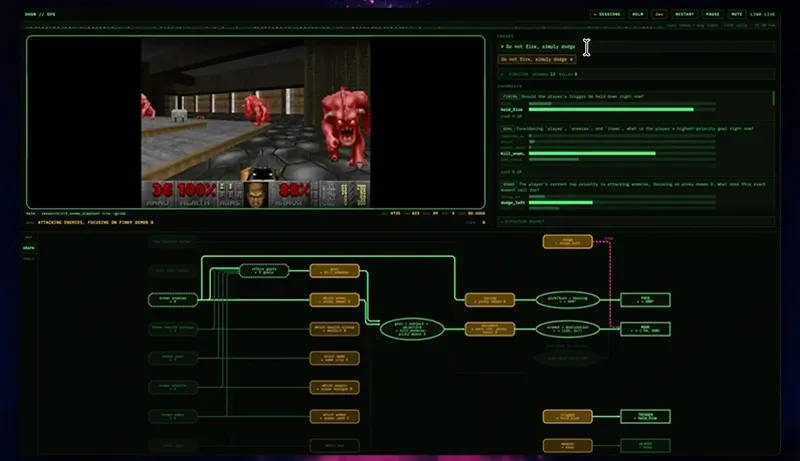
A Doom bot reads structured state, not frames, at about ten calls a second and about $7 an hour; a classical bot would likely play better, but the clip is a loop of cheap judgments inside ordinary code.
Wikiracing forces a choice among hundreds or thousands of links per hop, the setting where an invented URL ends the run.
An Every experiment pushed 37 documents through 21 questions at once and got 777 judgments in under 0.7 seconds for about a quarter of a cent; a smaller defect hunt against Fable 5.1 was hundreds of times cheaper, much faster, and caught six of seven planted errors while missing the same unexplained-action case three times. Almeida’s reply thread fills in the theory those toys are pointing at.
Focus is simpler tasks worth automating, because he thinks language models underdelivered hardest there.
Open-ended work is possible if the harness is code: the workflow is System Two, Jev is System One. Chat and coding remain. He treats this as a fork, and he thinks true automation will be the larger economy if the cheap layer works.
The name Jev is Jevons: more efficient coal engines did not shrink coal use.
They multiplied the jobs steam could take. The bet is that intelligence per dollar follows the same curve, and that AGI, if the word still means economically general competence rather than a single all-purpose speaker, arrives as millions of narrow, calibrated forks inside software rather than as one model that finally chats its way into running a firm.
TypeSafe left stealth with a $40 million DCVC-led seed and a reported $200 million valuation. Co-founders include Erik Gafni and Sasha Sheng. The API is one POST to /v1/systemone.
The years since ChatGPT's arrival create moments where people are given superhuman abilities through chats that did not produce factories of reliable automation because the interface was built for people, and that software needed a different object, closer to a typed function than to a conversation.
Jev is the first public test of that object. It will live or die in code paths that already exist, on questions narrow enough to name, at latencies short enough that a request handler can afford to wait.
At this time, the path towards AGI is still debated, and this oen is still unproven. But this one is still superhuman.




















































































































































































































































































