Creative projects often blur the line between social commentary and practical experimentation. Some are presented as artworks, others as thought experiments, and a few adopt the structure of familiar institutions to encourage people to think differently about everyday life.
In Japan, one of the more unusual examples takes the form of a parody religion that was created not to promote spiritual beliefs, but to explore how language, culture, and social expectations influence people's ability to say no.
MtoP, short for "Motohiro to People," is a satirical project founded in November 2018 by Japanese photographer and artist Motohiro Hisano.
According to Hisano, the idea for creating his own religion came from the pressures of everyday life in Japan.
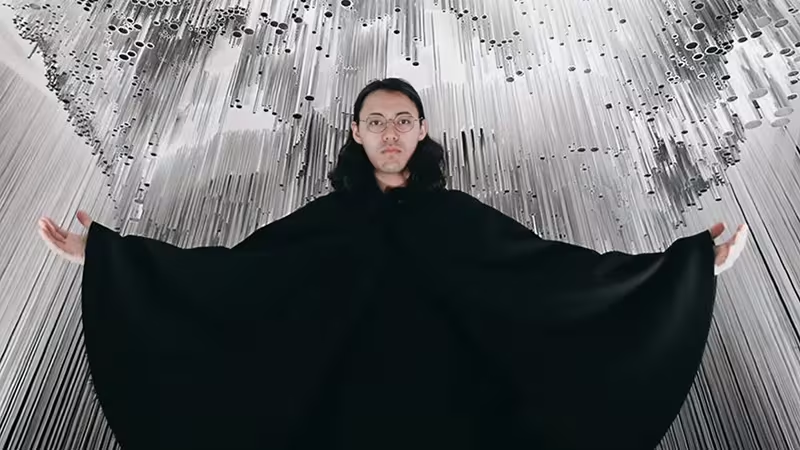
Born in 1996, Hisano began working as a freelance photographer in his early twenties, where he soon experienced the realities of Japan's demanding work culture firsthand.
Those realities include long working hours, expectations surrounding unpaid overtime, and the well documented phenomenon of karoshi, the term used for death caused by overwork.
The project emerged against that backdrop.
Hisano has said the idea was inspired by the Church of the Flying Spaghetti Monster, but adapted to address this very issue.
According to Hisano, the phrase "religious reasons" carries particular weight in Japan because freedom of religion is legally protected, making it one of the few explanations employers and others may hesitate to challenge directly.
Although MtoP is presented in the language of religion, it deliberately avoids many of the characteristics normally associated with one.
While he does claim to be the "god," he repeatedly states that he performs no miracles, possesses no supernatural powers, seeks no worship, and accepts no financial donations. Instead, his role is purely symbolic, serving as the figure who grants followers the ability to invoke "religious reasons."
The idea came to him after he created this tweet:
In a post, he explained it all:
The origin of this whole thing was this tweet that I posted on Twitter on a whim.
That said, to be honest, I never expected it to get such a response.
After all, 30 minutes after I declared myself a god, an Australian branch had already been formed. Even though the headquarters hadn't even been established yet.
I got a little scared, so I just went to sleep for the time being.
Then the next morning, when I opened Twitter with trepidation, as expected, or perhaps as I feared, my DMs were flooded with requests to join the faith.
Even though there were no scriptures, let alone a holy land, or even a name for the religion?
I honestly thought, are the young people of Japan okay?
What's more, I even received DMs saying, "Please let me deposit an offering," so the world is truly coming to an end.
Well, anyway, I have become a god.
Its central document, known as the R0304 Scripture, is a living collection of everyday situations in which followers are considered free to use religious reasons as justification.
Rather than presenting theological teachings, it functions more as a guide to establishing personal boundaries.
The examples include refusing unnecessary overtime, using all available paid leave, taking parental or maternity leave, protecting physical and mental health, declining unwanted drinking parties, avoiding pressure to make purchases or loans, refusing to act as a guarantor, opting out of social media expectations such as following someone back, declining horror attractions, and choosing not to participate in activities that cause unnecessary stress.
The scripture contains no definition of a deity, no required rituals, and no religious prohibitions.
Instead, it encourages followers to exercise their own judgment. In that sense, MtoP is not intended to promote worship or a system of belief.
Rather, it provides a fictional religious framework that people can cite when declining requests or obligations they would rather avoid.
In other words, the "religion" is an excuse to say "no."
it literally exists only as a form of social critic against Japan's demanding work culture. Hisano designed it specifically to exploit that cultural loophole.
Because this is not an officially recognized religion in Japan, Satino emphasized that every decision rests with the individual, and that those who follow its teachings do so at their own discretion and risk.
Regardless, despite being the powerless god, he needs to have a doctrine his followers must follow. He prototyped it, and in his own words:
- You must leave work on time as much as possible. If you must work overtime, you must keep it to the shortest time possible. Of course, you must receive the full amount of overtime pay.
- You must use all your paid leave. Also, during paid leave, you should do what you love.
- You must make maximum use of childcare leave. Also, during childcare leave, you must forget about work and cherish your children to the fullest.
- Use the magic words "for religious reasons" without hesitation, and strive to comply with 1-3.

Membership is equally unconventional.
There are no initiation ceremonies, membership fees, meetings, or attendance requirements. According to the project's own rules, a person becomes a follower simply by following the official @free_lance_god account on X.
The project describes those followers as members of MtoP, making participation almost entirely symbolic.
The idea attracted wider attention in 2019 after appearing on Japanese television, at a time when the project's social media following was still relatively small.
Since then, interest has continued to grow both within Japan and abroad.
Translated versions of the scripture have circulated in countries including South Korea, while international media have highlighted MtoP as an example of how satire can be used to discuss workplace culture, personal autonomy, and social expectations.
Hisano has consistently emphasized that MtoP should not be viewed as a conventional religion.
Instead, he describes it as a form of media art that uses the familiar structure of religious organizations to explore how people justify their decisions and negotiate personal boundaries.
By removing theology and replacing it with everyday situations, the project invites discussion about why some explanations are accepted more readily than others and why many people find it difficult to refuse requests, even when doing so would protect their own time, health, or well being.

















































































































































































































































































