Death is swift for some people who pass peacefully. But to others, it can be painful, and a mystery..
For the latter, some of them are considered cases for the living to solve.
Suchir Balaji was a bright young man.
The 26-year-old Indian-American researcher spent four years at OpenAI and was one of the key people behind the product that helped propel OpenAI into becoming a renowned and influential company, that Google even fears.
While death will happen to anybody, Suchir died by what the police thinks is a suicide.
And Suchir died only weeks after he made some serious allegations against his former employer.

Suchir Balaji, a former researcher at OpenAI, was found dead in a San Francisco apartment in late November.
Prior to his death, he had made serious allegations against the AI company, accusing it of copyright violations and unethical business practices.
Suchir, who had been working with OpenAI, helping it develop the GPT-4 model, which is still considered a cornerstone of OpenAI's generative AI products, had been accusing OpenAI of copyright violations, and claimed that its ChatGPT AI chatbot had been trained on unauthorized digital data.
He alleged that Sam Altman’s company harvested vast amounts of digital data from the internet to train its AI models, which include content from websites, books and other copyrighted materials.
All of which are 'stolen' just for the same of improving the AI's capabilities.
Suchir argued that OpenAI’s practices threatened the commercial viability of individuals, businesses, and online services that generated this digital content. He emphasized that ChatGPT AI models could produce substitutes directly competing with the original sources, thereby weakening the foundation of the fair use defense.
"This is not a sustainable model for the internet ecosystem as a whole," he once said in an interview with The New York Times.

Balaji also accused OpenAI of making unauthorized copies of copyrighted data and creating derivative versions resembling the originals.
He explained that OpenAI’s system could either be trained to generate exact copies of the data or produce text that, while not a direct replication, still mirrors the essence and style of the original content.
"The outputs aren’t exact copies of the inputs, but they are also not fundamentally novel. There are occasionally circumstances where an output looks like an input," he said.
The larger concern, he noted, is that as AI technologies replace existing internet services, they often generate false or entirely fabricated information — a phenomenon researchers refer to as "hallucinations."
"If you believe what I believe, you have to just leave the company," he continued.
Suchir resigned from OpenAI after working there when he learned the technology would bring more harm than good to society.
"I was at OpenAI for nearly 4 years and worked on ChatGPT for the last 1.5 of them," Balaji wrote in October on the social media platform X.
Here is the article: https://t.co/gUPomoel48
— Suchir Balaji (@suchirbalaji) October 23, 2024
"I initially didn't know much about copyright, fair use, etc. but became curious after seeing all the lawsuits filed against GenAI companies."
"When I tried to understand the issue better, I eventually came to the conclusion that fair use seems like a pretty implausible defense for a lot of generative AI products, for the basic reason that they can create substitutes that compete with the data they’re trained on," his post continued.
He also said that he contacted The New York Times to tell his story "because I thought I had an interesting perspective, as someone who's been working on these systems since before the current generative AI bubble."
Also, since I see some incorrect speculation:
The NYT didn't reach out to me for this article; I reached out to them because I thought I had an interesting perspective, as someone who's been working on these systems since before the current generative AI bubble. None of this is…— Suchir Balaji (@suchirbalaji) October 23, 2024
In all, Suchir alleged that OpenAI has been indulged in a business practice that is literally harming the internet, its ecosystem, and fair use.
Balaji’s revelations were central to many lawsuits filed against OpenAI for copyright violations.
Just weeks after accusing all the above, Suchir Balaji was found dead in his Buchanan Street apartment in San Francisco, California.
The San Francisco Office of the Chief Medical Examiner confirmed this, and identified the deceased as Suchir himself.
The manner of death has been ruled suicide.
First responders were called to his home to perform a wellness check, and no evidence of foul play was found during the initial probe.
The medical examiner said it had notified Suchir's family.
"We are devastated to learn of this incredibly sad news today and our hearts go out to Suchir’s loved ones during this difficult time," a spokesperson for OpenAI said.
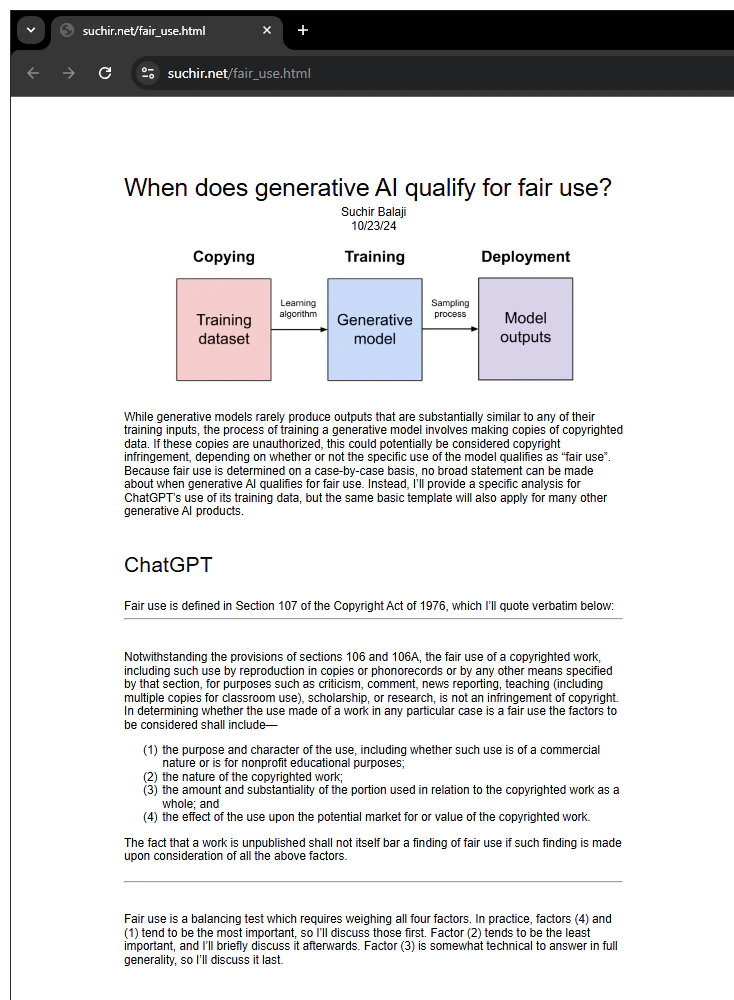
It's worth noting that back in October, Suchir published an essay on his personal website that raised questions around what is considered "fair use" and whether it can apply to the training data OpenAI used for its highly popular ChatGPT model.
"While generative models rarely produce outputs that are substantially similar to any of their training inputs, the process of training a generative model involves making copies of copyrighted data," he wrote.
"If these copies are unauthorized, this could potentially be considered copyright infringement, depending on whether or not the specific use of the model qualifies as 'fair use.' Because fair use is determined on a case-by-case basis, no broad statement can be made about when generative AI qualifies for fair use."
Suchir argued in his personal essay that using massive amounts of freely copied internet data to train AI models could jeopardize online knowledge communities.
He pointed to a research paper that discussed Stack Overflow, a well-known coding Q&A website, which saw sharp declines in traffic and user participation after the introduction of AI models like ChatGPT and GPT-4.
Since large language models (LLMs) and chatbots deliver direct answers to user queries, fewer people turn to original sources for information.
And because people become more interested in AI-generated content, the internet itself is seeing less and less fresh, human-generated content, weakening its role as a valuable resource for people as a whole.




















































































































































































































































































