Somewhere between the endless scroll and the quiet moments when people post their everyday activities, children go to school.
They put on uniforms, say goodbyes to their parents, climb into cars or buses, walk through gates that are supposed to mark the start of ordinary days filled with lessons and friends.
Parents send them off with the assumption that the worst thing waiting inside will be a difficult exam or a forgotten homework assignment. That assumption holds in most places on most mornings.
On the morning of August 7 in Nonthaburi province just outside Bangkok it did not.
A boy who lived with his grandparents woke early, took his grandfather's handgun, and killed both of them in their home. He then made his way to the secondary school where he was enrolled.
He began moving through the building and opened fire, before killing himself.
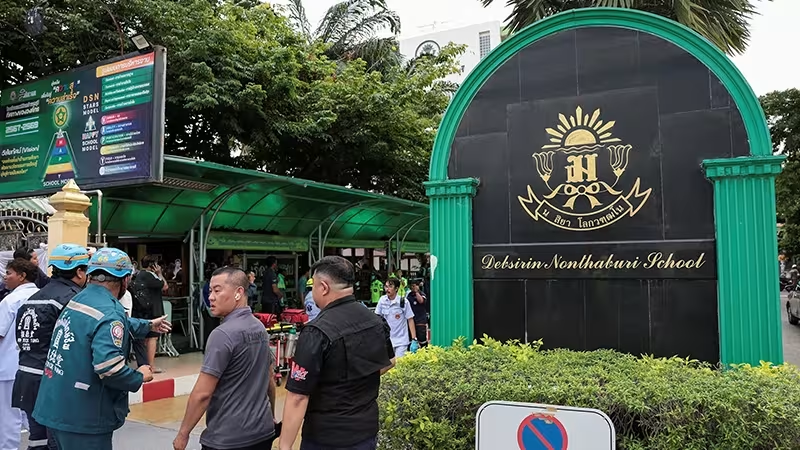
The boy who destroyed that ordinary morning, was Patchat Yimruang, a Mathayom 3 student at Debsirin Nonthaburi School.
He had lived for years with his paternal grandparents in a quiet house in Bang Bua Thong after his parents separated when he was young. Relatives described him as quiet and well behaved, a reasonably good student who kept mostly to himself, spent long hours on computers and games, and attended tutoring classes on weekends.
A teacher at the school later called him a good kid with solid study records.
In fact, he showed potentials in most subjects, having excelled most of them. The only concern was his poor performance in Thai language.
His father, speaking after the attack, said the boy had good results and that he had no idea what could have driven him.
Yet police found that in the week before the killings the teenager had downloaded and watched footage of mass shootings, including American school attacks.
He had also posted a photograph of his grandfather's registered 9mm CZ-75 Compact handgun on Instagram months earlier during Songkran.
Classmates said he was interested in guns and the FBI and that he had been bullied, with one unverified report claiming other students locked him in a bathroom the day before the attack.
The Thai prime minister said a close friend told investigators the boy had been under stress related to his studies.
The grandfather, a retired teacher, kept the pistol locked in a cabinet on the second floor. In the early hours of that Friday the boy used a chair to climb up, took the gun and two boxes of ammunition, and shot both grandparents once in the head.
Around 10 a.m., he arrived at school and began moving through the building.
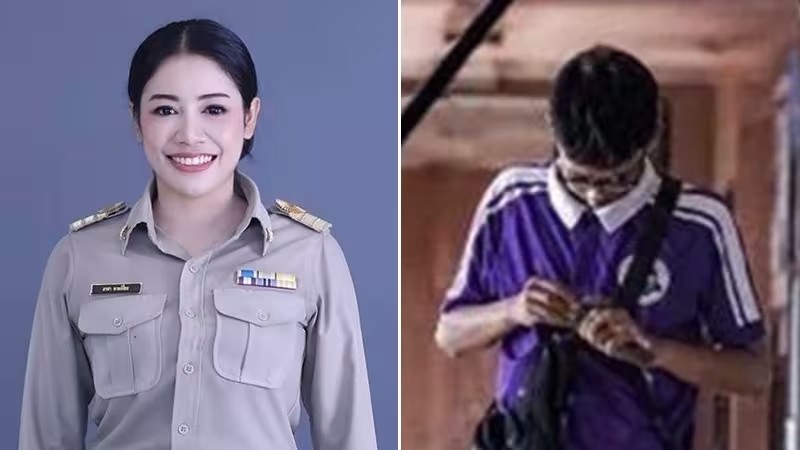
He killed five teachers and staff members. More than twenty other people were wounded, some critically. The youngest person caught in the attack was twelve.
One of the teachers, was his own Thai-language teacher, Arosa Namphicha.
The 31-year-old woman was killed in the school shooting, with reports describing her as having protected her students until the final moments of her life by shielding them and helping them take cover.
Students threw themselves under desks while shots continued in the corridors. Others fled over fences still wearing their uniforms.
When the shooting ended the boy turned the weapon on himself, shooting himself in the head.
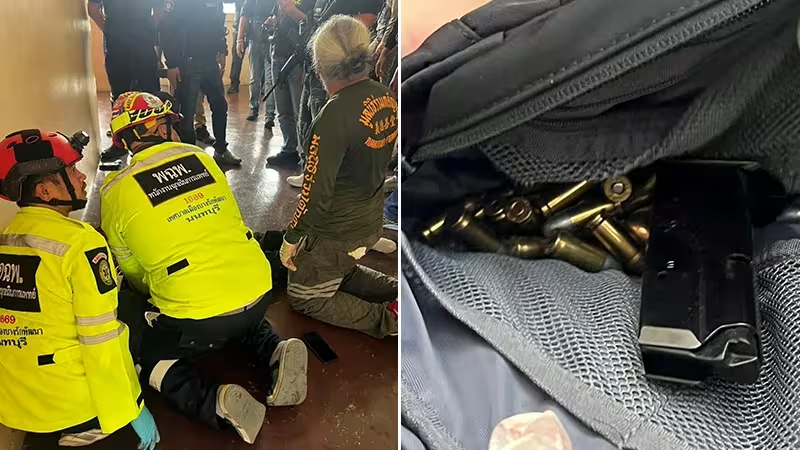
Emergency workers found a pulse and began CPR, but he died soon after.
He was only 14-years-old.
He had fired at least twenty-six rounds and still had more than thirty left.
The world has grown familiar with this pattern in one particular country.
School shootings appear so regularly in the U.S. that the language around them has become almost routine: active shooter, lockdown, thoughts and prayers, another round of debates that change little.
U.S.-based platforms are urged to anticipate this kind of incident. One example is Snapchat that made headlines after making one mistake.
The repetition has not made the deaths less brutal, but it has made the news less surprising. When the same sequence unfolds in Asia the reaction is different.
There is a sharper sense of violation, a feeling that a boundary has been crossed.
Classrooms in Thailand, like classrooms almost everywhere else, are still expected to be places of relative safety. The deliberate decision of a child to bring a gun into one of them and use it against the adults charged with teaching him, after first murdering the grandparents who raised him, is met with unambiguous condemnation.
There is no defense for the act.
No amount of reported academic stress, no history of bullying, no private family tension, no hours spent on violent games, no easy access to a relative’s firearm can turn the killing of grandparents and teachers into anything other than what it is.
Societies differ on how to reduce the chances of such attacks.
They do not differ on the basic judgment that walking into a school and firing at people who are simply doing their jobs or trying to learn is an outrage.
The Thai prime minister called the attack well prepared and horrible. Parents who waited outside the gates that morning needed no official language to feel the same thing.
The images of children running barefoot, of teachers lying where they fell, of students still in uniform describing how a classmate appeared in a doorway and shot the person speaking to them, leave little room for moral ambiguity.
What happened at Debsirin Nonthaburi School belongs to a category of violence the world already knows too well.
Its appearance in Asia does not invent new questions.
It only forces the same questions onto a wider stage. Children are sent to school so they can grow. When one of them decides instead to end lives inside those walls, the collective response is not confusion about whether the act was wrong.
It is a clear and shared rejection of it, and a demand that the conditions that allowed it be confronted before another ordinary morning is destroyed in the same way.

Within hours, the private horror became public material.
Inside Thailand the first videos left the school on students' phones. Clips of classmates pressed to the floor while gunfire cracked in the hallways, of the boy walking a corridor in his purple uniform with a bag across his body, of emergency workers performing CPR on the shooter himself, moved through local networks with startling speed.
Thai language posts carrying the school's name and the word for the shooting gathered hundreds of thousands and then millions of views.
Hashtags filled with condolences, anger, and appeals for blood donations.
Parents who had already collected their children still opened their phones to find the same footage waiting. Nearby schools suspended classes. Authorities announced tighter security checks and firearm inspections across the country.
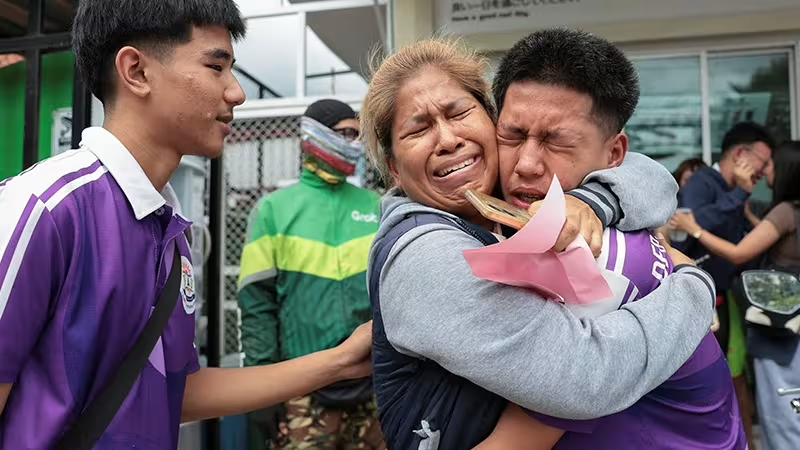
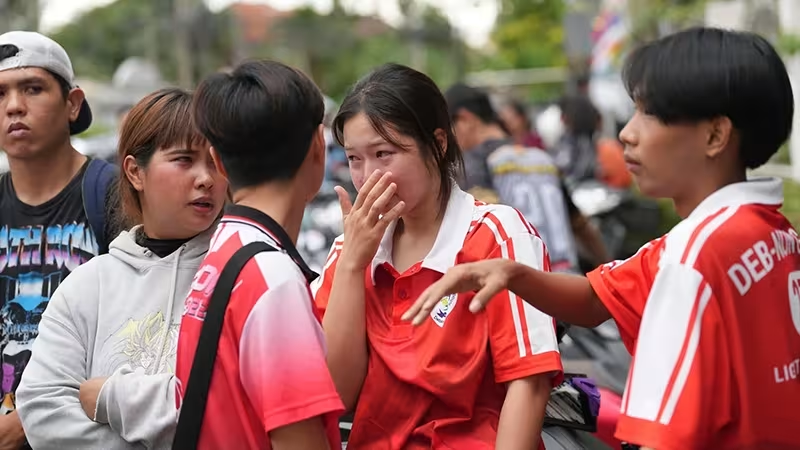
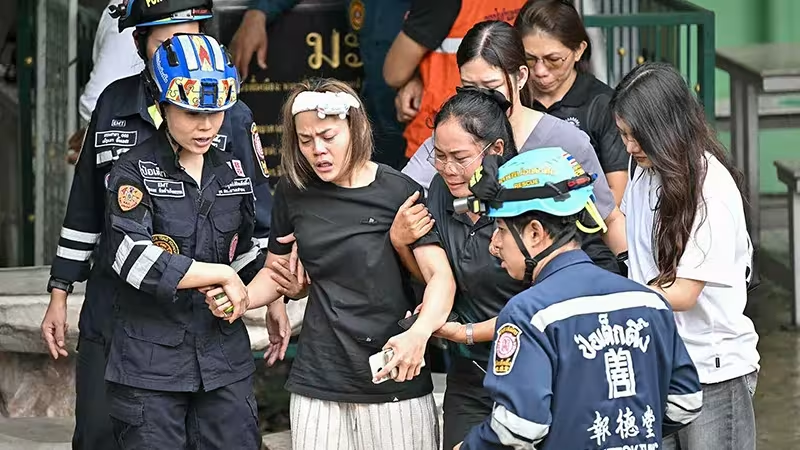
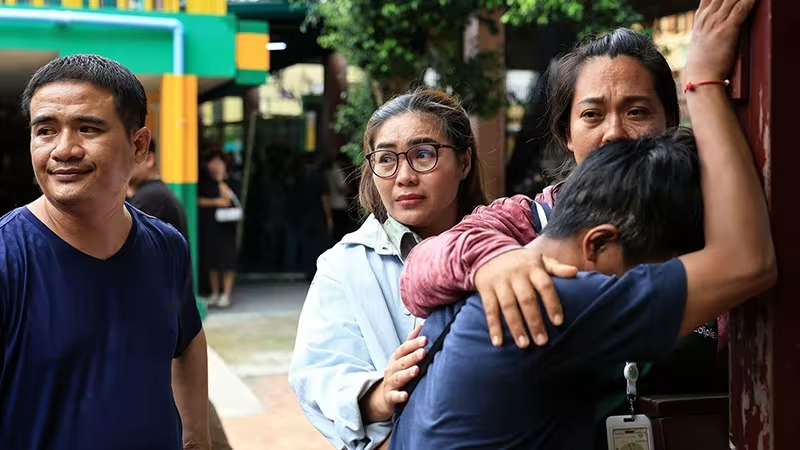
The mourning was immediate and local, expressed in the language of shared shock and the quiet determination to keep other children safe.
But when it corssed borders, international outlets carried the verified videos alongside official statements. Global timelines mixed the raw footage with statements of solidarity, with debates about gun access, and with the familiar pattern of distant outrage that follows every such attack. Condolence messages from accounts in other countries sat beside the Thai posts that had appeared first.
The internet did not invent the violence and it could not undo it.
It only ensured that the ordinary morning destroyed at Debsirin Nonthaburi School was witnessed, mourned, and condemned by people who would never stand outside those gates, turning a single local tragedy into a shared and visible rejection of the act itself.
Before this, on February, a gunman used a firearm stolen from a police officer to wound a teacher and a girl at a school in southern Thailand's Hat Yai district.
The 17-year-old shooter entered Patongprathankiriwat School in Songkhla Province, appearing agitated, the provincial government said in a statement.

















































































































































































































































































