The rise of AI-powered image and video generators has brought incredible entertainment value, letting people create and share visuals that were once unimaginable. With minimal effort, anyone can produce stunning content that racks up massive engagement online.
But every powerful technology has a dark side, and for AI, it's deepfakes, especially the non-consensual sexual kind.
Advances in these tools have made it frighteningly easy for anyone, even without editing skills, to generate realistic explicit imagery and footage of real people without their consent.
Millions worldwide are now using Telegram as a hub to create and distribute AI-generated deepfake nudes of women. Recent investigations, including detailed reporting from outlets like The Guardian, have identified at least 150 active Telegram channels dedicated to this abuse, drawing users from countries including the UK, Brazil, China, Nigeria, Russia, and India.

While non-consensual nude sharing existed on Telegram before, the explosion of accessible AI tools has changed everything.
A single photo and a simple prompt are now enough to "undress" someone, place them in any sexual position, scenario, or location the creator desires. In an era where billions overshare personal photos on social media, virtually no one is safe from this kind of manipulation.
Russian-language channels advertise "blogger leaks" and "celebrity leaks," promoting AI nudification bots with chilling promises: "a neural network that doesn't know the word 'no.'" They entice users to "choose positions, shapes and locations. Do everything with her that you can’t do in real life."
Chinese-language groups with tens of thousands of subscribers share deepfakes of "first loves" or "friends" girlfriends stripped and posed explicitly.
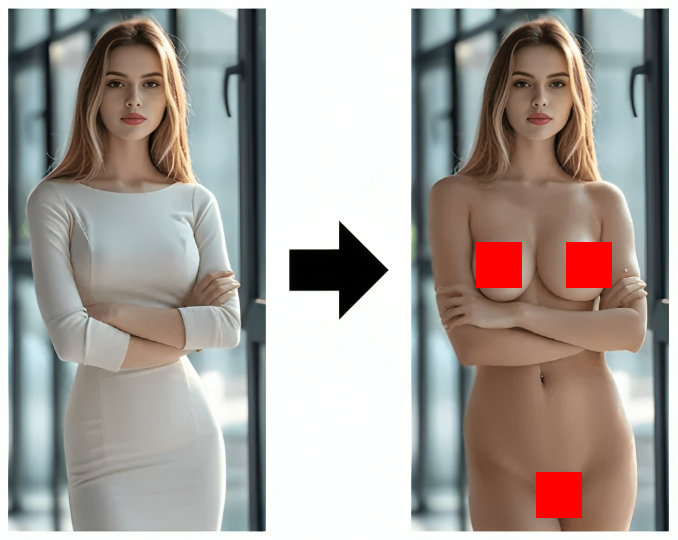
These channels act as encrypted broadcast networks where users upload everyday photos of influencers, celebrities, or ordinary women.
Bots or paid "nudification" services then generate hyper-realistic explicit content, often on a pay-per-use basis. What was once a technically demanding niche has become industrialized and accessible to anyone with a smartphone.
In Nigeria and elsewhere, dedicated channels mix stolen intimate images with AI-altered ones, often alongside blackmail threats. Sometimes, spiraling into debt from predatory loan apps exploited by abusers.
In India, women increasingly avoid online spaces out of fear.
Telegram has a terms of service that strictly prohibits "illegal pornographic content" on "publicly viewable" channels and bots, or "engage in activities that are recognised as illegal in the majority of countries." The platform has removed over 952,000 offending items in 2025 alone, but new channels pop up almost instantly after takedowns, often with nearly identical names and purposes.
But due to the sheer number of channels, combined with the platform's encryption and minimal moderation hurdles, enable rapid sharing, boasting, and even tips on evading detection, it can be extremely difficult for anyone, even Telegram itself, to track everything.
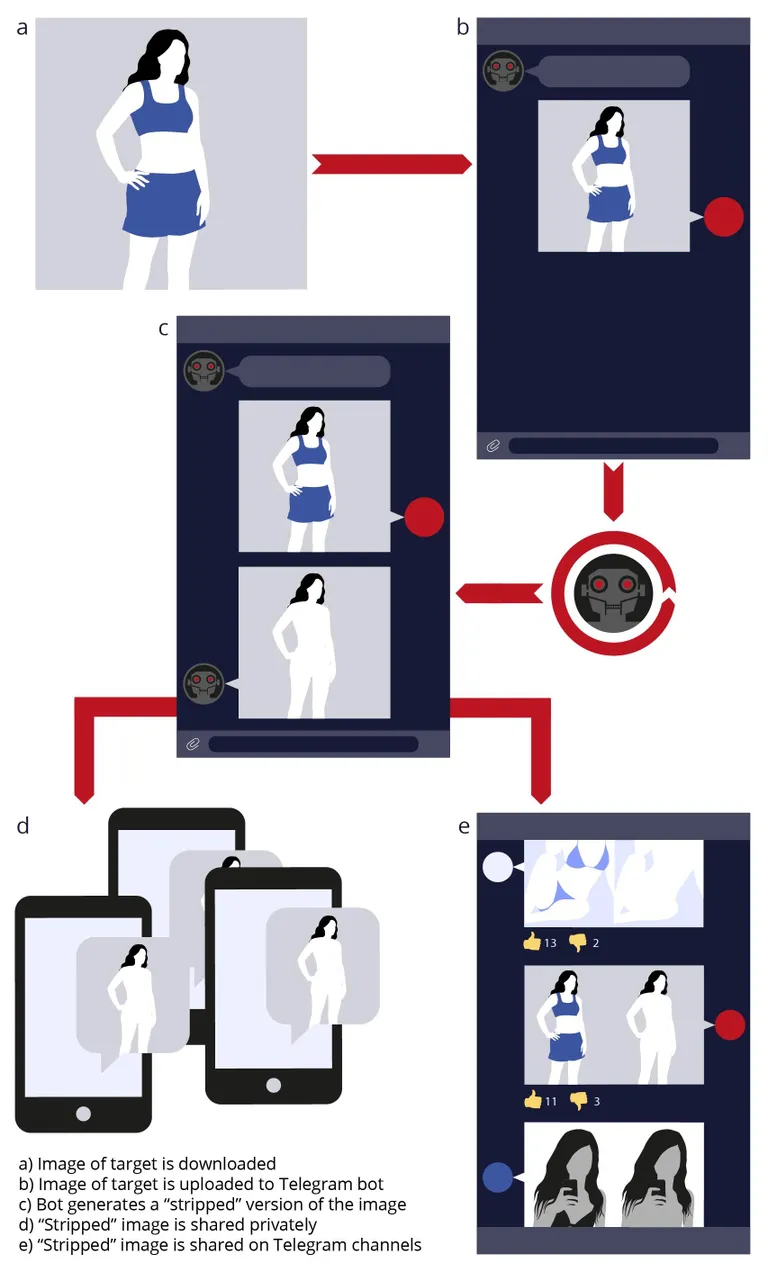
Deepfake technology has evolved explosively in a short time.
Roots trace to 1990s CGI and digital editing, but modern deepfakes exploded with GANs invented by Ian Goodfellow in 2014. The term "deepfake" emerged in 2017 from Reddit face-swaps, mostly non-consensual celebrity porn. It was around 2018, when online tools started democratizing deepfakes. And by early 2020s, Telegram bots simplified it to single-photo inputs.
Now in 2026, user-friendly bots and apps produce hyper-realistic explicit videos in seconds, with millions engaging monthly on Telegram alone, turning isolated acts into a global wave of digital sexual violence against women and girls.
Legal protections lag badly.
Fewer than 40% of countries have strong laws on cyber-harassment or stalking, leaving billions of women and girls vulnerable, per UN estimates.
In the Global South, poverty, low digital literacy, and weak enforcement make recovery nearly impossible as images persist forever.
This shift from fringe curiosity to everyday abuse tool shows a troubling path: as AI grows more powerful and accessible, so does its potential for harm.
Platforms, governments, and society must close the gap between tech capability and ethical accountability before the damage becomes irreversible.
The issue gained fresh attention when Grok, xAI's chatbot on X, was prompted to generate thousands of non-consensual images of women in bikinis, revealing outfits, or provocative poses.
After intense backlash, xAI restricted Grok from altering real people's photos in such ways.
Yet the broader ecosystem thrives across forums, websites, apps, and especially encrypted messaging apps like Telegram, where millions access and create explicit non-consensual material.
Making things worse, nudification apps have even slipped into major app stores, amassing over 700 million downloads collectively, and a lot of nudifying web tools exist and thrive. Together, they profit from this toxic cycle.
The ease of generating "something out of nothing" has empowered creativity, but it has also industrialized violation. The challenge now is ensuring innovation doesn't come at the cost of people's safety and dignity.

It's worth noting that harm is the most severe the moment an image or video is uploaded to the internet.
If AI-generated content is created strictly for private use and never posted to a website, forum, social platform, or shared space, remaining only in a closed environment where no one else can access or download it, its spread is limited.
While the potential for misuse still exists, its reach is contained.
That situation changes completely once the content is made public online.
The moment a deepfake is uploaded for others to view, control is effectively lost. Anyone can download, copy, re-upload, edit, or redistribute it across platforms, communities, and even private networks. From there, it can spread far beyond the original source, often faster than it can ever be taken down.
In the digital environment, replication is effortless and permanence is hard to reverse, which is what makes public exposure of this kind of material especially damaging.
Further reading: The Trends Of 'Undressing' People On X, Abusing Celebrities, Trolling Of World Leaders: Huge Amusement, Enormous Backlash














































































































































































































































































