
Software ecosystems often evolve through deliberate phases of expansion and restriction.
When Apple introduced its latest developer preview cycle across iOS, iPadOS, macOS, and visionOS 27.3, the platform strategy shifted noticeably to incorporate broader external utility.
By opening Siri AI integration to all third-party app developers through updated App Intents frameworks, the company moved past an initial phase where artificial intelligence capabilities were largely constrained to first-party software.
The technical implementation relies on exposing developer-defined actions and content structures directly to the assistant.
Rather than forcing users to navigate through multiple interface screens or strictly adhere to rigid, predefined system schemas, external applications can now plug their core functionalities directly into natural language processing workflows.
Developers gain access to personal context and onscreen awareness tools, allowing voice commands to interact dynamically with what is visible or active on the device.
Alongside opening these capabilities to external apps, Apple is also expanding how Siri AI interacts natively with web content inside Safari.
Instead of only looking at what is immediately visible on the screen, the updated assistant can parse and read the entire contents of open web pages across all tabs.
This means users can ask questions about information located deep within a long article or webpage without having to scroll down manually. Furthermore, the assistant can execute direct management tasks on Safari tabs and windows, such as sorting product pages by price, grouping specific topics together, closing batches of tabs, managing reading lists, or clearing browsing history per site.
To achieve this integration, developers must configure several architectural components outlined in official Apple Developer documentation.
The core requirement involves updating existing App Intents code so that applications can expose custom actions, data types, and enums directly as tools the assistant can call.
Applications must also adopt system-defined schemas across standard domains like messaging, calendar, and media to act as smooth contracts between the software and the operating system.
Additionally, developers use Spotlight indexing for semantic search, transferable types to move information between different apps, and view annotations to give the assistant context over active onscreen content.
A central addition within this developer preview is the introduction of app skills, which are designed to handle more complex scenarios.
These skills allow developers to chain multiple independent actions and data sources into a single coordinated request, enabling the assistant to execute multi-step workflows from a single user prompt.
Furthermore, context-aware routing improvements mean that users frequently will not need to explicitly name an external application if it is currently running in the foreground or maintaining an active Live Activity.
Developers can also leverage Xcode's Siri Integration Advisor for implementation feedback alongside the Siri Evaluations framework to track response changes during testing.
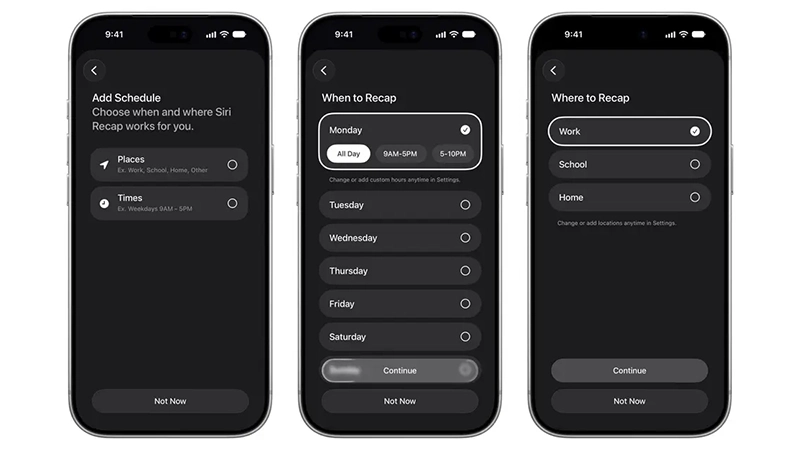
Concurrently, Apple expanded similar intelligence features across its own native suite, updating applications such as Photos, Messages, Calendar, Safari, Files, and Journal to support deeper conversational management.
Capabilities range from granular media organization and file handling to automated schedule creation and tab management.
While the developer preview is currently active for internal testing channels via TestFlight and Xcode development builds, public deployment is scheduled for later in the development cycle, with App Store submissions supporting these integrations expected to open in the spring.
Regional and platform exceptions remain notable, as certain markets and operating system environments continue to face deployment restrictions regarding advanced assistant features.
Further reading: Apple Unveils 'Siri AI' In iOS 27, A Ground-Up Rebuild Powered By Apple Intelligence And Google Gemini
























































































































































































































































































