In the broader evolution of commercial AI, the primary development barrier has shifted from raw intelligence capabilities to operational economics.
As enterprises integrate large language models deeper into software engineering pipelines, automated agents, and daily office workflows, the financial overhead of high-frequency querying becomes a major constraint.
Addressing this challenge requires mid-tier architectures capable of maintaining high contextual and visual accuracy while significantly reducing the cost per transaction.
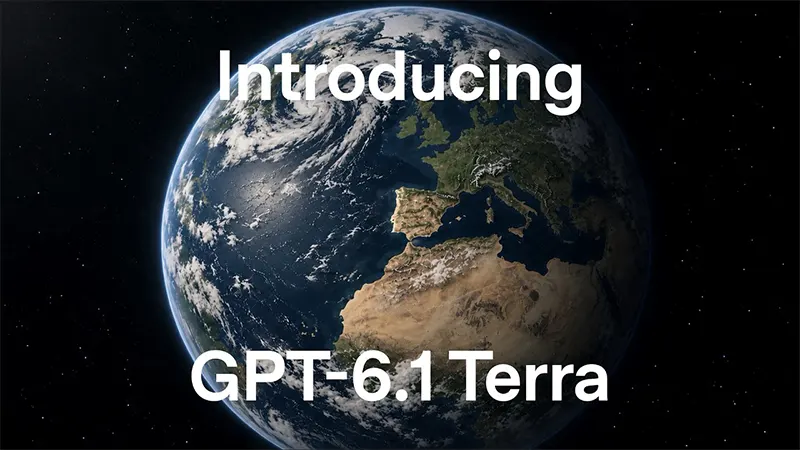
OpenAI has addressed this requirement through the release of 'GPT-6.1 Terra,' a mid-tier model designed to optimize the balance between speed, cost-efficiency, and targeted operational capabilities.
Positioned within the GPT-6.1 family below higher-tier variants, the model is structured specifically for high-volume automated environments, coding tasks, and everyday agentic workloads.
By recalibrating the economic and performance parameters of its mid-sized tier, the architecture provides organizations with an alternative to deploying top-tier models for routine processing.
According to a website post, the central focus of the GPT-6.1 Terra release is its capability in visual reasoning and computer interaction.
The model is optimized for tasks such as interpreting complex technical diagrams, matching product photographs to structured database catalogs, and navigating graphical user interfaces or screenshots.
This makes it suited for agentic systems that require real-time interpretation of visual data on a screen or terminal environment without introducing excessive latency.
Technical evaluations indicate performance improvements in structured execution and reliability.
Benchmark's highlight substantial reductions in hallucination rates compared to previous mid-tier iterations, alongside notable gains in terminal-based agentic evaluations.
These performance markers suggest that mid-tier models are closing the reliability gap previously observed outside of flagship architectures, allowing automated tools to operate with fewer manual interventions or error-correction loops.
Economically, the pricing model accompanying GPT-6.1 Terra reflects an effort to make high-volume automation financially sustainable. Priced significantly lower per million input and output tokens than its predecessors, the architecture provides a Pareto-optimal option for organizations balancing multi-step workflows against monthly operational allowances.
Features such as optimized context management and tiered reasoning effort levels allow developers to tune the model's resource consumption relative to the complexity of the assigned task.
The integration of GPT-6.1 Terra across developer platforms and productivity environments signals a broader industry transition toward specialized efficiency classes.
Despite these architectural and cost-efficiency advantages, GPT-6.1 Terra involves distinct operational tradeoffs when evaluated against its siblings and competing models from other laboratories.
Further reading: 'GPT-6.1 Sol,' and How OpenAI Plans to Disrupt the Rules of App Stores Using ChatGPT
Because it occupies a mid-tier position, the model occasionally falls short on deeply nuanced reasoning tasks or multi-step programmatic debugging where flagship models excel.
When confronted with highly ambiguous instructions or complex codebases that require extensive cross-file refactoring, organizations may still need to rely on more resource-intensive variants to prevent subtle logical errors. Furthermore, while its baseline pricing is optimized for volume, intensive reliance on the model's high-effort reasoning configurations can still generate substantial costs over extended processing cycles.
These performance boundaries also expose the model to strong market pressures from rival enterprise offerings. Major proprietary alternatives from competing developers often match or surpass GPT-6.1 Terra in specialized domains, such as real-time multilingual translation and deterministic structured data extraction. Additionally, open-weights alternatives offer organizations complete data sovereignty and local deployment options that proprietary cloud endpoints cannot provide.
Nevertheless, as commercial applications depend more heavily on autonomous agents to manage complex, multi-stage workflows, the demand for accessible, cost-effective models continues to grow. GPT-6.1 Terra addresses this specific market need by providing a balance of performance and efficiency that can effectively shape how modern software systems and digital workflows are constructed.






















































































































































































































































































