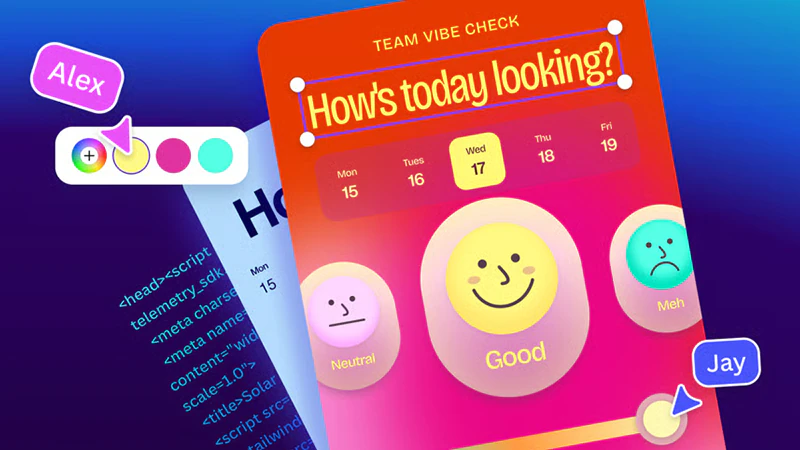
Canva has made its AI-powered coding tool available to every account holder, including those on free plans.
The update, called 'Code 2.0,' lets users generate interactive websites, simple apps, and other digital experiences by describing them in ordinary language.
Once generated, the results can be adjusted inside the Canva editor through familiar controls for text, images, colors, and fonts, or refined further with additional prompts.
The system also accepts imported HTML from external AI tools and offers more than 50 new templates.
Generation times are reported to be substantially shorter than the previous version, and the finished pieces adapt to different screen sizes before they are published on free or custom domains.
This move sits inside a wider shift often called vibe coding, in which people without programming backgrounds produce functional digital products by describing outcomes rather than writing instructions.
Canva already reported more than six million sites created with the earlier version of the tool over the past year.
By opening the updated version to its full base of more than 265 million monthly users, the company is testing how far visual design platforms can absorb lightweight coding tasks that once required separate development environments.
Educators, small operators, and individual creators now have a path to add interactivity to classroom pages, simple business tools, or presentation elements without leaving the same interface they already use for static graphics.
The practical reach of the feature remains bounded by design choices that favor accessibility over depth.
Structural changes such as rearranging major elements still require a fresh prompt rather than direct manipulation.
The tool is built for front-end experiences at modest scale and does not handle complex server logic, authentication systems, or traffic levels measured in hundreds of thousands of daily visitors.
Free accounts operate under AI credit limits that restrict sustained use, pushing heavier activity toward paid tiers.
Generated code is treated as an editable design object rather than source that can be inspected or refined line by line, which can leave inefficiencies in place.
Many outputs begin with a generic visual character that demands extra manual work before they feel distinctive, and the entire workflow stays inside Canva’s hosting and collaboration systems.
In the broader pattern of internet culture, the release continues the long reduction of technical barriers around web creation.
It expands the set of people who can publish interactive material, yet it also concentrates that activity inside a single commercial platform whose constraints shape what can be built and how long it remains under the creator's control.
For routine educational, promotional, or internal projects that value speed and visual consistency, the combination may prove sufficient.
For work that needs independent code ownership, greater scalability, or deeper technical flexibility, the same limits keep specialized development tools relevant.
The update therefore records another step in the gradual redistribution of who can shape the interactive web, while leaving the underlying trade-offs between ease and capability largely intact.






















































































































































































































































































