Large language models have come a long way.
But only since the public release of ChatGPT in late 2022, marked a clear turning point in the development of the technology. It demonstrated the practical reach of transformer based systems trained at scale and triggered rapid investment and iteration across the industry.
In the years that followed, research groups and companies in the U.S. continued to push model size, training data, and multimodal capabilities, while laboratories in China increased the pace of their own releases.
Open weight models from Chinese teams, successive iterations of the Qwen series, and specialized systems for coding, reasoning, and image generation have narrowed performance gaps on many public benchmarks and in some domains produced results that match or exceed those of leading Western counterparts.
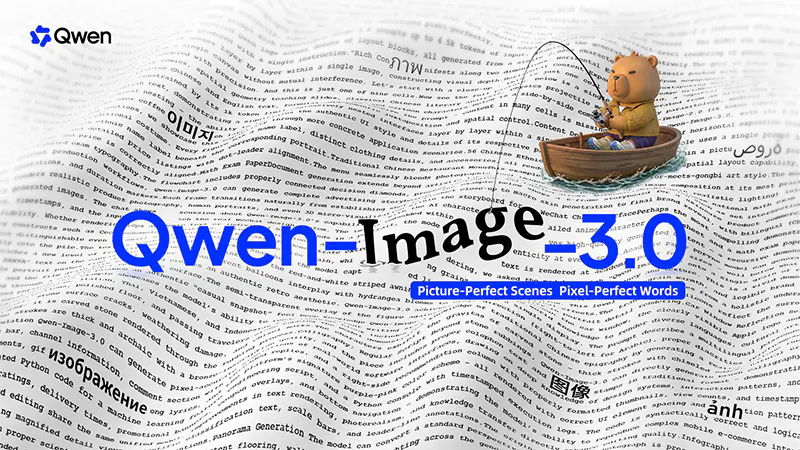
Within this broader competition Alibaba's Qwen team introduced 'Qwen-Image-3.0' as the third generation of its foundational image generation model.
Whereas earlier versions had emphasized precision and then expanded range of styles, completeness, beauty, and authenticity. The new release organizes its improvements around three linked aspects of realism: rich content, authentic details, and deep knowledge.
Rich content refers to the ability to process prompts of up to 4,500 tokens and to produce complex layouts in a single generation step.
Demonstrations include full newspaper pages, storyboards, examination papers, and multi-panel arrangements.
One example used approximately 3,700 tokens to create a single image containing a 3 by 3 grid of infographics.
The nine panels addressed separate topics: a tunnel safety comic, spatial geometry, stylistic analysis of the classical Chinese text Chu Shi Biao, projectile motion, parasitology, chest-pain diagnostics, Sylow theorems, bank internal-control procedures, and DNA structure.
Each panel retained precise text and corresponding visuals without visible interference between neighboring cells. This indicates stronger control over the simultaneous placement of multiple independent concepts inside one image.
A second example focused on nested depth.
A single instruction generated successive layers of interfaces: an outer VSCode window, Qwen Chat inside it, a messaging application within that, and a pour-over coffee poster at the innermost level. Each layer preserved the characteristic visual style of its source design, producing a coherent picture-in-picture structure.
Authentic details address fidelity at small scales.
The model can render text that remains readable at sizes near 10 pixels, produce complete pages of LaTeX-formatted mathematical papers, and depict fine surface features such as skin pores and individual hair strands. These capabilities appear across both technical diagrams and more naturalistic subjects.
Deep knowledge covers broader contextual range. The system supports native text rendering in twelve languages, draws on more than one hundred artistic styles, and can recreate realistic user interfaces for websites, games, and livestreams. It also incorporates general world knowledge and optional live web retrieval when current information is required.
Taken together, these features are intended to support practical outputs such as newspaper-style PDFs, short-drama storyboards, and complex interface mockups.
Unlike several earlier Qwen image models, the weights of this version are not expected to be released under an open license.






















































































































































































































































































