Beneath the surface of one of the world's most watched waterways, a second, quieter network has quietly become almost as strategically important as the tankers passing overhead.
The Strait of Hormuz has long been known as the narrow passage through which roughly a fifth of the world's oil moves. What fewer people notice is that the same stretch of seabed also carries fibre-optic cables that keep entire regions online, process financial transactions measured in the trillions, and connect the data centres and AI projects now rising across the Gulf.
Reports that began circulating in 2026 describe Iranian officials and media close to the Islamic Revolutionary Guard Corps (IRGC) treating those cables as a new form of leverage.
IRGC-linked outlets mapped the systems in detail and framed the concentration of cables as a vulnerability that could be turned into an advantage.

An Iranian military spokesperson stated that Iran would impose fees on internet cables crossing the strait.
Hardline voices went further.
The editor of Kayhan, one of Iran’s most hardline official newspapers, asked whether it was not Iran's "indisputable right" to prevent the cables from passing through the depths of the Persian Gulf and the Strait of Hormuz in order to bring "these sources of evil to their knees and cut off their lifeline."
Written by Hossein Shariatmadari, it's indicated that the IRGC had considered sabotage as part of a further escalation, while parliament moved toward requiring official Iranian approval for any data-transmission equipment transiting the waterway.
Fars News Agency (IRGC-affiliated) also reported the approval of a parliamentary article making transit of data cables through the Strait of Hormuz subject to official Iranian consent.
The logic presented in these reports is straightforward. After months of tension that had already disrupted shipping, the cables offered another potential pressure point.
Iranian sources spoke of turning the strait into a "digital toll road," extracting licensing and annual fees from foreign operators and compelling major technology companies to operate under Iranian law.
Estimates floated in affiliated media reached into the billions of euros or dollars per year.
Exclusive control over maintenance and repair was also mentioned, potentially giving Iranian firms a gatekeeping role over systems that serve neighbouring Gulf states and connect onward to Europe and Asia.
In this framing, the cables are both an economic opportunity and a potential retaliatory instrument.
Most of the international systems were laid in Omani waters precisely to stay clear of Iranian territorial claims, yet they still cluster tightly within a relatively narrow corridor.
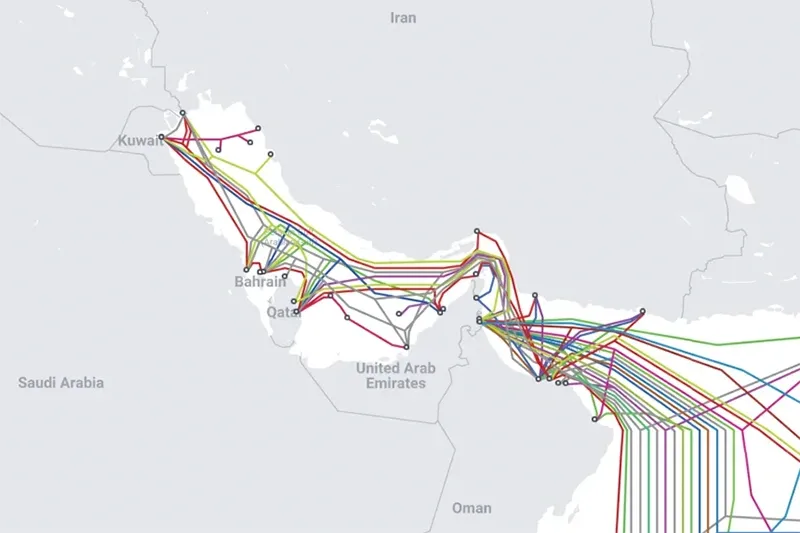
A handful of systems do enter Iranian waters or land on Iranian soil. The principal cables identified in the reporting include:
- AAE-1 (Asia-Africa-Europe 1): A 25,000-kilometre system linking Southeast Asia, India, the Gulf, Egypt, and southern Europe.
- FALCON: Connecting India and Sri Lanka with Gulf countries, Sudan, and Egypt.
- Gulf Bridge International (GBI/MENA): A regional ring connecting the Gulf states, including Iran.
- Tata TGN-Gulf.
- OMRAN/EPEG and the POI Network: Shorter Iran-Oman links.
- Older bilateral cables such as UAE-Iran and Kuwait-Iran.
Additional projects, including segments of 2Africa Pearls, the Fibre in Gulf system, and planned extensions of SeaMeWe-6, have faced delays because of the security environment.
The waterway itself is relatively shallow, which makes the cables accessible to anchors, fishing gear, or more deliberate interference.
Repair would require specialised ships that must obtain permits and remain stationary for days. Only a limited number of such vessels exist, and operating them inside an active conflict zone would introduce further delays and risks.
Landing stations on shore present another potential point of pressure.
It is worth noting that severing one or several of these cables, or even all of them, would not plunge the world into darkness or take the global internet offline.
The cables that pass through or near the Strait of Hormuz and/or Iranian territory carry less than 1% of global international bandwidth, according to TeleGeography data cited across multiple analyses. Even if every one of them were severed at once, the rest of the world's submarine cable network, including the larger trans-Pacific systems, other Indian Ocean routes, the much larger Red Sea corridor, and trans-Atlantic links, would continue carrying the overwhelming majority of global traffic.
Operators routinely reroute traffic around cable faults because the internet is designed with this kind of redundancy in mind.
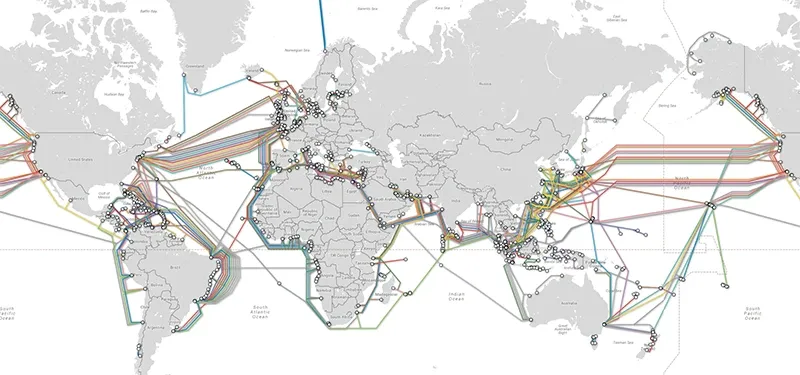
The more likely consequence would instead be regional and, to some extent, intercontinental disruption: slower or degraded connections for Gulf states, possible capacity strain on remaining Asia-Europe routes, higher latency, and additional load on terrestrial networks that serve as backups in countries such as Saudi Arabia.
Gulf countries possess some terrestrial backup routes, particularly through Saudi Arabia, but those alternatives have finite spare capacity.
That could create significant problems for the concentration of cloud infrastructure and AI data centres in the UAE and neighbouring states, which depend on uninterrupted connectivity through the region.
The countries most exposed if these cables were severed include:
- Bahrain, Kuwait, and Qatar: These countries have terrestrial network connections to Saudi Arabia, while Kuwait is also connected to Iraq. These terrestrial routes provide onward connectivity to the rest of the world.
- UAE: The country also has terrestrial connections to neighbouring states, while many of its submarine cables land in Fujairah, on the Gulf of Oman. This gives the UAE a reliability advantage over cable landings deeper inside the Gulf, which could be more exposed to disruption around the Strait of Hormuz.
- Saudi Arabia: Only a small number of the country's submarine cable landings are on the Gulf coast. The vast majority of its international bandwidth enters through cables landing on the Red Sea coast.
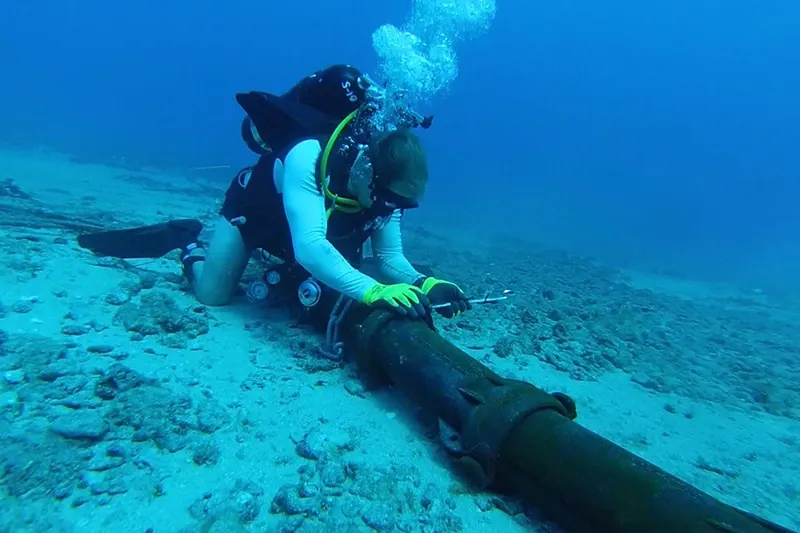
If any of these cables were damaged, intentionally or otherwise, repairs could take days, weeks, or even months. The reasons would not simply be the conflict environment. Specialised cable-repair ships are scarce, and obtaining permits to operate in or around the Strait has become increasingly difficult.
For example, UAE-based e-Marine is the maintenance authority responsible for repairs in the Gulf region. At present, the company operates five vessels, with only one positioned inside the Gulf. The others are located in the Red Sea and Indian Ocean. If the Strait of Hormuz became inaccessible, repairs to cables inside the Gulf could therefore depend heavily on that single vessel.
Satellites cannot replace the sheer volume of capacity provided by submarine cables.
None of this amounts to a worldwide blackout or a return to the pre-internet era. But the vulnerability is real: a narrow stretch of seabed carries a disproportionate amount of the connectivity on which some of the Gulf's most digitally dependent economies now rely.






















































































































































































































































































