James Cameron's Terminator 2: Judgment Day never let fans forget the assembly line. In the teaser and the future-war flashes, T-800 endoskeletons hang from hooks and roll down dark factory floors like any other industrial product, chrome skeletons waiting for living tissue and a mission to terminate.
That image of the killing machine being stamped out by the thousand was supposed to stay in the realm of nightmare.
In September 2026, it walked off a real production line in the Northern Ecological New Area of Liuzhou, Guangxi, and the West is paying attention.
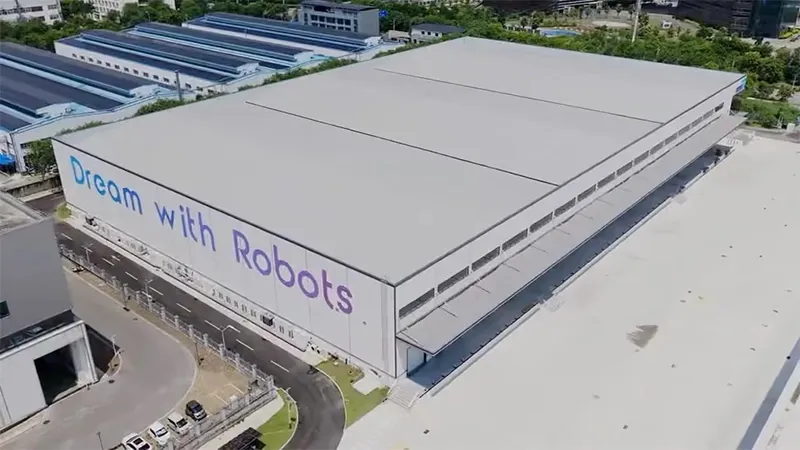
UBTECH Robotics has opened what it calls the world's first 10,000-unit-scale smart factory dedicated to industrial humanoid robots.
At the 14,000-square-metre plant called the Industrial Humanoid Robot Super Smart Factory (工业人形机器人超级智慧工厂), the Shenzhen-headquartered robotics company targets one finished Walker S or Cruzr-series machine every ten minutes.
But unlike Cameron's AI-powered machines created for infiltration and killing, this one from China is designed for civilian and domestic kind of work.
At this time, robots from UBTECH Robotics already do much of the work traditionally require humans. The wheeled Cruzr Y1 and S2 units can depalletize, load, and ferry parts while collaborative arms and unmanned forklifts handle the rest.
Siemens software runs the digital twin and the "smart brain" that schedules the whole chain.
Each finished robot spends more than four hours in testing, including a 360-degree lighting tunnel borrowed from automotive quality control, then goes into a compact automated warehouse that packs 112 units into 65 square metres.
The company says this is no longer a pilot line. It is the template for "robots building robots."
Specifically, the factory's main products include the industrial Walker S family.
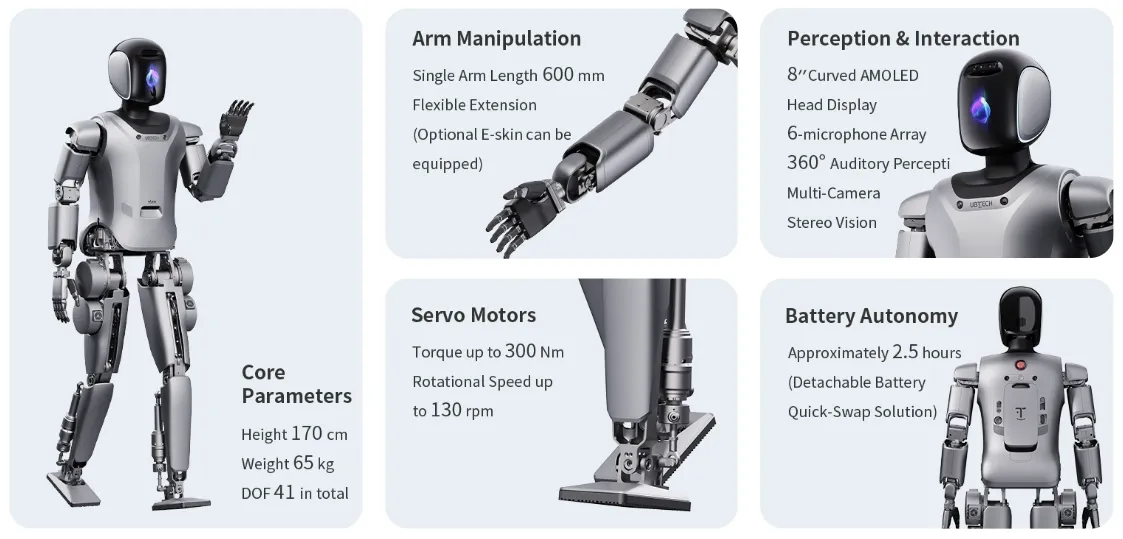
- Walker S1: first unit made in Guangxi, rolled off in June 2025. About 172 cm tall, 76 kg, grey alloy body, five-finger hands. It went straight into Dongfeng Liuzhou Motor for factory training. That is the pilot-generation industrial Walker.
- Walker S2: the current mass-production model and the one the new 10,000-unit factory is built around. About 176 cm tall. Signature feature is autonomous battery swap so it can run 24/7.
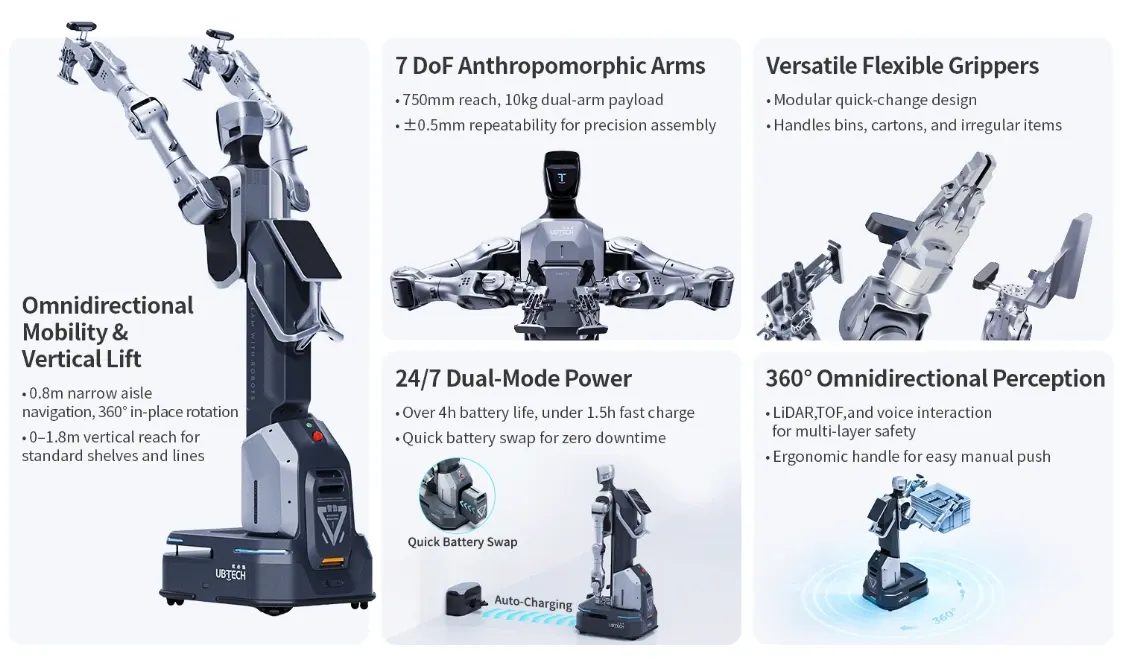
Cruzr (wheels, no legs). The same factory builds this type, and also uses as them and also uses it as workers on the line.
- Cruzr Y1: lighter wheeled manipulator for logistics. About 170 cm, 90 kg, roughly 10 kg payload, dual arms on a rolling base. In Liuzhou it does depalletizing, bin picking, tote moves, and parts feeding.
- Cruzr S2: full-size wheeled humanoid. About 176 cm, around 185 kg, 15 kg payload, 44 degrees of freedom, up to 2 m/s, ±170° spin in a 0.8 m aisle, same style of binocular vision and fourth-gen hands as Walker S2. Used both as a product and as a shop-floor handler (palletizing, loading, material transfer).
This is not an isolated stunt.
Months earlier Leju Robotics and Dongfang Precision started a line in Foshan that claimed one humanoid every 30 minutes and an annual capacity above 10,000.
EngineAI, whose flagship model is literally named T800, opened a Shenzhen plant that targets one unit every fifteen minutes after 79 inspections and 46 simulation tests; a second site in Zhengzhou followed.
XPeng's Iron walked itself off an automated line in Guangzhou.
At this time, Chinese firms already account for roughly 90 to 97% of global humanoid shipments, with AgiBot and Unitree leading the volume charts.
UBTECH itself sold more than 900 full-size units in the first half of 2026 and booked hundreds of millions of yuan in new orders. The Ministry of Industry and Information Technology has floated an official target of more than 100,000 complete machines for the year.
The numbers are why the West is uneasy.
Figure AI's BotQ factory in California has ramped from one robot a day to one an hour and is aiming for perhaps 12,000 units a year.
Tesla talks about converting Fremont lines for Optimus and dreams of a million robots annually, yet public production figures remain modest and mostly internal. Valuations in the U.S. and Europe still dwarf Chinese peers, but the factories that actually exist and the robots that actually leave them are overwhelmingly Chinese.
Washington has already moved: a ban on new Chinese humanoid and quadruped imports, framed as a national-security measure against cyber risk and supply-chain dependence.
The same industrial-policy playbook that produced electric vehicles and solar panels is now being applied to walking machines.
The robots themselves are not Terminators.
Walker S units train at Dongfeng Liuzhou Motor plants, move bins, inspect parts, and swap their own batteries for 24-hour shifts. Cruzr platforms handle logistics. Companion models with silicone skin have taken thousands of consumer pre-orders.
Battery life, dexterity, and reliability still lag the marketing videos, and many early buyers are government training centres rather than profit-seeking factories.
Yet the infrastructure is now in place: digital twins, flexible mixed-model lines, traceability codes on every unit, and a domestic supply chain that Chinese executives say would be almost impossible to replicate at the same cost anywhere else.
What Cameron filmed as a warning now looks like a production schedule.
The T-800 in the movie was a weapon. The machines coming off the Liuzhou line are, for the moment, warehouse hands and assembly-line assistants.
The fear in Western capitals is less that they will start hunting people tomorrow and more that the country that can stamp them out every ten minutes will also own the data, the software stack, and the labour substitution that follows.
One factory does not make a Skynet.
Ten thousand robots a year, built by robots, in a country that already dominates the category, is enough to make the old factory footage from Terminator 2 feel less like science fiction and more like a preview.
The story quickly escaped the robotics industry and went viral across social media, largely because the factory footage looked almost indistinguishable from the industrial nightmare imagined in Terminator 2.
Clips of humanoid robots moving through production lines were reposted alongside scenes of T-800 endoskeletons rolling through Skynet's factories, turning a complicated manufacturing story into an instantly recognizable cultural reference.
That comparison did more than generate memes.
It put a spotlight on a development that might otherwise have remained buried in production figures and corporate announcements: China is no longer simply demonstrating humanoid robots at trade shows.
It is building the factories, supply chains, software, and production capacity needed to manufacture them at industrial scale.
And that is why the images spread so quickly. The unsettling part was not seeing a robot that looked like a Terminator.
It was seeing thousands of machines being built in a factory that increasingly resembles the one science fiction warned us about.




















































































































































































































































































