
Sharing information on social media has long felt as simple as clicking a button and pasting a web address into a chat box. However, the architecture of the modern internet means that the strings of text used to navigate the web often carry a heavy load of hidden data.
When people share content from major digital platforms, they are frequently passing along more than just a destination. The simple act of sending a video or an interesting update to a friend can quietly signal exact user habits, preferred hardware, and network relationships to the companies managing these services.
The mechanics of this data collection rely on query parameters, which are the characters that appear after a question mark in a standard web address.
Traditionally, these suffixes served functional purposes, such as telling a video platform exactly what minute and second to start playing a clip.
Over time, digital platforms realized these trailing strings could be repurposed to map user behavior. By automatically injecting specific snippets of code when a user selects a copy link feature, companies can effortlessly trace the journey of a specific piece of media across the web.
On platforms like X, these suffixes have evolved into a sophisticated tracking array.
For several years, basic codes embedded in copied web addresses revealed whether an item was shared from a mobile device or a desktop browser.
More recent updates have expanded this toolkit to include session timestamps and unique sharing tokens. These specialized identifiers act as a digital signature, ensuring that whenever an external link is clicked, the platform can link that traffic back to the specific profile that generated the copied text.
By utilizing these parameters, X can achieve a remarkably granular view of its ecosystem.
The data allows the social media platform to verify whether a piece of content is spreading organically through genuine interpersonal messages or if it is being artificially amplified by automated systems. Furthermore, by linking the unique suffix to individual user accounts, the system can map social circles and connections that occur outside the application. If a user texts a link to a friend who then opens it, the platform can deduce a real world relationship between those two individuals, even if they do not interact directly inside the app.
This aggregation of behavioral data ultimately feeds directly into the algorithms that shape user experiences and advertising.
Understanding who shares what, when they share it, and what devices their inner circle uses provides a comprehensive blueprint for ad targeting and content recommendations.
While these data streams are deeply integrated into the platform architecture, individuals have several effective options to safeguard their personal privacy and break the link between their sharing habits and their digital profile.
For normal people, or people in general, the trackers don't do anything that changes experience. But for privacy concerned individuals, they may want to remove the trackers.
The most direct and immediate method to avoid this form of tracking involves manual deletion.
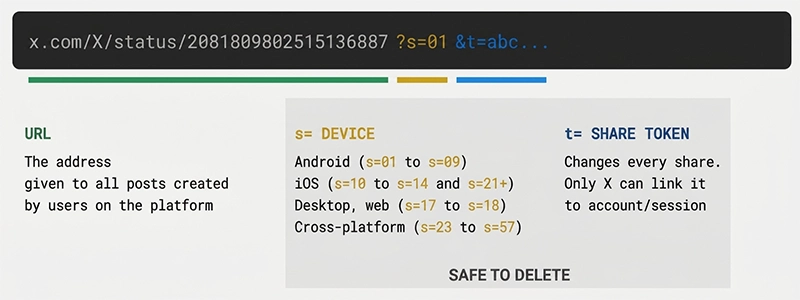
s= (share source) and t= (timestamp). Depending on where it is copied, extra parameters like ref_src= (embedded widgets), ref_url= (third-party sites), or si= (cross-platform redirects) help the platform map every step of its journey across the webSince these tracking components are merely appended to the end of the text string rather than forming the core destination address, anyone can manually remove them before hitting send.
When a user pastes a copied web address into a message box, email, or browser tab, they simply need to locate the question mark within the string and delete that question mark ("?") along with every character that follows it.
The remaining, shortened address will still direct anyone who clicks it to the exact same post or piece of media, but it will do so without carrying the original sender identification data.
For those who frequently share content and find manual editing tedious, automated software solutions can handle the cleaning process invisibly. Modern, privacy-focused web browsers, for example, often have native features that strip known tracking tokens from web addresses automatically when a user right-clicks to copy text.
Additionally, open-source browser extensions and dedicated mobile applications can be installed to monitor the system clipboard. These tools automatically recognize the specific signatures used by major social networks and instantly scrub the tracking suffixes the moment a link is copied, allowing for seamless sharing without the accompanying digital footprint.






















































































































































































































































































