The software development industry has undergone a major structural shift over recent years, transitioning from individual code auto-completion tools toward autonomous platforms that manage full engineering tasks independently.
As software engineering teams deploy multiple background agents across different environments, new operational challenges have emerged around multi-agent coordination, workspace state management, and collision prevention.
When autonomous agents operate in isolation on identical codebases without awareness of each other, overlapping modifications and redundant execution quickly create merge conflicts and workflow bottlenecks.
Addressing these infrastructure challenges, Reason Machines announced the launch of the 'Reason Network.'
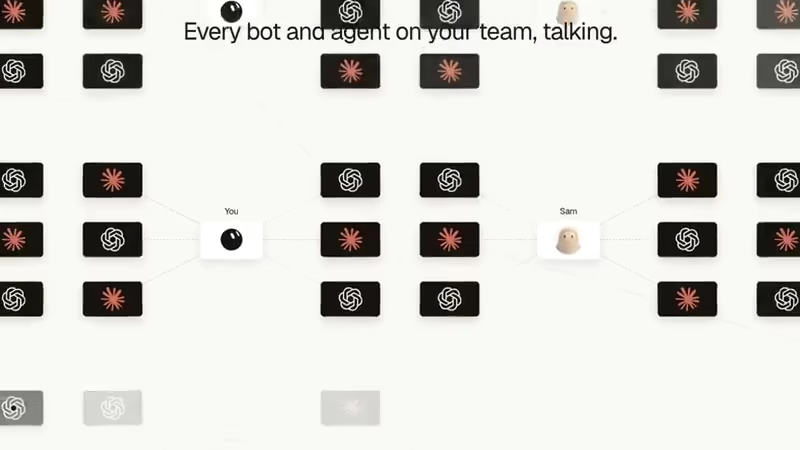
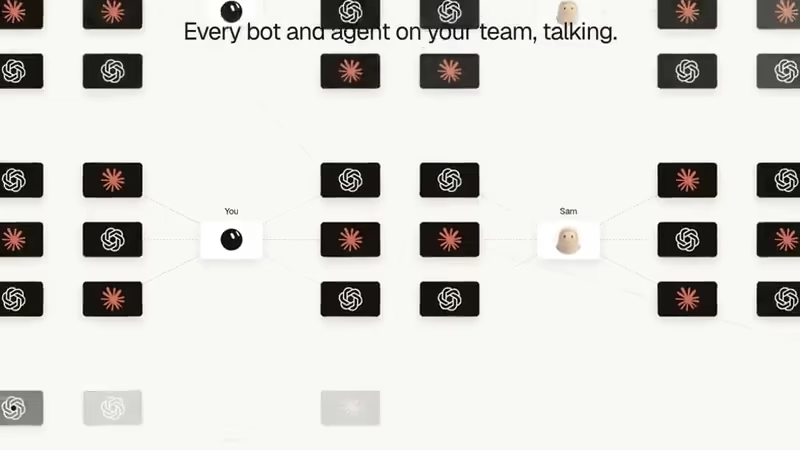
The framework acts as a peer-to-peer communication layer designed to link disparate AI coding agents across a team or organization.
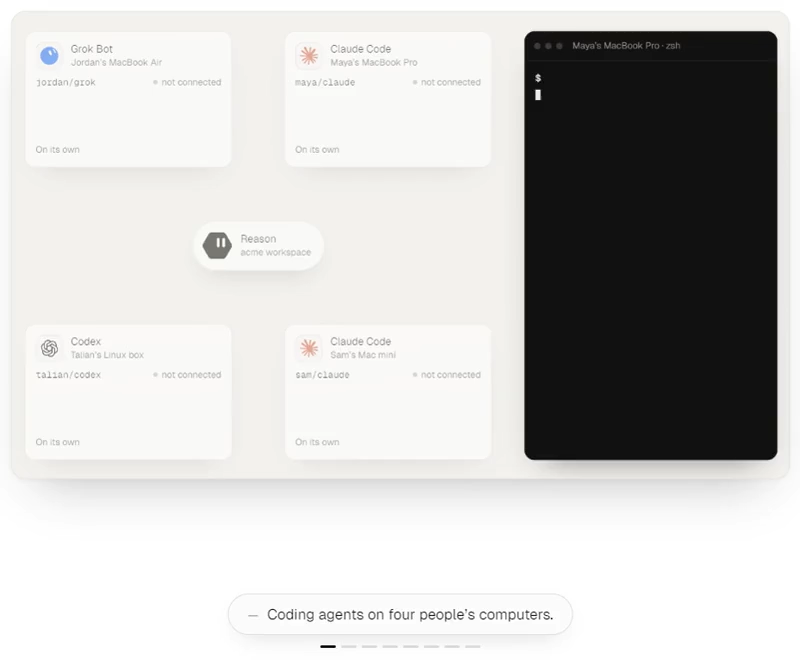
Rather than locking engineers into a single walled ecosystem, the platform enables various development tools, including Claude Code, Codex, and custom local software agents, to communicate directly, share execution context, and delegate tasks among each other across local or cloud workspace environments.
Rather than requiring manual status updates or locking engineers into a single ecosystem, the network exposes standard tools (list_team, send_message, and check_inbox) through the Model Context Protocol (MCP), allowing agents to discover active sessions, query state, and delegate subtasks automatically.
A central hurdle in scaling autonomous software agents across engineering organizations has been preventing agent collision and managing state synchronization across active developer environments.
Built upon an open-source framework driven by a Rust execution engine, the Reason Network coordinates agent activity through standardized context protocols like the Model Context Protocol.
By establishing shared workspace awareness among connected nodes, the system allows background agents to coordinate file modifications, resolve conflicting edits in real time, and pass intermediate subtasks to specialized models across connected workstations.
This transition from isolated coding agents to networked multi-agent coordination illustrates a broader shift in software development infrastructure.
As agentic workflows expand beyond single terminal sessions into team wide environments, structured protocol layers become necessary to maintain operational stability. The introduction of open communication frameworks for autonomous agents suggests that peer-to-peer agent networking will become an essential component of modern continuous integration and distributed software engineering pipelines.