
The growing use of AI is creating new demands on computing infrastructure. As AI moves beyond generating content on request and into interactive applications, systems must produce results continuously, quickly, and without consuming excessive resources.
Real-time video generation is a good example of this challenge.
Unlike conventional video generation, where users wait for a completed clip, interactive systems must produce frames continuously while responding to users.
At 24 frames per second, for example, each generation step must finish in roughly 167 milliseconds. Maintaining this speed becomes particularly difficult when running models containing tens of billions of parameters.
In a post on its website, Runway demonstrated how much optimization can improve this process.
Its Characters system uses an approximately 57-billion-parameter video diffusion transformer to generate video alongside a voice agent. Initially requiring eight Nvidia H100 GPUs per session, the system was optimized to run on just four while maintaining real-time performance.
Much of the improvement came from changing how existing hardware was used rather than adding more computing power.
One optimization addressed memory management.
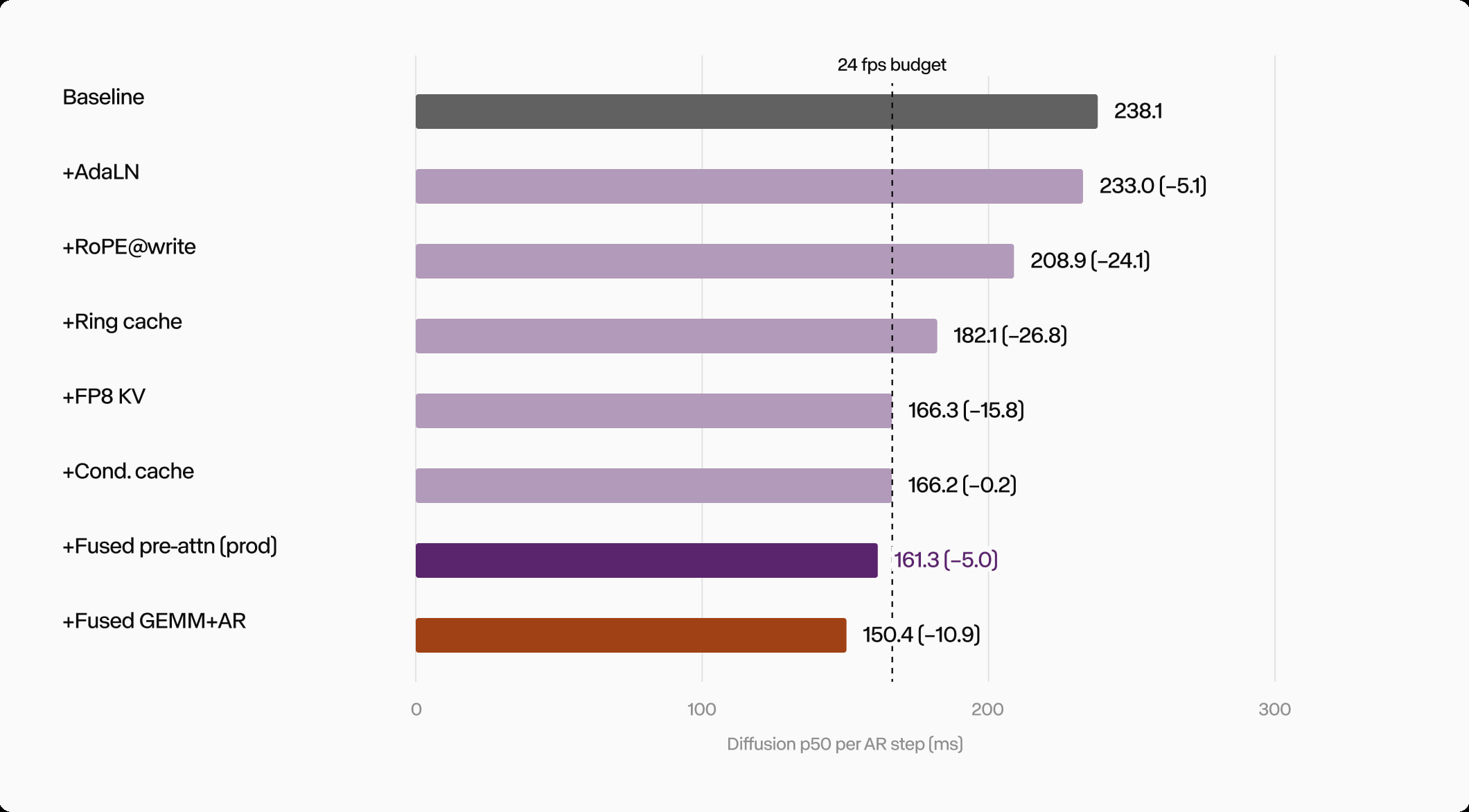
The original implementation repeatedly performed operations on cached information, even when that information had not changed. Moving these operations to the moment new information entered the cache reduced cache maintenance time from 69.7 milliseconds to 6.2 milliseconds per generation step.
Another improvement involved communication between GPUs.
Large models distribute calculations across multiple processors, which must constantly exchange intermediate results.
By combining communication operations with matrix calculations, Runway allowed some processes to run simultaneously instead of waiting for one another.
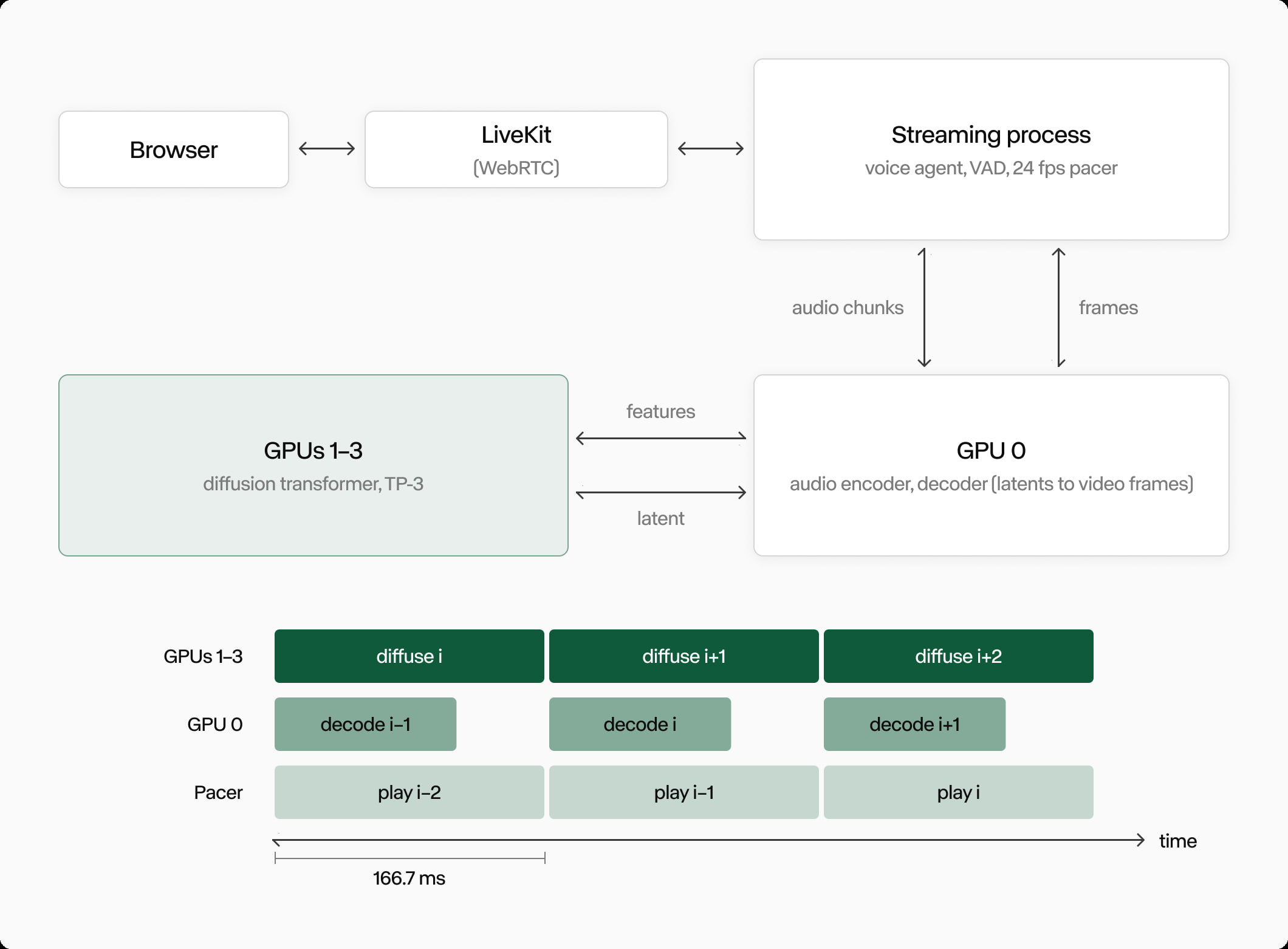
Video decoding was also moved to a separate GPU, allowing frame generation and decoding to happen at the same time without competing for the same computing resources.
Together, these changes reduced generation time from 240.9 milliseconds to 159.3 milliseconds on four H100 GPUs. Further improvements to GPU communication brought it down to 147.4 milliseconds, meeting the requirements for 24 frames per second.
These improvements highlight a growing challenge across the AI industry: access to computing resources is becoming increasingly difficult.
Demand for GPUs continues to rise as companies expand AI training and inference, while semiconductor manufacturing, advanced memory production, data center construction, electricity, and cooling capacity limit how quickly supply can grow.
GPU availability and power have become major obstacles to expanding AI infrastructure, while rental prices have also started rising again.
As a result, adding more GPUs is not always a practical solution.
Hardware is expensive, supply is limited, and operating large computing clusters requires substantial power and cooling infrastructure.
Even companies with sufficient budgets may struggle to secure the capacity they need. Optimizing existing hardware is therefore becoming more than a way to improve performance or reduce costs. It is increasingly necessary to make advanced AI systems practical to operate at scale.
The same challenges apply to large language models, image generators, robotics, and other interactive AI applications.
A model that performs well in a controlled environment can become considerably more expensive when thousands of users access it simultaneously. Reducing unnecessary calculations, improving memory access, and managing communication between processors can make a significant difference to operating costs and reliability.
However, efficiency must not come at the expense of quality.
In video generation, small numerical differences can accumulate across frames and affect visual consistency. Optimizations therefore need to be evaluated not only by processing speed but also by their impact on visual quality and synchronization between speech and movement.
The broader lesson is that building larger AI models is only part of the challenge.
Making them practical requires equally serious work on the infrastructure that runs them.
As models become more capable and applications demand faster responses, efficient use of computing resources will play an increasingly important role. Better hardware will remain valuable, but simply adding more processors cannot solve every problem.
In many cases, the next major improvement will come from making existing hardware work more efficiently.