Over the past few years, interest has surged in AI models that users can download and run locally rather than routing every request through a remote server.
Running models offline on personal hardware not only keeps sensitive data private, but also avoids ongoing cloud API costs. With that in mind, Thinking Machines Lab has released 'Inkling 2 Mini,' an open-weights multimodal model with 26.4 billion total parameters.
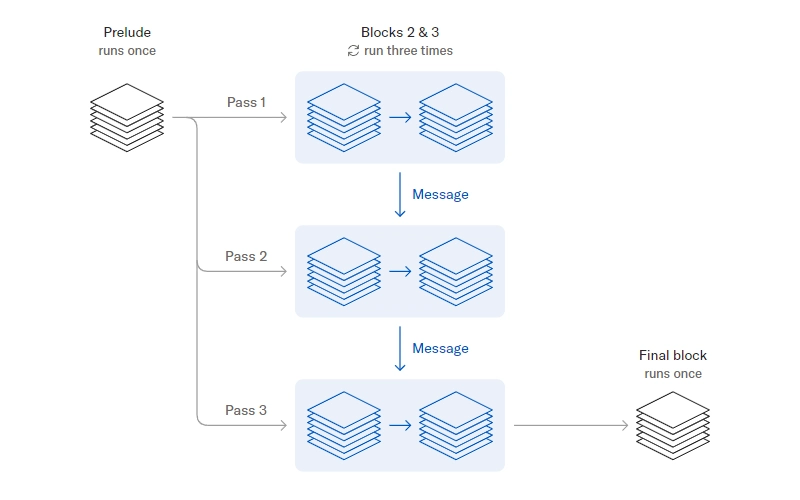
Under the hood, the model uses a looped transformer architecture built from 24 layers.
The first six and last six layers run once per token, while the middle twelve run three times using shared weights, effectively delivering 48 layer passes for every token generated.
It also employs a Mixture-of-Experts (MoE) design that routes each token through 8 of 128 experts. This keeps the active parameter count to roughly 3.4 billion per pass (or about 5.4 billion across all repeated loops).
Because most of the weights were trained and released natively in a 4-bit format, the entire model takes up just ~20 gigabytes of memory.
Because of that size, the model can run offline on a Mac with 32 gigabytes or more of memory, on a single Nvidia DGX Spark, or on other GPUs that have at least 32 gigabytes of video memory.
Quantized versions exist for tools such as Ollama and llama.cpp. The weights are available under an Apache 2.0 license on Hugging Face, and the lab also offers inference and fine-tuning through its Tinker platform.
Inkling 2 Mini accepts text and images as input and produces text. Its context window reaches one million tokens.
On independent evaluations it scores 20.1 on the Artificial Analysis Intelligence Index, matching the result reported for Alibaba's Qwen3.8-27B dense model of similar total size.
On coding and agentic benchmarks the lab reports higher numbers than several other open models in the same weight class, including 48.2% on DeepSWE v1.1 and 77.9% on the hard subset of SWE-bench Pro v2.
It also posts strong results on certain search and tool-use tests.
In other words, Inkling 2 Mini excels in local agentic coding, tool use, and energy efficiency in the sub-30B / laptop-sized class (~20GB memory), making it arguably the strongest open-weights model released so far.
The looping design adds serial computation for each token without increasing the number of stored parameters.
On multi-step tasks that benefit from extra internal processing, this can improve results while keeping the written chain of thought shorter yet still readable, according to the lab's own observations.
At the same time, the modest total parameter count limits how much factual information the model can hold compared with much larger systems. When the lab's own API is used, pricing is $0.15 per million input tokens and $0.50 per million output tokens.
Separate measurements on an Nvidia DGX Spark recorded higher intelligence-per-joule numbers for Inkling 2 Mini than for several other models of similar class run under the same conditions.
In practice the model occupies a middle position.
Very large cloud-only systems generally score higher on broad knowledge and on complex multi-constraint instruction following.
Among open models small enough to run on a laptop, Inkling 2 Mini sits in roughly the same weight class as Google's Gemma 4 variants around 26-31 billion parameters. It matches or undercuts the memory footprint of those peers while using a looped architecture that those models do not.
Proprietary lightweight tiers such as Claude Haiku 5.5 operate in a different category, since their weights are not available for local use.