
Recent months have seen a noticeable trend across the AI industry, where teams are building automated systems that can solve difficult scientific problems.
These advanced systems work by generating a massive variety of candidate solutions, scoring them against measurable criteria, and then refining the process over and over until a specific target is achieved.
When a complex problem can be stated with a clear evaluation function, computers can use extra processing power and search algorithms to locate breakthroughs that had never been found by hand.
OpenAI recently described internal models producing new results on ten longstanding open problems, and other global groups have documented similar automated loops applied to geometry, code optimization, and molecular design.
Within this rapidly evolving landscape, Tencent developed a specialized system named Hyra, a highly technical tool engineered specifically for scientists, laboratory researchers, and AI developers.
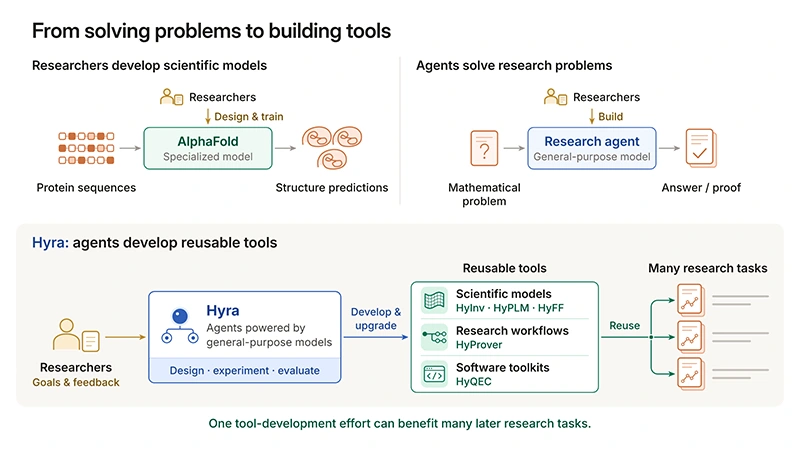
The first version of the system proved its value earlier this year by identifying optimal mathematical exponents to settle a question in combinatorics that had remained open for more than fifty years. However, the engineers at Tencent recognized that focusing entirely on finding individual answers to single problems is expensive, takes a massive amount of computing power, and makes it difficult to transfer knowledge to later projects.
To solve these limitations, Tencent launched 'Hyra 2.0.'
This updated version completely reorients the underlying approach to automated science.
Instead of concentrating primarily on the production of one-off answers, the system is organized to design, train, and refine reusable artifacts, including scientific models, validation pipelines, and multi-step workflows.
This design directly addresses the high cumulative cost of repeated computer search and the immense difficulty of sustaining long running experimental programs that must last for days or even weeks at a time.
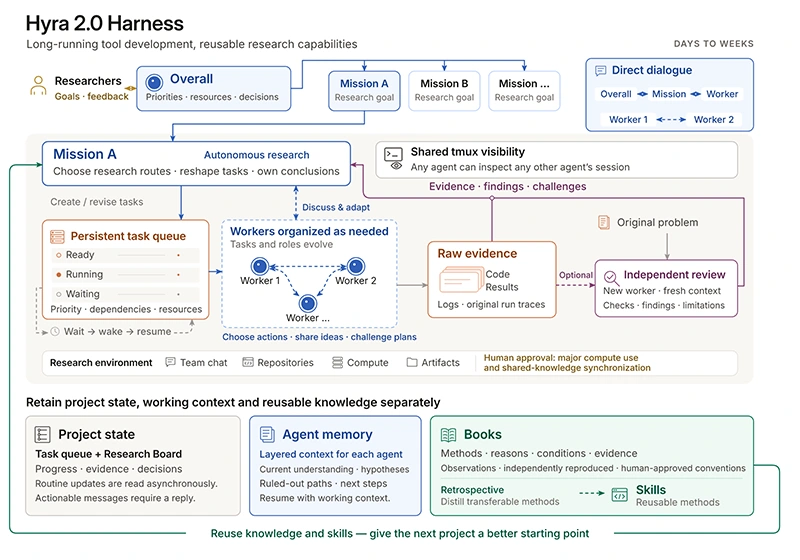
The system manages these long projects by dividing the workload across three distinct layers of digital assistants.
An overall layer maintains direct contact with human researchers, sets the main project priorities, and allocates the computing budget.
Below that, mission agents own specific research directions, choose experimental routes, and remain accountable for the conclusions.
Finally, worker agents read code, run live experiments, analyze failures, and propose alternatives, with multiple workers operating in parallel under different base models.
Tasks are placed in persistent queues that survive system interruptions, and a shared research board records ideas, intermediate findings, and decisions so that later agents can resume work without losing context.
Every final conclusion is attached to concrete logs and code versions, and a separate review worker re-examines the claim from a fresh starting point before it ever reaches human hands.
Shared knowledge within this digital laboratory is kept in highly structured records called books.
These entries separate single-run observations from fully reproduced findings and human-confirmed conventions, and every entry carries supporting evidence that updates dynamically when new data appear.
Methods that prove highly effective across multiple projects are extracted into small, reusable packages called skills that subsequent runs can invoke and modify. Crucially, the system is connected to ordinary laboratory infrastructure, including enterprise messaging for requirement clarification, job submission platforms for large experiments, and code repositories for changes.
Human approval is strictly required before any high-resource, expensive operations are allowed to proceed.
Using this robust infrastructure, the system has successfully built permanent tools that fall into two main classes.
The first class consists of symbolic tools, which are code, rules, or procedures like search heuristics and formal checkers. The second class consists of parametric tools, which are fully trained models.
Several of these models have been trained entirely from scratch or substantially revised by the agent system itself, spanning multiple fields of physical science and engineering.
- Biology: The AI created a model named HyInv that designs proteins 57 times faster than previous industry methods. This helps scientists understand the building blocks of diseases and design new medicines in milliseconds.
- Chemistry: It designed virtual simulation tools that let researchers watch chemical bonds break and form in real time inside a digital environment.
- Advanced Mathematics: The system created an automated proof-finder that successfully verified complex geometric and mathematical theories alongside human mathematicians.
- Hardware and Robotics: The AI designed a more efficient five-fingered robotic hand that moves smoother and drops fewer objects. It also found and fixed hidden software bugs inside open-source computer processors.
Finally, the system applied its automation to robotics and hardware design.
It proposed a novel five-fingered robotic hand whose fingers increase in length around the palm. After running a fixed training budget, this new design rotated objects 28.6% faster in simulations than prior references, completed more trials successfully, and showed much higher physical stability.
For open-source computer chips, the system located optimizations that raised performance scores by nearly 6% while barely increasing the physical chip area, and its automated testing successfully identified and repaired hidden multi-core bugs.
By shifting the unit of progress from temporary answers to permanent tool construction, this technology aims to build a lasting infrastructure for scientific teams.