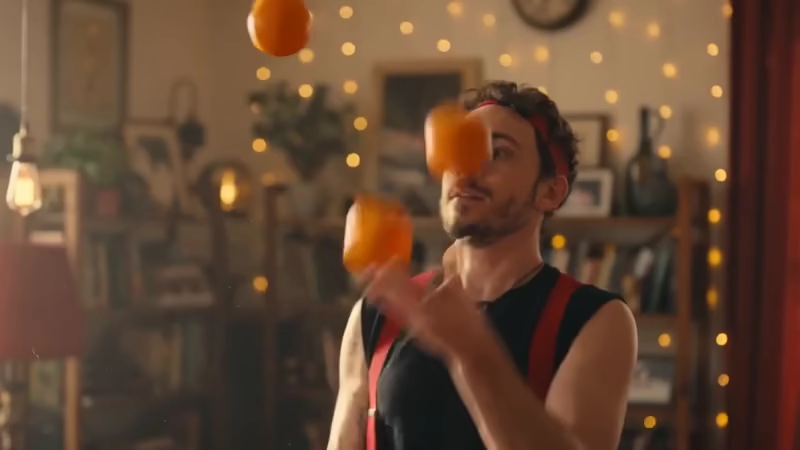
Realism in visual media refers to the degree to which an image or video matches the way objects, people, light, textures, and motion behave in everyday experience.
It demands accurate handling of perspective, material properties, anatomy, expressions, and the subtle ways elements relate to one another within a scene. AI models reach this level of output even though they possess no eyes or ears of their own.
They arrive at it by processing vast collections of existing photographs, videos, and descriptive text.
Through exposure to these examples the models internalize recurring statistical patterns that correspond to physical and social regularities in the world. When presented with a fresh request they reassemble elements into new combinations that often match what a human viewer would accept as a credible photograph or video frame.
And this time, Meta announced the released 'Muse Image' and an early preview of 'Muse Video' on July 7, 2026.
And these have the potential of disrupting existing competition.
Introducing Muse Image and Muse Video, the first media generation models developed by Meta Superintelligence Labs.
Muse Image is our most advanced image generation model yet. It follows instructions faithfully, edits with precision, composes from multiple references, and draws… pic.twitter.com/byNpQZO1RW— AI at Meta (@AIatMeta) July 7, 2026
The models originate from the company's Superintelligence Labs division.
First off, Muse Image functions as an agent during generation rather than mapping a prompt directly to a finished picture. It can call external tools while working. Web search supplies current facts or reference material when needed. Code execution produces precise diagrams, charts, or encoded visual elements.
The model also performs self refinement, examining an initial result and then making targeted corrections or regenerating portions before delivering the final output.
Multiple separate images can be supplied in one prompt so that distinct subjects, clothing, styles, or settings are combined into a single coherent composition.
A distinctive element of Muse Image is its direct link to Instagram.
Muse Image works as an agent rather than a direct prompt-to-image model: it invokes tools, self-refines, improves with scaled test-time compute, and pairs with Muse Spark for collaborative media generation.
🧵👇 https://t.co/kftRoTgq6W pic.twitter.com/zh7jHcM6Jl— AI at Meta (@AIatMeta) July 7, 2026
A prompt can include a mention of any public account, and the system draws visual information from the photos associated with that profile.
This supplies social context that lets generated images incorporate real individuals or scenes drawn from the platform.
The model is accessible now through the Meta AI app and website. It also powers more than thirty effects inside Instagram Stories for users in the United States and supports image generation inside WhatsApp chats in a limited set of countries. Availability on Facebook is scheduled to follow.
As for Muse Video, it builds on the same pretraining base.
Alongside the release of Muse Image, we’re sharing an early preview of Muse Video. It offers competitive performance in prompt adherence, visual fidelity, and temporal consistency.
We’re investing in areas with current performance gaps, such as audio-video synchronization and… https://t.co/kftRoTgq6W pic.twitter.com/iIFeFGLzoE— AI at Meta (@AIatMeta) July 7, 2026
In preview form it generates video sequences together with native audio. Demonstrations show consistent visual detail from frame to frame and reasonable adherence to detailed instructions.
The company has stated that work continues on tighter synchronization between audio and visible actions as well as on more accurate rendering of rapid or physically complex motion.
Independent rankings that rely on human preference scores placed Muse Image second in text to image generation, single image editing, and multi image composition tasks as of early July 2026.
Muse Video placed third in text to video evaluations conducted on the same basis.
These positions situate the models competitively among other systems then available, though not at the top of every reported category.
The announcement produced rapid and widespread criticism that centered on privacy.
Exciting news: Meta’s Muse Image just claimed #2 in the Image Arena!
Muse Image from @AIatMeta now ranks second only to OpenAI's GPT Image 2, outperforming Nano Banana, Grok Imagine, MAI Image, and many other leading image models.
It holds #2 across the board: Text-to-Image,… https://t.co/46ugzuajF7 pic.twitter.com/577214iiqj— Arena.ai (@arena) July 7, 2026
Because prompts can reference public Instagram accounts, photographs from open profiles can be pulled into new AI generated images without the account holder’s knowledge or prior agreement.
The relevant control operates as an opt out setting rather than requiring affirmative consent.
No notification reaches the person whose images are used. Meta has indicated that account owners can adjust the setting through the platform's privacy controls and that the feature applies only to future generations.
Critics have highlighted the risk that such access enables the creation of altered or fabricated depictions of real people.
They have also questioned the broader practice of treating publicly posted personal images as ready material for derivative AI content without explicit permission.
The default configuration drew particular attention because it places the responsibility for limiting use on individual users rather than establishing consent as the starting point.
Meta introduced an accompanying identification system called 'Content Seal.'
Content Seal is built into the Meta AI app and https://t.co/SSo3nt3D0w — every generated image carries a hidden provenance signal that stays intact through cropping, compression, and resizing.
We are previewing a public identification tool to verify the presence of this…— AI at Meta (@AIatMeta) July 7, 2026
It embeds an invisible marker into generated images. The marker is designed to survive common alterations such as cropping, compression, or resizing. A public tool allows anyone to check whether an image carries the marker.
Plans exist to extend comparable identification to video outputs later.
These releases show how far generative systems have advanced in producing detailed, context aware visual results while also surfacing immediate questions about how personal images are sourced and how individuals are informed when their likeness appears in new creations.
As the tools continue to embed themselves in widely used social platforms, the mechanics of reference selection and user notification will likely remain active topics of examination.






















































































































































































































































































