The race among large language models (LLMs) is not going to end anytime soon.
In a race that accelerated sharply after OpenAI's ChatGPT appeared in late 2022, the contest over text generation has since broadened into a wider struggle for dominance across modalities. Systems that once answered questions or wrote essays evolved into tools that could produce images, audio, and increasingly complex video sequences.
By 2025 and into 2026 the field had settled into a familiar pattern of offline generation: models that accept a prompt or short input clip, process it in batches, and return a finished result after some delay.
Real-time interaction remained largely out of reach for high-fidelity video, leaving most applications confined to pre-rendered clips or limited special effects.
Against that backdrop, Decart, an Israeli AI research laboratory founded in 2023 and focused on realtime world and video models, released 'Lucy 2.5.'
The company builds systems intended for continuous operation rather than discrete offline jobs, spanning entertainment, gaming, and physical AI applications.
Lucy 2.5 is presented as a live video editing and world transformation model that operates directly on streaming camera input.
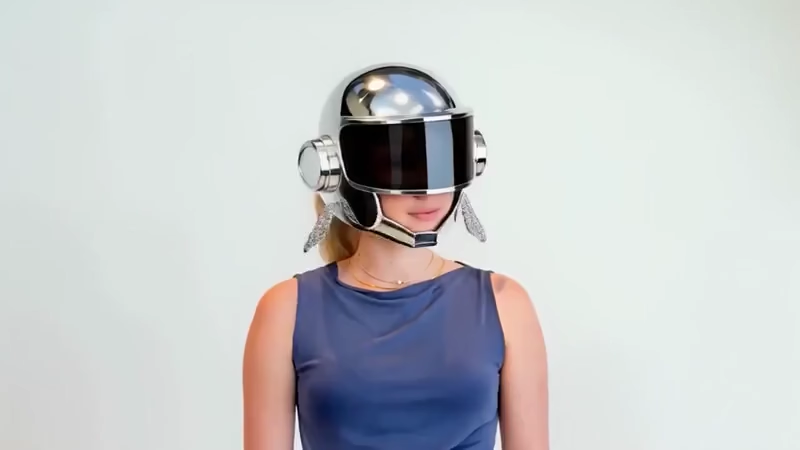
It can add, replace, or remove objects, restyle entire scenes, swap characters using reference images, apply clothing or product changes, alter backgrounds, and insert visual effects, all while the video continues to run.
The model is described as a pure diffusion system that does not rely on explicit 3D meshes or depth maps; physical consistency and motion continuity emerge from patterns learned during training. Latency is kept low enough for interactive use, and sessions can continue for extended periods without the quality drift that has limited earlier continuous generators.
What distinguishes Lucy 2.5 within the broader generative AI competition is the direction of interaction it enables.
Earlier world models typically placed a user inside a generated environment that could be navigated through a fixed set of controls such as moving forward or turning. Lucy reverses that relationship.
The user stays in their physical surroundings while the model forms a generated layer around the live camera feed.
The system observes movements and actions in real time and adjusts the output accordingly. In this framing the camera itself becomes an interface to a continuously updating generative world rather than a simple recording device.
Interaction is open-ended and driven by what a person does in front of the lens instead of by predefined navigation commands.
What distinguishes Lucy 2.5 within the broader generative AI competition is the direction of interaction it enables.
Earlier world models typically placed a user inside a generated environment that could be navigated through a fixed set of controls such as moving forward or turning. Lucy reverses that relationship.
The user stays in their physical surroundings while the model forms a generated layer around the live camera feed.
The system observes movements and actions in real time and adjusts the output accordingly.
In this framing the camera itself becomes an interface to a continuously updating generative world rather than a simple recording device. Interaction is open-ended and driven by what a person does in front of the lens instead of by predefined navigation commands.
The practical uses follow directly from that capability.
From live streaming, where hosts can alter their appearance, environment, or on-screen elements in response to audience input without interrupting the broadcast, to e-coomerce applications creating virtual try-ons of clothing or accessories.
The implications extend beyond any single industry.
Continuous, low-latency transformation of live video lowers the barrier between recorded reality and generated content. Creators gain the ability to treat video as a programmable medium that responds while it is still being produced. Viewers of live streams may encounter moments shaped in real time by collective input. Retail and advertising environments can become more adaptive without requiring separate production pipelines.
At the same time, the same tools raise questions about authenticity, consent, and the ease with which visual identity or product placement can be altered on the fly.
As models of this type mature, the distinction between offline generative systems and always-on interactive layers continues to narrow, shifting the competitive focus from static output quality toward sustained, responsive presence in the physical world.






















































































































































































































































































