
The way people interact with AI is gradually changing. What began largely as a question-and-answer experience is becoming something closer to a workspace, where a model can examine information, perform calculations, write code, create files, and refine the result without requiring the user to move between several different tools.
The distinction between an AI that simply responds and one that actually carries out parts of a task is becoming increasingly important.
Sakana AI is now moving its own chat service further in that direction.
On August 13, 2026, the Japanese AI company announced a major update to Sakana Chat, adding its Sakana Fugu orchestrator, a new generation of Sakana Namazu, code execution, generated-file previews, and support for image and document attachments.
The company describes the update as an effort to expand both the models available through the service and what those models can actually do for users.
Sakana Chat was originally introduced as a way for people to try Sakana AI's models without going through an API.
With this update, the service is becoming more capable as a general-purpose AI workspace. The company says Sakana Chat is available for free, and its recent social media posts have highlighted that users can access the upgraded experience without logging in.
At the center of the update is Sakana Fugu, the orchestration model that Sakana AI introduced earlier this year.
Unlike a conventional chatbot that relies primarily on one underlying model, Fugu is designed to decide how a task should be handled and, when appropriate, coordinate multiple AI models to produce an answer.
Sakana AI has described it as a multi-agent orchestration system that can route work across a pool of models and even recursively call instances of itself for more complicated tasks.
That approach is important because it reflects a broader change in how AI companies are thinking about scaling capability.
Instead of assuming that every improvement must come from making one model larger, orchestration attempts to improve results by deciding which models should participate in solving a particular problem and how their work should be combined.
Fugu was built around this idea, with Sakana AI training the orchestration layer to decompose tasks, assign subtasks, evaluate responses, and synthesize the results.
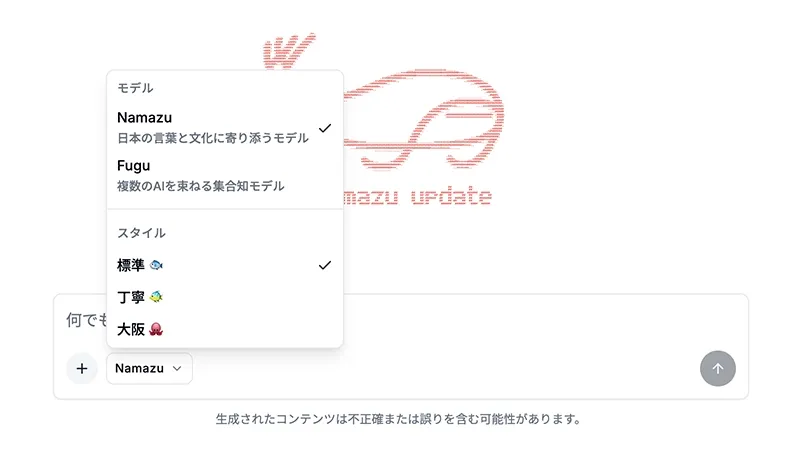
The arrival of Fugu inside Sakana Chat therefore makes that research direction more visible to ordinary users. Instead of interacting with orchestration as an API or developer-facing system, users can now encounter it through a conventional chat interface. Sakana AI says Fugu is particularly intended for complicated instructions and tasks that span multiple steps, where the quality of the final result depends on more than simply producing a good paragraph of text.
The second model available through the updated service is a new generation of Sakana Namazu. Namazu has a different emphasis. Sakana AI says the updated model improves Japanese-language response quality as well as its ability to perform agentic tasks. It is designed to accept instructions written naturally in Japanese and produce documents and other materials suitable for recurring workplace tasks.
This gives Sakana Chat a somewhat different model-selection philosophy from many mainstream chatbot services. Rather than presenting users with only a single general-purpose model, Sakana AI is exposing different systems with different strengths. Fugu is positioned around broad capability and orchestration, while Namazu is more specifically tuned toward Japanese-language interaction and practical execution.
The bigger change, however, is what happens after the model generates an answer. Previously, Sakana Chat largely stopped at the response itself. The new version allows models to execute Python code inside a sandbox, which means the system can perform calculations, process data, and generate files as part of the conversation. Users do not necessarily have to take the code or instructions produced by the model and execute them somewhere else.
File handling has also been expanded. Users can attach images, PDFs, and Office documents, allowing the conversation to begin with information that already exists on the user's computer. Images can be used for things such as screenshots of errors or charts, while documents can be summarized or analyzed. When combined with code execution, the system can extract information from a document and transform it into another format.
The significance of the update is therefore less about adding another chatbot to an already crowded market and more about bringing several of Sakana AI's research ideas together in one consumer-facing product.
Fugu supplies the orchestration layer, Namazu provides a Japan-focused model option, and code execution gives the models a way to act on information rather than simply discuss it.
There are still practical limitations to this approach. Allowing an AI system to execute code introduces a different class of risks from ordinary text generation, which is why Sakana AI says the execution takes place in a sandbox.
Generated files and calculations also still require human inspection, particularly when the underlying data or task has consequences beyond a simple demonstration. The ability to produce an artifact does not by itself guarantee that the artifact is correct.
Even so, Sakana Chat's latest update shows where Sakana AI appears to be taking its research.
The company is not abandoning its emphasis on orchestration or Japan-focused models. Instead, it is bringing those ideas into a single environment where users can ask a question, provide their own files, let the system process information, execute code, and receive something that goes beyond a text response.
That makes the update another example of the AI industry gradually moving from chat toward task completion.
The competitive question is increasingly not only which model can produce the most convincing answer, but which system can turn a user's instruction into a useful result with fewer intermediate steps.
Sakana Chat's combination of Fugu, Namazu, code execution, file analysis, and in-interface previews represents Sakana AI's attempt to answer that question from Japan.






















































































































































































































































































