
In recent years the conversation around AI has steadily shifted from systems that answer questions to systems that carry out sequences of actions.
Chat interfaces remain useful for drafting text or summarizing documents, yet many everyday professional tasks still require logging into multiple applications, moving data between them, following multi step procedures, and returning only when a decision is needed.
That gap has drawn attention from several research groups that have begun releasing experimental agents capable of operating browsers, desktops, or cloud environments with varying degrees of autonomy.
One such system, released in early beta by xAI in mid August 2026 and expanded a few days later, is called 'Grok Bot.'
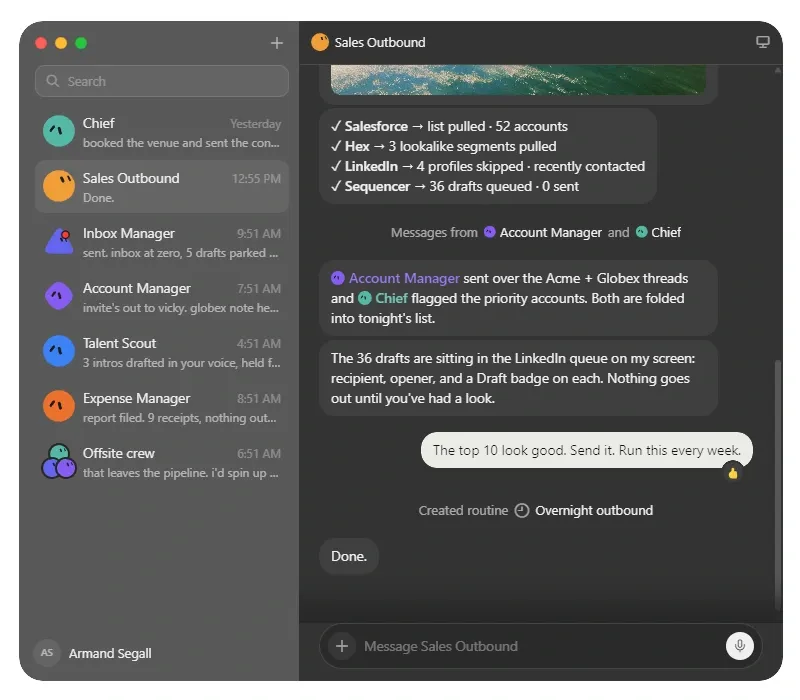
It consists of named AI teammates that each run on a persistent cloud computer.
Once granted access, a bot can sign into the same web applications and tools a person already uses, navigate interfaces that lack clean programming interfaces, and complete jobs end to end.
Multiple bots can operate at the same time, pass context to one another inside shared threads, and continue working after the user’s device is closed.
Workflows can also be taught by demonstration: a person performs a routine once while the bot observes, after which the sequence is stored and can be scheduled or triggered later without further instruction.
The practical result is that tasks such as researching prospects overnight, drafting personalized outreach in a user's own style, updating customer records, processing invoices received by email, reproducing software bugs, or maintaining reporting pipelines can be handed off and completed with only occasional human approval.
Because the bots keep durable memory of preferences and past interactions, later runs tend to require less correction.
Access was initially limited to higher tier subscribers of SuperGrok and Cursor plans; as of 21 August 2026 it became available to SuperGrok Plus, Cursor Pro+, and Cursor Teams subscribers, with a limited free trial offered to other users.
Grok isn't alone in this attempt
Comparable efforts exist at other major laboratories.
OpenAI's agent features, previously previewed under the name Operator and later integrated into ChatGPT Agent and related work modes, allow multi step browser and desktop actions, often within a sandboxed environment or through connected apps, and emphasize finished deliverables inside the ChatGPT interface. Anthropic's Claude models have demonstrated strong performance on computer use benchmarks, with desktop oriented tools that interact with local files and selected applications, frequently scoring highly on tasks that require precise GUI navigation. Google's Gemini line has incorporated native computer use capabilities, evolving from earlier research projects focused on browser automation and workspace integration.
Each approach differs in architecture: some prioritize sandboxed safety and explicit tool connectors, others emphasize local desktop control or deep integration with existing productivity suites.
Grok Bot’s design places heavier emphasis on a shared cloud computer that remains available around the clock, on bots that can collaborate among themselves, and on learning routines directly from live observation rather than from predefined automation graphs.
These systems remain early, which means reliability varies across complex interfaces. Permission management and audit trails continue to evolve, and the amount of oversight required still depends on the sensitivity of the work.
Yet the underlying direction is consistent across laboratories: moving from conversational assistance toward agents that operate the same digital environments people already inhabit, so that the boundary between instruction and completed outcome grows narrower.






















































































































































































































































































