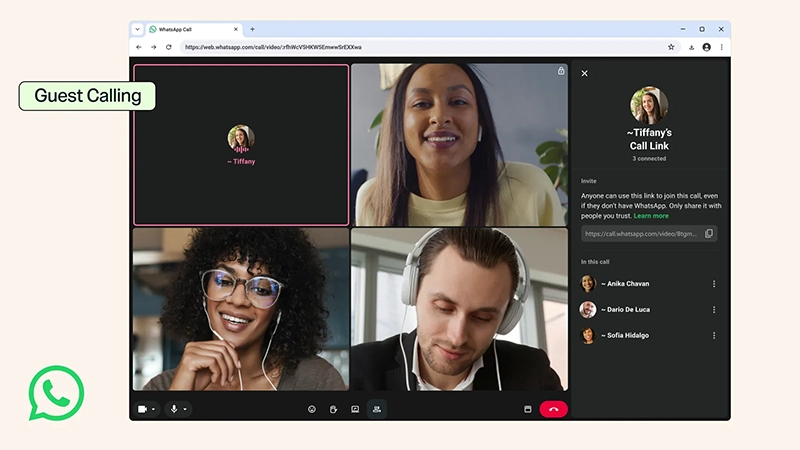
Traditionally, communicating through an app like WhatsApp required both participants to install the software, create an account, and establish user profiles before any conversation could take place.
This structural requirement often introduced friction when connecting with individuals who did not actively use the platform or preferred not to create an account for a single interaction.
Meta designed the guest calling architecture by extending its browser-based calling infrastructure and web application services.
In this case, Meta announced that people who no longerr need to be a WhatsApp user to receive call from WhatsApp users.
In other words, WhatsApp users can now invite literally anyone to a call.
To make this happen, the process doesn't require native app binaries. Instead, it utilizes WebRTC and modern browser APIs to route audio and video streams directly within web clients.
In a separate announcement, WhatsApp said that when a WhatsApp user creates a call link via the mobile application, the platform generates a unique session identifier managed through Meta's backend signaling services.
When an unregistered guest accesses the shared URL through a desktop browser, they are prompted to input a display name before entering a virtual holding space.
This waiting room architecture acts as a security gate controlled entirely by the call host.
The host receives real-time notifications via their client app and must manually approve each guest before media and data paths can be established between the endpoints.
To maintain end-to-end encryption across browser environments, Meta implements cryptographic protocols using browser-native security standards, such as the Web Crypto API, alongside encrypted media transport protocols.
This ensures that media packets remain encrypted in transit between endpoints without exposing sensitive routing or identification data to external intermediaries.
The underlying infrastructure handles both 1:1 sessions and multi-party group calls scaling up to 32 participants simultaneously.
Essential collaborative features including screen sharing, emoji reactions, and hand-raising mechanics, are mapped directly to the web client interface.
To prevent abuse and protect participant privacy, guests operate under strict protocol limitations: they cannot view other participants' phone numbers, transmit text messages, or invite additional users directly.
Further extending the reach of this infrastructure, Meta plans to roll out calendar integrations for platforms like Google Calendar and Outlook.
This system relies on a dedicated plugin that allows users to embed standardized WhatsApp call links directly into calendar invitations, enabling automated creation of guest-accessible call sessions straight from productivity suites.






















































































































































































































































































