For large public websites that must remain usable on ordinary connections, the time between a request and the appearance of the first useful content is often measured in seconds rather than milliseconds.
When that interval stretches long enough that a user is left staring at a loading indicator, the practical effect is that many people simply leave.
X, formerly known as Twitter, has evolved, and scaling up can be a burden, especially since additions upon addition simply become overhead weights.
An engineer at X published a detailed account of how the company replaced the web version of its platform with an entirely new application, and a former product lead responded by noting that the change removes one of the last major technical constraints on further development.
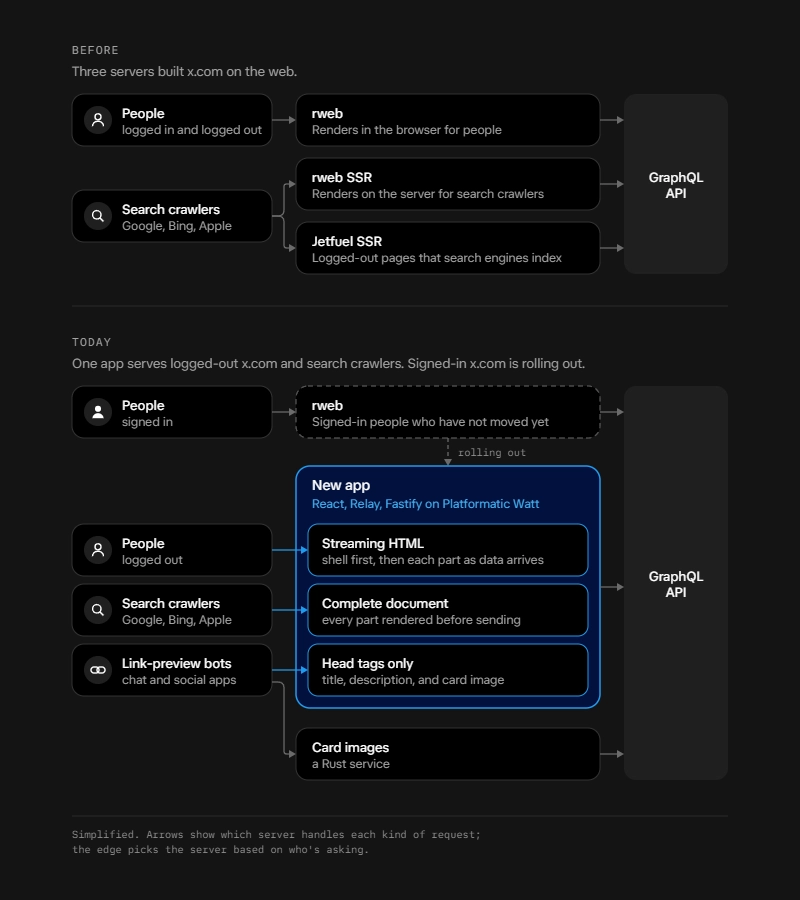
The previous web stack, known internally as rweb and introduced as the main site in 2019, relied on three separate servers for what users experience as a single URL.
One server rendered the interactive application in the browser for both signed-in and logged-out visitors. A second produced server-rendered HTML specifically for search crawlers. A third handled logged-out pages that needed to be indexed, including profiles, events, Spaces, and trends.
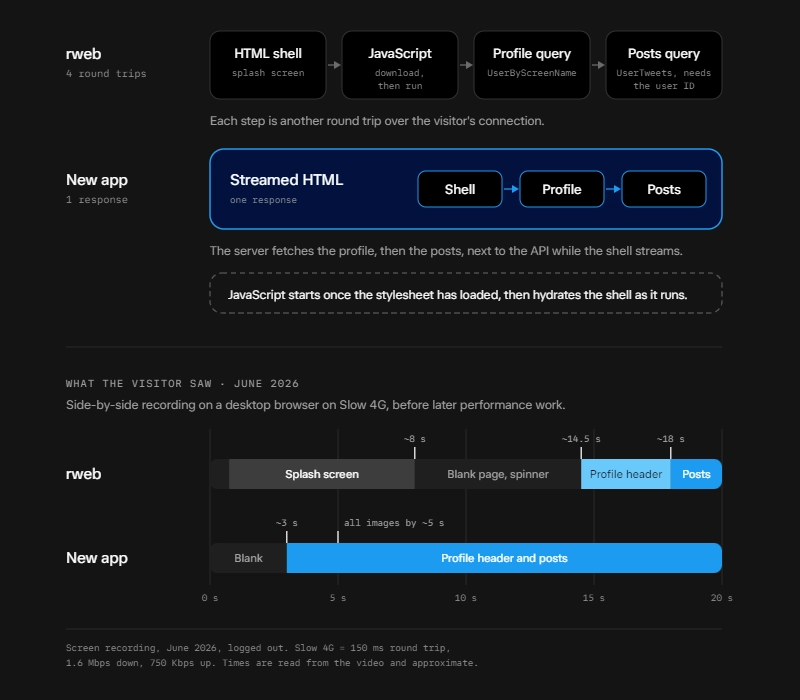
On a simulated slow connection the first post on a profile could take more than 22 seconds to appear, because the browser first received an empty shell, then downloaded JavaScript, then issued further requests for data.
Logged-out visitors received the slowest path while crawlers received an optimized document, and fixes made to one server frequently failed to propagate to the others.
The new application collapses those responsibilities into a single server that inspects the requester and chooses an appropriate response.
Ordinary visitors receive a streaming HTML document that begins with the page shell and fills in content as GraphQL responses arrive. Verified search crawlers receive a complete, non-hydrating document under size limits that search engines accept. Link-preview services receive only the title, description, and image.
The same routes and URL rules are preserved, and a shared component library is used across the company’s mobile apps. On the same slow-connection benchmark the first post now appears in roughly 2.7 seconds.
JavaScript volume before that moment is also lower. Five engineers working with coding agents produced the initial version in under six months; more than twenty people have since committed changes as the signed-in experience is moved over.
Rollout has been staged.
Search-crawler traffic was switched first, allowing the older server-side rendering systems to be retired in August and September 2026. Logged-out visitors followed.
Signed-in users are being moved country by country through edge routing and feature flags, with the previous application remaining as a fallback until the migration is complete.
The engineering post records laboratory medians taken on November 3, 2026, under controlled network conditions; real-world results will vary with device, location, and connection quality, and the company continues to track Core Web Vitals.
Nikita Bier, who led product work at X until earlier this year, described the web rewrite, together with a rebuilt Android application and a refreshed iOS application, as the removal of a long-standing bottleneck.
In his view the remaining limit on the pace of change is now the set of ideas the team chooses to pursue. Whether that assessment holds will depend on how quickly the remaining traffic is migrated and how the new stack behaves under sustained load once the older systems are fully retired.
The practical outcome so far is a measurable reduction in the time required to display content on constrained networks, achieved by consolidating previously divergent rendering paths into one codebase.
The same change also simplifies ongoing maintenance, because there is no longer a set of parallel servers that can drift out of alignment.
Further effects on user retention, search visibility, and the speed of subsequent product work will become clearer only after the country-by-country transition finishes.
























































































































































































































































































