The world is now experiencing a massive technological paradigm shift that is moving at a pace faster than the Industrial Revolution.
Nvidia's CEO Jensen Huang describes this period as the largest infrastructure buildout in human history. At a recent Sequoia Capital event, he shared his foundational mental models for understanding this new era, outlining how AI is shifting the nature of computing, how it will reshape the global economy, and why the current narrative around job destruction is fundamentally wrong.
For the last few decades, computing has operated under a single dominant framework based on retrieval. Historically, when people interacted with a computer, they were retrieving pre recorded data. Whether it was text, a photo, or a video, it was saved to a file, stored in a data center, and recalled via a recommendation system.
AI completely flips this script.
And this is evolving the cake.
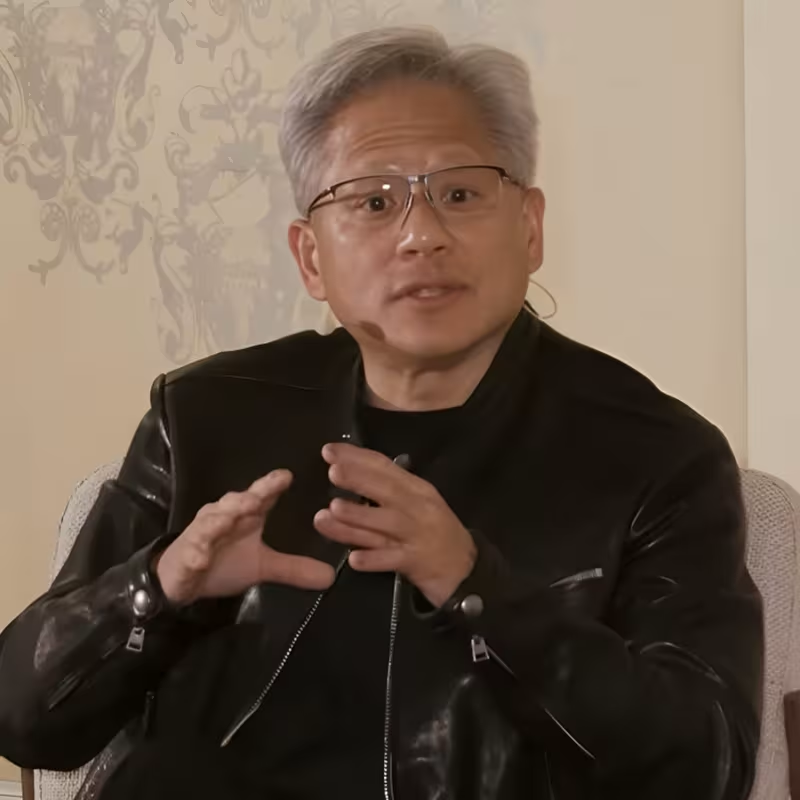
When using AI, prompting the sytem will have it process the query within the specific context and generates a completely original response. In the future, every pixel you see and every video people watch will be custom generated for them in real time rather than retrieved from a database.
To explain how this new computing era functions at scale, Huang draws a historical parallel to the Industrial Revolution.
Three hundred years ago, companies introduced the dynamo, a machine that turned physical motion into electricity, creating a power grid that cocooned the earth.
Nvidia's AI factories are the dynamos of the modern era, but instead of turning atoms into electrons, they take electrons in and spit tokens of intelligence out.
These tokens represent the structural language of the physical world, allowing computers to process the language of proteins, human biology, climate physics, and three dimensional space for robotics and self driving cars.
To conceptualize this massive shift, Jensen Huang frequently uses a "five-layer cake" analogy to explain AI not as a single technology or clever app, but as a full industrial stack.
This essential infrastructure is comparable to electricity or the internet.
The cake framework helps explain why the AI boom involves far more than model training, reshaping energy policy, semiconductor design, data center construction, and entire industries. Huang emphasizes that we are still in the early stages of this transformation, and understanding how these layers stack up from top to bottom is crucial for predicting where the future is headed.
From top to bottom:
- Energy: this is the foundational layer. AI generates intelligence in real time, so it requires massive, real-time power. Every token or computation depends on electricity. Huang calls energy the "binding constraint" on scaling intelligence. Without sufficient power, the rest of the stack cannot expand effectively. This layer drives huge investments in power generation, grids, and infrastructure.
- Chips: The hardware layer where hardware makers reside, the place where Nvidia dominates. This includes specialized processors (like GPUs), networking, memory, and interconnects optimized for massive parallelism in AI workloads. Chips convert energy into efficient computation at scale.
- Infrastructure: The systems that turn chips into usable compute capacity. This encompasses data centers ("AI factories"), power delivery, cooling, land, construction, networking, and cloud software that orchestrates thousands of processors. Building these at scale is a major bottleneck in many regions due to time, cost, and complexity.
- Models: These are the AI models themselves, including large language models, multimodal systems, and specialized ones for biology, chemistry, physics, robotics, etc. Huang notes that while generative AIs brought attention here, the layer is broader than just language models and continues evolving toward more capable "agentic" systems.
- Applications: The top layer where economic value is realized. This includes real-world uses such as drug discovery platforms, industrial robotics, legal copilots, autonomous vehicles, humanoid robots, and industry-specific tools. Applications "pull" on all layers below and ultimately determine productivity gains and societal impact.

In his understanding, AI is an industrial system, not just software. Every successful application depends on the entire stack down to the power plant, and that countries or companies that master multiple (or all) layers gain strategic advantages.
The buildout is enormous and early. Now, hundreds of billions invested so far, with trillions more needed for infrastructure.
This This framework helps explain why the AI boom involves far more than model training.
It reshapes energy policy, semiconductor design, data center construction, and entire industries. Huang emphasizes that we are still in the early stages of this transformation.
And energy, the first layer of the cake, is the most fundamental of all. All the layers above it requires energy. Without energy, there is no cake.














































































































































































































































































