There is a running joke in PC gaming that if a machine can count from 1 to 10, someone will eventually make it run DOOM.
Calculators, ATMs, printers, even a pregnancy test have all been dragged into that bit, mostly because id Software released the engine and because the 1993 game is small, software-rendered, and built on a level format that a stubborn programmer can recreate from almost nothing.
The joke works so well that it has crowded out a stranger fact.
Two games that matter more to how shooters actually evolved are now showing up on the same kind of obsolete hardware, and they are doing it without the shortcut that made DOOM portable in the first place.
Argentine developer Dante D. Leoncini managed to run two newer, popular games, on old Nokia phone.
First of, the developer posted footage of the original Half-Life running at about 30 frames per second on a Nokia N95, the Symbian slider phone from 2007.
Mouse and keyboard support came with it, over the phone's Bluetooth 2.0 radio, and the single-player campaign was already far enough along that sound, weapons, and dedicated servers worked. Slowdowns remained.
He said he had found the cause and was fixing it.
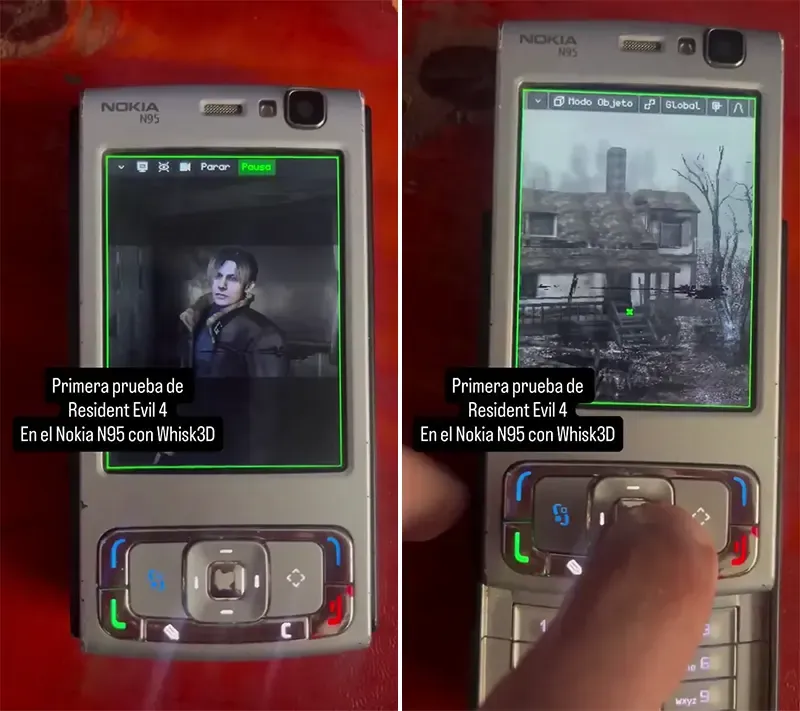
A few months later, on October 1, he posted something harder to dismiss as a novelty: a cutscene from the 2005 GameCube version of Resident Evil 4, playing on the same handset.
That one is not a finished port. It is the first test of a scene, and it already explains why these two games almost never join the "it runs on everything" club.
The N95 is not a toy by 2007 standards, and it is not a modern handheld either.
It uses a Texas Instruments OMAP 2420, with an ARM11 CPU at 332 MHz, PowerVR MBX graphics that speak OpenGL ES 1.1, and either 64 or 128 MB of RAM depending on the variant. The screen is 240 by 320.
When it was released, it was definitive flagship device for Nokia.
Half-Life, released in 1998, required a 133 MHz Pentium and 24 MB of RAM at minimum, so the phone clears the old PC box on paper. What it does not have is an x86 processor or a desktop graphics card, and Symbian is not Windows.
Emulating the retail PC build would have been a dead end. Leoncini built a native port instead.
In order for it to run, the Half-Life project sits on Xash3D FWGS, an open-source reimplementation of Valve's GoldSrc engine. GoldSrc is the heavily modified Quake engine that Half-Life shipped on, and Xash3D is written so that it can load the original game's content and behave like that engine on platforms Valve never shipped.
Leoncini maintains a Symbian build of it.
The practical setup is the usual one for this kind of port: install the engine, copy the original game files into the folder it expects, and run it.
He has also shown the same build on later Symbian phones such as the Nokia N8 and E7, and he has been adding local network play, which would in theory let a room full of N95s host a match. Bluetooth input adds latency.
The resolution is tiny. None of that changes the basic method. The phone is executing ARM code written for Symbian, talking to the PowerVR chip for 3D, and reading Half-Life's own maps, models, and sounds. It is not streaming the game from a PC, and it is not pretending to be a Pentium.

As for Resident Evil 4, he was challenged with a different problem.
Leoncini approached this with a different tool. Whisk3D is his own open-source project for 3D modeling, rendering, animation, and game work. It runs on Windows, Linux, macOS, Android, WebGL, and Symbian, including the N95. He has been clear that it is not a Blender port and does not share Blender's code.
For this test, he is pulling assets from the GameCube version of Resident Evil 4 and feeding them through Whisk3D.
He has used the same route for other experiments, including a Grand Theft Auto III converter that takes original assets, runs them through Python, and writes them out in Whisk3D's W3D format.
The preferred path for Resident Evil 4 is the same idea at a larger scale: a GameCube-to-Whisk3D converter, so the phone keeps the original models rather than a hand-simplified substitute.
That choice is why the cutscene struggles.
Leoncini says the bottleneck is skinning, not rendering.
Skinning is the step that deforms a character mesh so it follows a skeleton. Eyes, mouth, hair, clothes, and fingers each add animated vertices, and the N95's CPU has to transform thousands of them in a few milliseconds before the PowerVR chip ever draws the frame. He has also said that Resident Evil 4 and Half-Life 2 push him into deformable meshes of more than 10,000 vertices.
The GPU on this phone can do hardware-accelerated OpenGL ES 1.1. The animation work still lands on a 332 MHz ARM11. Dropping to lower-poly models would, by his estimate, push the test to 30 frames per second or better, but those models would have to be edited by hand.
He would rather spend the effort on the converter.
The contrast with DOOM is not that Half-Life and Resident Evil 4 are obscure. They are the opposite.
Half-Life turned the late-1990s shooter away from pure arena combat and toward scripted spaces, named characters, and a campaign people still argue about. Its modding scene produced Counter-Strike, which for years was more culturally unavoidable than the game it came from.
Resident Evil 4, released on GameCube in January 2005 and then on almost everything else, dragged third-person action toward an over-the-shoulder camera, a tighter inventory, and a pace that later action games spent a decade copying.
The 2023 remake only underlined how long the original had stayed in circulation. Both games sold in the millions, both still get replayed, and both sit near the center of how their genres are remembered.
Unlike DOOM that is relatively easy to port, Half-Life and Resident Evil 4 are much worse condidates.
DOOM 's levels are built from a binary space partition, its enemies are sprites, and once the source was public the renderer could be rewritten in whatever language the target device allowed. Half-Life needs a GoldSrc-compatible engine, skeletal characters, scripted sequences, and a content pipeline that was closed for years. Resident Evil 4 needs cutscene-grade meshes, facial and cloth animation, and assets that were authored for a console GPU, not a phone from two years later.
Regardless, Leoncini has proven that his old N95 is more than capable. He can make it draw the frames, tweak its CPU to bend 10,000 vertices for Leon's coat, hair, and fingers.
That is also why the footage matters more than another DOOM calculator. One of these is a playable native port of a 1998 classic at 30 frames per second.
The other is an early, honest look at what a 2005 character scene costs on hardware that was already impressive when it was new, and is now close to 20 years old.
Further reading: 30 Years Of 'Doom': The Story Of A First-Person Shooter That Remains Relevant






















































































































































































































































































