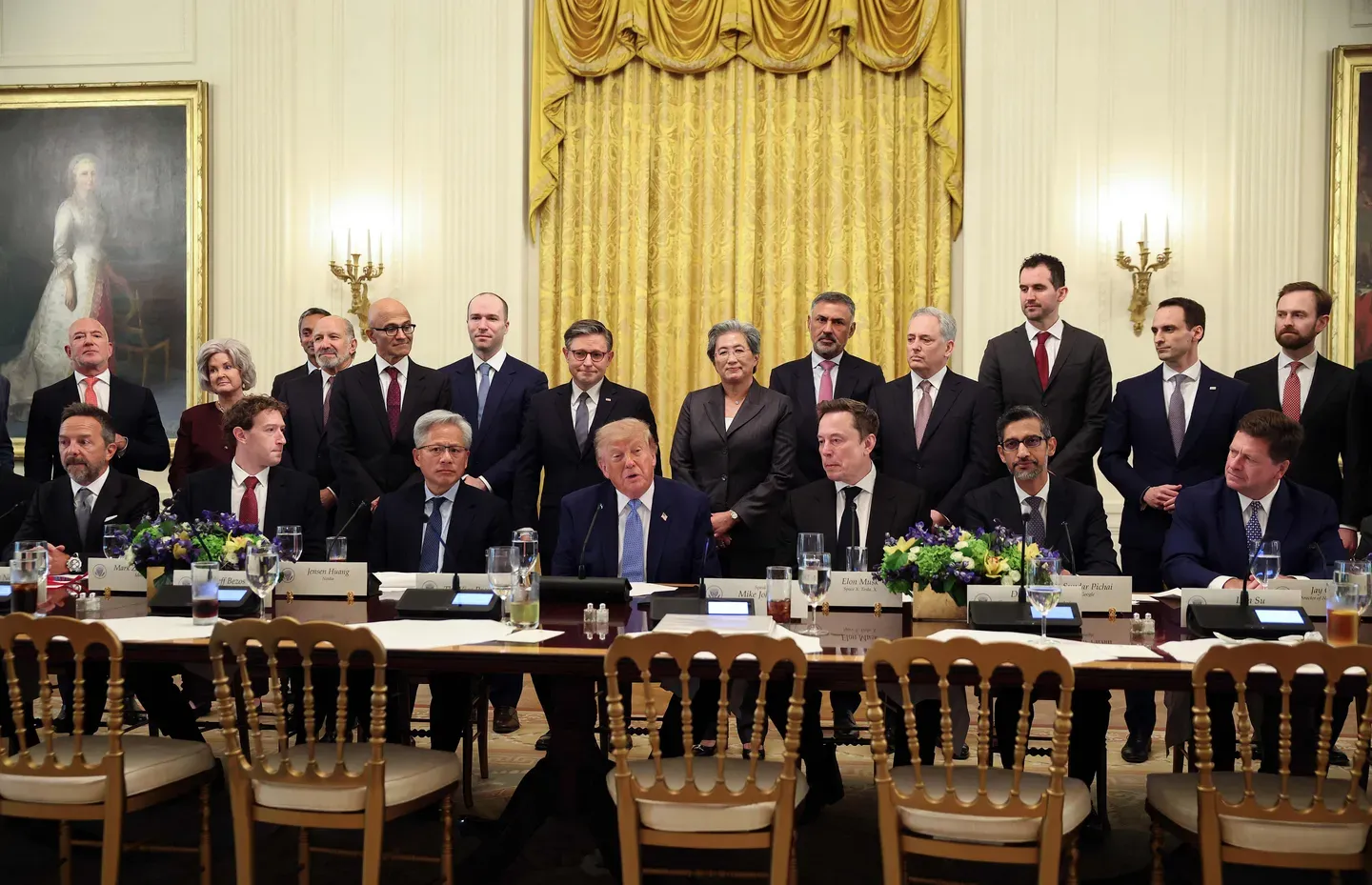
U.S. President Donald Trump hosted a Super Intelligence luncheon in the White House East Room on September 29, 2026, gathering leading figures from the technology sector for what participants and officials described as the first time so many of them had been assembled in one room.
Those present included Elon Musk of xAI, SpaceX and Tesla, Mark Zuckerberg of Meta, Jensen Huang of Nvidia, Dario Amodei of Anthropic, Sundar Pichai of Google, Greg Brockman of OpenAI, Jeff Bezos of Amazon, Satya Nadella of Microsoft, Lisa Su of AMD, and Alex Karp of Palantir, along with Vice President JD Vance, House Speaker Mike Johnson, and unspecified members of the Cabinet.
Seating arrangements placed figures such as Zuckerberg, Huang, Musk, Pichai, and others around a single table with the president.
The gathering produced a short voluntary document titled the White House Accord on Super Intelligence, also called the Joint Commitment on Frontier Responsibilities. Trump, Musk, Zuckerberg, Huang, Amodei, Pichai, and Brockman signed it. Bezos and Nadella attended but their companies did not.
The accord, roughly 308 words long, commits participating companies to four layers of controls focused on high-risk capabilities in cybersecurity, biosecurity, and chemical threats.
Companies are to implement internal monitoring during training and deployment so models do not access systems in unintended ways, empower an internal team to verify those controls and remediate problems, partner with an independent external auditor for assessments, and designate an independent committee of the board of directors to oversee reports and ensure issues are fixed.
Participants agreed to meet regularly to develop standards.
Trump called the document morally binding and compared it to a constitution that offers protection through tremendous self-policing. He said the United States is leading and will keep it that way, adding that whoever wins SI is going to win.
Speaker Johnson described the discussion as striking a balance between public benefit, maintaining an edge over China, and safety. Amodei later called the accord a start.
After the White House meeting with AI leaders, Trump issued an executive order shifting the term from AI to SI, arguing "artificial" sounds fake while "super intelligence" captures its true power.
It directs executive branch agencies to use Super Intelligence and SI in official correspondence, public communications, websites, reports, policy documents, and other non-statutory materials, and to stop acknowledging Artificial Intelligence or AI.
Existing regulations, contracts, and historical documents need not be rewritten.
The Assistant to the President for Science and Technology has 60 days to propose legislative language for a federal definition that reflects current capabilities and to recommend further actions.
For now SI refers to the same systems already covered by the statutory definition of artificial intelligence.
What the inauguration really means, the term "AI" is no longer an accepted term.
In fact, Trump even called AI a hoax in remarks to reporters.
The stated reason for the shift is that the original term no longer fits.
Official documents note that the field originated in the U.S. more than 70 years ago and that frontier systems now amplify human ingenuity, unlock creativity, and make previously impossible work possible in science, medicine, and other domains rather than merely imitating or automating intelligence.
Trump has said artificial makes the technology sound fake. He prefers super because it conveys extreme, superior, and supreme intelligence while remaining simple.
He has used the term in public remarks, including at the United Nations, and has mentioned discussing it with Chinese President Xi Jinping.
The administration presents the change as a way to keep agencies focused on expanding capabilities that empower Americans and strengthen the economy.
The order sits inside a larger policy sequence. After taking office the administration rolled back prior restrictions it described as overreaching.
It released America’s AI Action Plan in 2025 with more than 90 federal actions and a National Super Intelligence Policy Framework in 2026.
It has also announced more than $5 billion for the Genesis Mission, a government effort to apply the technology to scientific, medical, energy, and manufacturing breakthroughs.
An AI-powered government website using models from Google and xAI launched the same day as the luncheon. Trump indicated he was close to naming an AI czar and considering a committee to watch over the enterprise.
By "Inaugurating the Era of Super Intelligence." the move prompted widespread laughs online, with people sharing classic Sports Illustrated covers and joking about branding mix-ups for the sports magazine.
Reactions on X and in reporting mixed practical questions with skepticism.
Some users noted that ASI already has an established meaning as artificial superintelligence and that SI coincidentally matches the Spanish word for "yes." Others treated the change as branding that does not alter compute shortages, safety challenges, or the underlying systems.
Commenters pointed out the accord lacks legal force, leaves companies to choose their own auditors and boards, and contains a misspelling of U.S. beneath Trump's signature.
Supporters framed it as recognition that the technology has outgrown its original label and as a signal of American lead in a global race.
It's worth noting though, that the terminology applies only inside the executive branch unless Congress acts.






















































































































































































































































































