In laboratories and research centers around the world, the race to build practical quantum computers has been unfolding for years as a quiet contest of precision and patience.
Every advance in qubit design or control systems runs up against the same stubborn barrier: the natural world itself is noisy at the atomic scale. Tiny magnetic fluctuations from the nuclei of certain isotopes can disrupt the delicate quantum states that make these machines powerful, causing information to fade before it can be put to use.
Scientists have known for more than a decade that the right materials could silence much of that interference, yet producing them at the required purity and in useful quantities remained out of reach for most nations.
That long standing obstacle has now been cleared on American soil. Researchers working across two Department of Energy national laboratories announced that they have produced silicon and germanium precursor gases so free of troublesome isotopes that they surpass every commercial source by a factor of at least one hundred.
The silicon is produced as silane gas enriched to 99.9999% silicon-28, with the spin-bearing isotope silicon-29 reduced to less than one part per million.
In parallel, researchers achieved the same level of isotopic purity for germanium-73 in germane gas, creating materials that are at least 100 times more depleted of isotopic noise than any commercially available alternatives.
This extraordinary purity makes silicon-28 an ideal material for silicon-based quantum chips.
Because it contains virtually no nuclear spin, it provides a far quieter environment for qubits, allowing them to remain stable and retain quantum information for longer periods.
As a result, silicon-28 is widely regarded as one of the purest and most valuable semiconductor materials for advanced quantum computing.
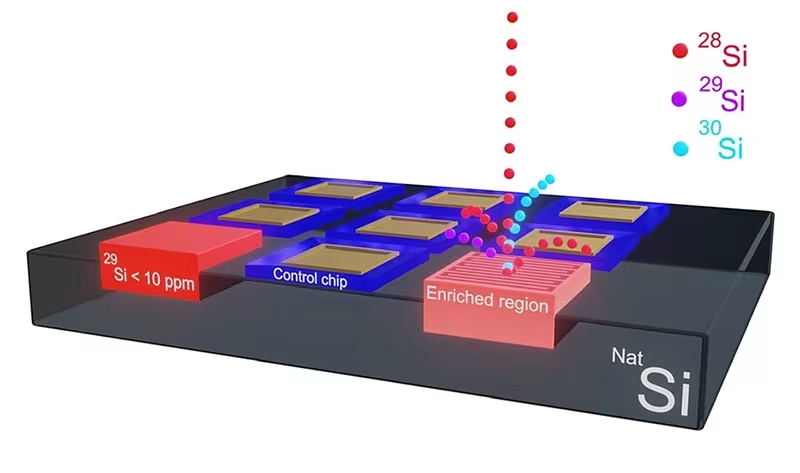
Although silicon-28 is the most abundant naturally occurring isotope of silicon, ordinary silicon still contains several percent of silicon-29.
Unlike silicon-28, silicon-29 has a nuclear spin that behaves like a tiny magnet, constantly disturbing nearby electron spins and reducing the coherence time of spin qubits.
By removing nearly every silicon-29 atom, the new material creates what researchers describe as a virtually spin-free environment, dramatically reducing one of the biggest sources of quantum noise.
Researchers have understood the benefits of isotopically purified silicon for more than a decade.
Experiments dating back to 2014 demonstrated that qubits fabricated from highly enriched silicon-28 maintained their quantum states significantly longer than those made from natural silicon.
The latest achievement builds on that foundation by producing silicon-28 at unprecedented purity and in practical quantities, bringing more reliable and scalable quantum computers a significant step closer.
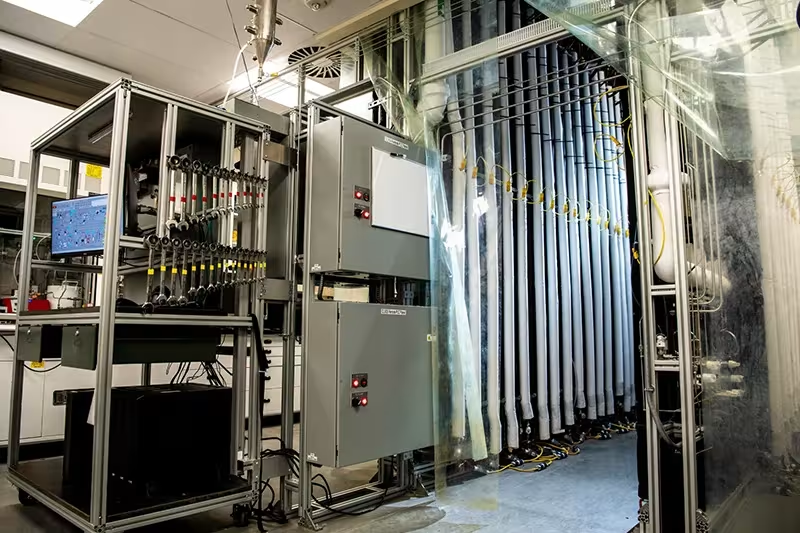
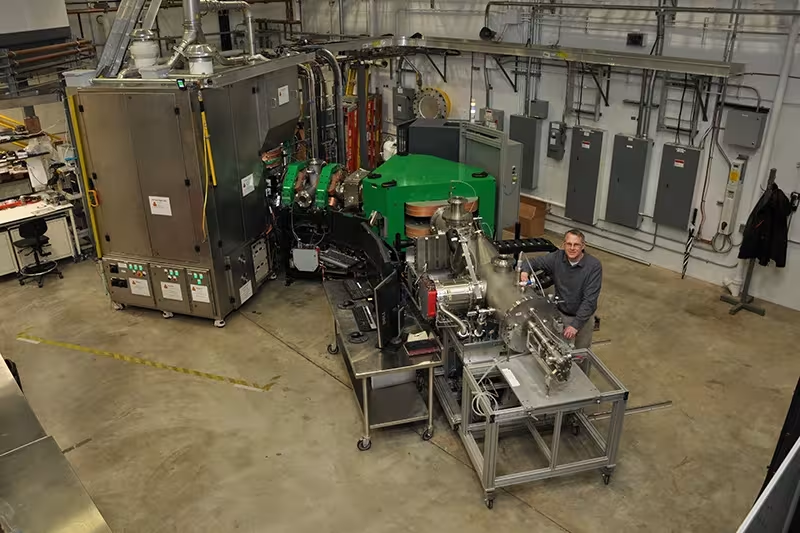
The production path begins at Oak Ridge National Laboratory, where electromagnetic isotope separation systems refined over a decade of research sort the atoms by mass with extraordinary precision.
Starting from ordinary commercial feedstocks, the machines isolate silicon-28 and the desired germanium isotopes in a single run, achieving depletion levels that older Cold War era calutrons could not match.
The enriched solids then travel to Pacific Northwest National Laboratory.
There, chemists convert them into silane and germane through carefully controlled high-purity reactions, followed by purification steps that keep chemical contaminants equally low.
Complementary thermal diffusion systems allow further enrichment of the gases themselves, minimizing any chance of isotopic dilution during handling.
Automated controls watch hundreds of process variables to keep the work both safe and pure.
The result is more than a laboratory curiosity.
It restores a domestic supply chain that the U.S. largely lost when its wartime calutrons were decommissioned in 1998.
Quantum hardware developers no longer need to rely on limited overseas sources of uncertain quality. The same facilities can also supply related isotopes such as germanium-70, germanium-76, and ytterbium-171, each useful for different quantum architectures.
Officials describe the achievement as a foundational step for the Genesis Mission, the national effort to secure leadership in quantum information science.
"This advancement has the potential to increase the operability of quantum computers and will help enable the U.S. to be the undisputed leader in the quantum technology race," said Darío Gil, DOE Under Secretary for Science. "This is our generation's space race, and with this breakthrough, we aren't just competing, we are setting the pace."
By silencing the atomic noise that once limited coherence, the new materials open the door to larger, more stable quantum processors and to the practical applications that have long been promised but never quite within reach.
It's worth noting that a month before this, in June, Chinese scientists have also achieved a major breakthrough in stable isotope enrichment, successfully producing industrial-scale silicon-28 with an isotopic purity exceeding 99.99% for the first time.
Announced on June 15, the achievement marks a significant milestone in China's efforts to advance its semiconductor industry and silicon-based quantum computing technologies.
The project was led by the Research Institute of Physical and Chemical Engineering of Nuclear Industry, a subsidiary of the China National Nuclear Corporation (CNNC) operating under the China Atomic Energy Authority.
The achievement came as China's Three-Year Action Plan for the High-Quality Development of the Nuclear Technology Application Industry (2024–2026) enters its final year, highlighting the country's progress in transforming laboratory research into an integrated industrial supply chain.
According to Chinese Academy of Sciences academician Yu Dapeng, the breakthrough removes a critical raw material bottleneck that had long constrained silicon-based quantum computing in China, addressing what he described as an "urgent shortage" of ultra-pure silicon-28 and paving the way for large-scale qubit development.
Chinese Academy of Engineering academician Lei Zengguang likewise described the milestone as the result of years of sustained research, saying its impact extends well beyond quantum computing and could benefit a wide range of advanced semiconductor and nuclear technologies.

















































































































































































































































































