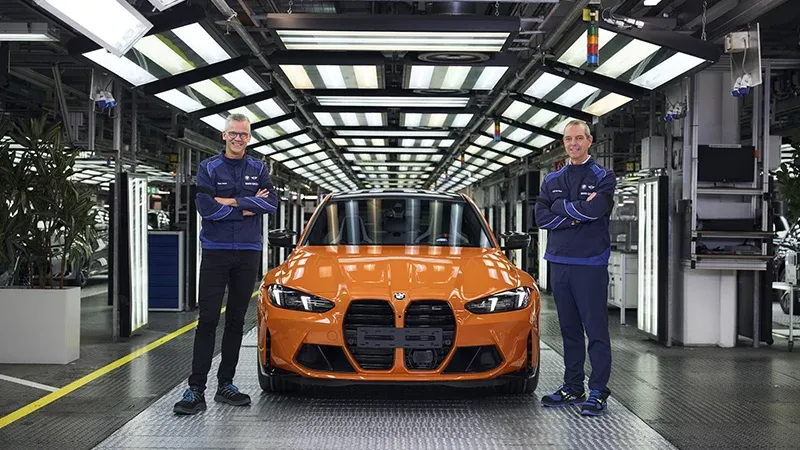
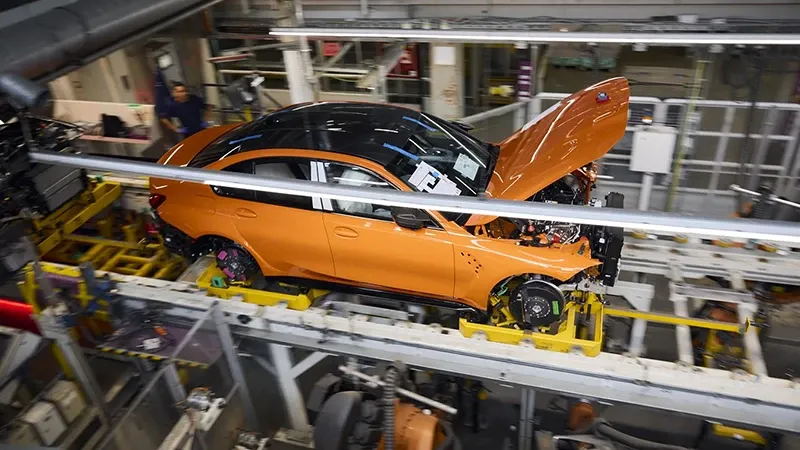
On the afternoon of September 18, a Fire Orange III BMW M3 Competition xDrive rolled off the line at BMW Group Plant Munich and became the one-millionth genuine M car.
Peter Weber, the plant's head, handed the keys to Franciscus van Meel, chief executive of BMW M, in a short factory ceremony that should have been a tidy corporate footnote.
Within hours it was not.
The clip traveled because the car is the color of a warning flare, and because the video does not end on the orange sedan.
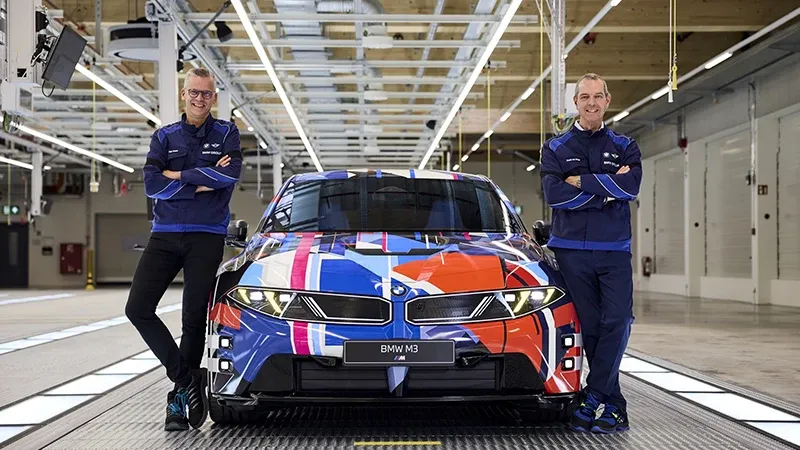
It ends on a camouflaged prototype wearing an M-colored wrap, the first all-electric M3, sitting in the same hall that has been building the name since the E30.
That is why the moment went feral online.
Enthusiasts did not share a production counter. They shared a handoff. One frame is the last loud, turbocharged chapter of the car that defined modern M. The next is the machine that is supposed to replace the feeling without the engine.
Comment sections split on sight.
One side treated Fire Orange as proof that M still understands theater. The other froze on the quad-motor mule and decided the badge had already left the building.
Renders of the ZA0 with the wrap digitally peeled off multiplied faster than official photos. Track lights, flared arches, a hood vent, the M3 script on the door: people argued about a car that has not even had its debut, because BMW put the argument in the same post as the anniversary.
The number only lands if the automotive industry remember how small this started.
BMW Motorsport GmbH was founded in 1972 to go racing, not to fill order books.
The first M3, the E30, went into production in Munich in the mid-1980s as a homologation special, a boxy sedan with a high-revving four-cylinder, wide arches, and a purpose that had almost nothing to do with commuting. Fewer than 18,000 were built through 1991. It was a race car that happened to have license plates.
Successive generations stretched that idea until it barely resembled the original: the E36 and E46 turned the M3 into the default answer for anyone who wanted a usable coupe that could still embarrass a sports car on a back road, the V8 E90/E92 era chased outright pace, and the turbocharged F80 and current G80 made the car broader, faster, and heavier, with all-wheel drive and enough torque to make the old "ultimate driving machine" line feel like a negotiation.
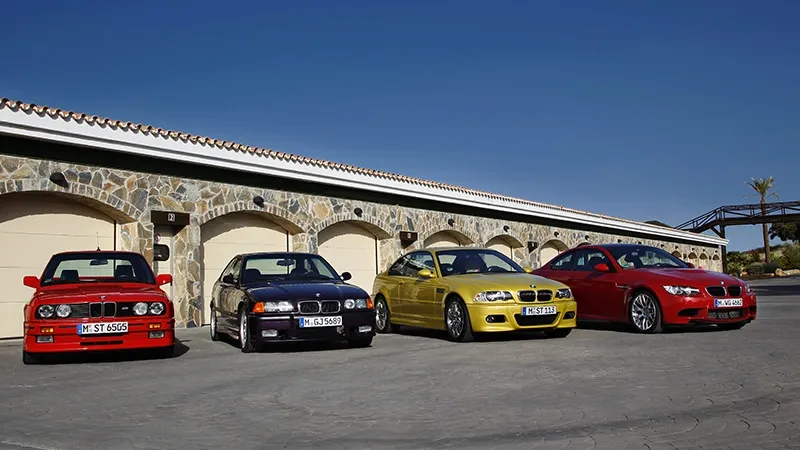
40 years after the first M3 went on sale, the millionth example is a Competition xDrive in an Individual paint.
The philosophy van Meel keeps repeating is the one that actually scaled: racetrack ability that still has to survive a Tuesday.
What changed is the factory as much as the car.
From 2027, Plant Munich builds only electric vehicles. BMW has put about €650 million into the conversion, new body shop, assembly, and logistics across roughly a third of the site, all while the line kept moving.
The electric M3 will be the first high-performance model on BMW M's Neue Klasse technology, and the second Neue Klasse car built in Munich after the i3.
An 800-volt architecture, a structural battery, and a motor at each wheel are the hardware BMW is willing to confirm. Output is not.
Van Meel has already waved off the fantasy of a 1,000-horsepower M3.
The point, the company keeps insisting, is torque control at the limit, not a number on a slide. A six-cylinder M3 is still coming, on a separate path, so Munich is not deleting the engine so much as splitting the icon in two and keeping the electric half at home.
The comparison the internet reached for, almost before the AMG and Audi arguments, was the Porsche 911.
Both cars are homologation myths that outlived the race series that created them. Both are built in the same city that invented them, Zuffenhausen for the 911, Munich for the M3. Both have spent decades getting wider, faster, and more electronic while their owners insist the soul is unchanged.
The difference is what each company is willing to do with the name.
Porsche has spent 60 years refusing to let the 911 become something else. The engine stayed in the back. The flat-six stayed in the car. When electrification finally arrived, it arrived as a hybrid assist on the GTS, a motor tucked around a combustion engine, not a replacement for it. The 911 is still allowed to be the 911. BMW is doing the opposite in public.
It is keeping a six-cylinder M3 alive and, in the same breath, putting the M3 badge on a car with no engine at all, four motors, and a battery as a stressed member of the chassis.
That is why the orange handover clip cut deeper than a Porsche milestone video ever would.
A new 911, even a hybrid one, confirms the religion. An electric M3 asks whether the religion was the engine or the way the car rotates.
Rivals have already had their version of this argument, and most of them lost the internet before they won the spec sheet.
Mercedes-AMG's four-cylinder hybrid C 63 arrived with more power than the old V8 and still got treated as a betrayal, because the sound and the character did not survive the downsizing. Audi's RS cars have stayed safer and, to many, less interesting. Porsche's Taycan proved an electric performance car can feel expensive and serious, but Porsche was careful not to call it a 911, which is the whole trick. Hyundai's Ioniq 5 N proved an EV can feel playful, with fake shifts and a sense of humor AMG's sedan never found. Tesla made the straight-line war irrelevant years ago. BMW is walking into that field with the one name, besides the 911, that still carries amateur-racer mythology, and with a prototype that already likes to hang its tail out on test footage.
If the electric M3 only wins on a data sheet, it will join the C 63 in the museum of cars the internet refused. If the four motors can fake, or improve on, the adjustability people still associate with an E46, it does something the 911 has never had to do: reset what the badge means without keeping the engine that made the badge.
That is the redefinition hiding inside a paint job.
For half a century the performance industry treated the engine as the identity and the factory as background. Porsche still does.
Here, the oldest plant in the company is the announcement. A site that built the first M3 will, from 2027, build only electric cars, including the first full M car without a combustion engine, while the orange G80 that marked one million sits in the handover photos as the last combustion souvenir of that particular line.
The virality is not really about a round number. It is about the two cars being forced into the same frame, and about a comment section that still has not decided which one gets to keep the badge, the way Porsche never had to ask.
Further reading: How A Viral Nürburgring Crash Video Reignited The Decades-Old Porsche-BMW Rivalry






















































































































































































































































































