The Indonesian Navy has firmly rejected an appeal from former Marine Second Sergeant Satria Arta Kumbara, who requested repatriation and the restoration of his Indonesian citizenship after reportedly joining Russian volunteer forces fighting in Ukraine.
According to Navy spokesman Commodore I Made Wira Hadi, Satria was dishonorably discharged in April 2023 after being convicted in absentia by Jakarta Military Court II-08 for desertion during peacetime. The court sentenced him to one year in prison, and the discharge became official on April 17, 2023, when the ruling gained permanent legal force.
“Second Sergeant Satria Arta Kumbara, NRP 111026, was a former member of the Marine Corps Inspectorate (Itkormar). He has been considered a deserter since June 13, 2022, and remains so to this day,” Wira Hadi said on Friday, May 9, 2025.
He reiterated on Monday, July 21, 2025, “Satria is no longer affiliated with the Indonesian Navy.”
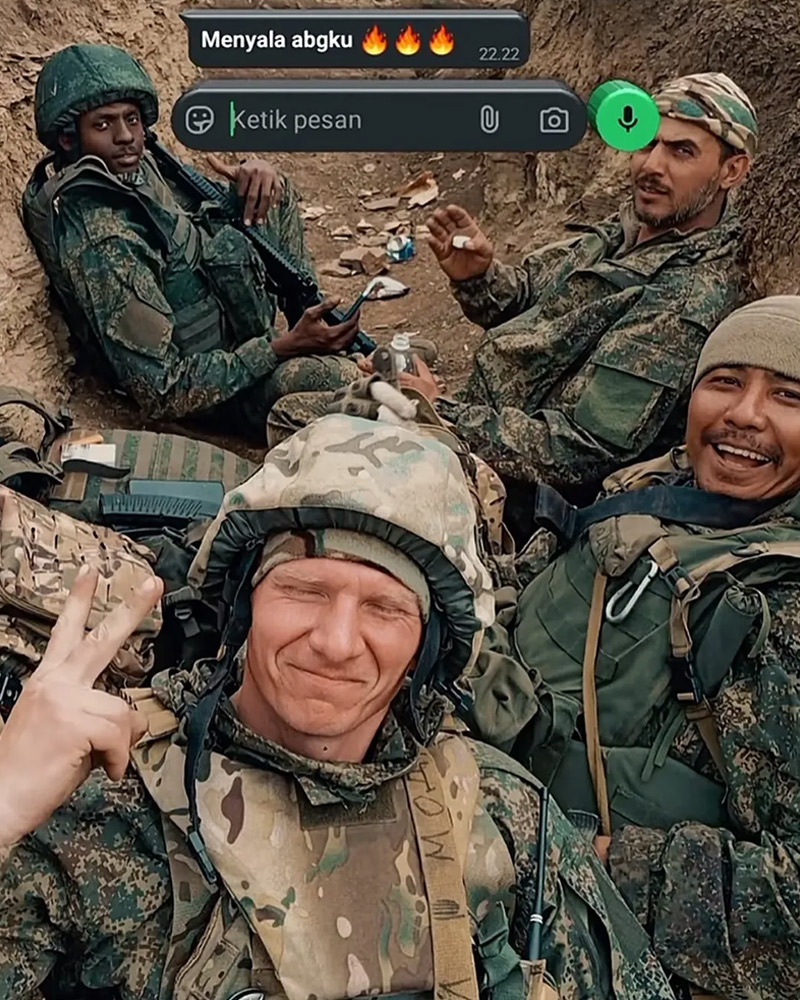
Satria first went AWOL in mid-2022, but his case reemerged in May 2025 when videos of him in full Russian military uniform began circulating on Indonesian social media. The viral footage sparked intense public debate, prompting the Navy to confirm his identity.
In a video uploaded on July 22, 2025, via the TikTok account @zstorm689, Satria appeared in Russian combat gear and made a heartfelt appeal to President Prabowo Subianto, Vice President Gibran Rakabuming Raka, and Foreign Minister Sugiono. He pleaded for help returning to Indonesia and reclaiming his citizenship, insisting he was unaware that signing a contract with the Russian Ministry of Defense would lead to losing his Indonesian nationality.
“I never wanted to lose my citizenship because it means everything to me,” Satria said. “Only President Prabowo can end my contract now. I did not know my actions would cause me to lose my rights as an Indonesian.”
Responding to the plea, Foreign Ministry spokesperson Rolliansyah “Roy” Soemirat confirmed that the Indonesian Embassy in Moscow is monitoring Satria’s situation and maintains communication with him. However, he emphasized that matters of citizenship fall under the authority of the Ministry of Law and Human Rights.
That ministry, led by Supratman Andi Agtas, confirmed as early as May 2025 that Satria had lost his Indonesian citizenship due to his unauthorized enlistment in a foreign military—a clear violation of Law No. 12 of 2006 on Indonesian Citizenship.
Brigadier General Frega Wenas Inkiriwang, Head of the Defense Ministry’s Information Bureau, warned the public against joining foreign militaries as contract soldiers, noting the serious legal consequences. “Satria’s case is a stark example—his decision led to the revocation of his citizenship and rights,” Frega said. He urged citizens to exercise caution and avoid offers to serve as soldiers for foreign powers.
First Admiral Tunggul, Chief of the Naval Information Office, echoed that stance, stating that the military court ruling on April 6, 2023, had irrevocably proven Satria’s desertion. The resulting prison sentence and dishonorable discharge, he said, “permanently severed his ties with the Navy.”
Satria, who once served with the Marine Corps’ First Infantry Brigade in Cilandak, South Jakarta, now finds himself in legal and diplomatic limbo—facing the consequences of his actions alone.
Under Article 47 of Additional Protocol I to the Geneva Conventions, individuals who join foreign armed forces without formal enlistment are typically considered mercenaries and are denied combatant and prisoner-of-war protections. The UN Mercenary Convention goes even further by criminalizing mercenary recruitment, use, and financing, especially if such activities undermine state sovereignty.
If one joins a foreign army through official procedures and becomes a recognized member of that military, they may receive lawful combatant status. However, simply donning another country’s uniform—especially without authorization—can result in being classified as a mercenary under international law, carrying significant legal and diplomatic risk.
In Indonesia, the consequences are equally serious. Citizens who enlist in a foreign military without presidential approval can automatically lose their nationality. And that is precisely what Satria failed to consider.
Satria maintains that he is not a mercenary and insists he is a regular soldier in the Russian Army—not affiliated with groups like the Wagner Group, Russia’s notorious paramilitary outfit once led by Yevgeny Prigozhin, who died in a 2023 plane crash. Wagner had a reputation for recruiting highly paid, battle-hardened veterans from around the world.
“I’m not part of Wagner. I joined as a regular army soldier under official contract,” Satria claimed, seeking to distance himself from the mercenary label.
Reports suggest that certain Russian contract soldiers can earn up to $40,000—or around Rp 600 million—per month, although The Moscow Times clarified that such rates apply only to specific, high-risk roles.
Satria’s case has raised concerns not only about national security and loyalty but also about diplomatic transparency. Indonesia’s Ministry of Foreign Affairs noted that it had no official record of Satria's departure to Russia, deepening the mystery surrounding his enlistment.
As a Marine Second Sergeant, Satria held a relatively junior non-commissioned officer rank—just above enlisted level. Still, he was a trained serviceman entrusted with responsibilities within Indonesia’s defense structure. His desertion and decision to fight abroad have thus sparked strong moral and legal reactions.
His story also highlights how the global nature of modern conflict can lure individuals into foreign wars with promises of financial gain—bringing with it profound implications for national identity, legal status, and international relations.
Although Satria claims to have joined legally and out of necessity, his actions continue to provoke public debate across moral, legal, and diplomatic lines.
Ultimately, this case serves as a sobering reminder that the consequences of war are not limited to the battlefield. They reverberate into courtrooms, cabinet meetings, and the hearts of nations. And in today’s interconnected world, Satria’s fate might have remained obscure—had his videos not gone viral.
Deputy Chairman of Commission I of the Indonesian House of Representatives (DPR RI), Dave Laksono, emphasized that this issue must not be approached emotionally or hastily. Instead, the state must uphold the principles of law and the integrity of citizenship when addressing Satria’s plea.
“As the Deputy Chairman of Commission I, I believe this issue must be handled with care, grounded in legal principles, nationalism, and a strong commitment to the integrity of Indonesian citizenship,” Dave said in a statement on Tuesday, July 22, 2025.
Dave pointed to Law No. 12 of 2006 on Citizenship, which clearly states that any Indonesian citizen who joins a foreign military without presidential approval may lose their Indonesian citizenship.
“Therefore, it’s essential to first verify administratively whether Satria has legally lost or renounced his citizenship in accordance with the law,” he explained.
The Golkar Party politician also stressed the importance of verifying Satria’s loyalty to Indonesia, especially considering his military background. “Since he comes from a military background, loyalty is a key factor in this verification process,” Dave said.
He added that Commission I supports inter-agency coordination—including the Ministry of Law and Human Rights, Ministry of Foreign Affairs, and the Indonesian Armed Forces Headquarters (Mabes TNI)—to determine the appropriate legal and administrative actions.
“Caution must be exercised so that any decisions made do not undermine the public’s sense of justice or the nation’s sovereignty,” Dave concluded.






















































































































































































































































































