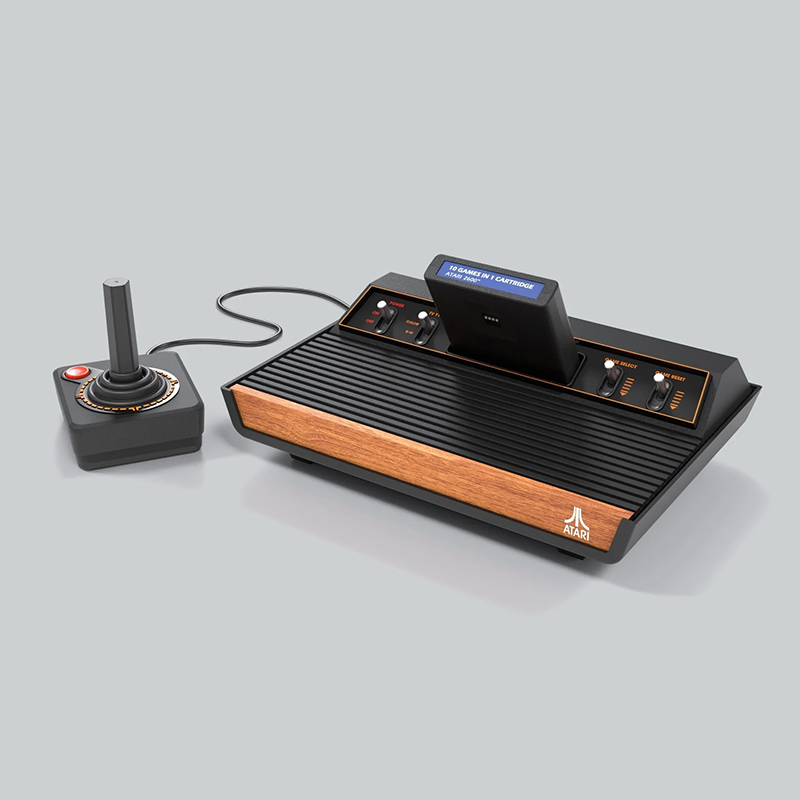
Old, not obsolete. That is probably the best to describe an Atari 2600 device.
Large language models are powerful, smart and extremely capable. It can write essays, speak fluently in different languages, debate politics like politicians, talk like a comedian, understand the cosmos far better than Ph.Ds, and lots more. But despite all its advances, an Atari 2600 is still smarter.
At least in chess.
With only a miniscule 128 bytes of RAM, the Atari 2600 was pitted against the cutting-edge LLM powered by trillions of parameters and the world's internet, supported by many thousands of graphics cards and billions of dollars of Microsoft money. And yet, ChatGPT lost.
In a post on LinkedIn, Citrix software engineer Robert Jr. Caruso explained how the OpenAI chatbot "got absolutely wrecked" by an Atari 2600 running Atari Chess, a game for the system released in 1979.
The Atari 2600, also marketed at the time as the Atari Video Computer System, was originally launched in September 1977 as the Atari VCS (Video Computer System).
It was one of the first widely successful home video game consoles. It helped bring arcade-style gaming into living rooms, back when the idea of playing video games on a TV screen felt futuristic and magical.
In 1982, when it was rebranded as the Atari 2600, named after its model number (CX2600).
With inly an 8-bit MOS 6507 at 1.19 MHz, a graphic resolution of just 160 × 192 resolution in very limited color and sprite capability, 2-channel mono sound, Atari 2600 is now a relic of the past.
But when it went against ChatGPT in a game of chess, the old school tech still managed to not only keep up, but obliterated the AI, fair and square.
"ChatGPT got absolutely wrecked on the beginner level," Caruso wrote.
"This was after a conversation we had regarding the history of AI in Chess which led to it volunteering to play Atari Chess. It wanted to find out how quickly it could beat a game that only thinks 1-2 moves ahead."
In all began by setting up the game between the two.
Caruso gave ChatGPT a "baseline board" to learn the game and identify pieces. But during the game, the AI kept mixing up rooks and bishops, misread moves, and "repeatedly lost track" of where its pieces were.
To make matters worse, as Caruso explained, ChatGPT also blamed Atari's icons for being "too abstract to recognize" — but when he switched the game over to standard notation, it didn't perform any better.
For an hour-and-a-half, ChatGPT "made enough blunders to get laughed out of a 3rd grade chess club" while insisting over and over again that it would win "if we just started over," Caruso noted. (
"Meanwhile, Atari’s humble 8-bit engine just did its thing," the engineer noted. "No language model. No flash. Just brute-force board evaluation and 1977 stubbornness."
Then, Caruso tried using Microsoft Copilot.
"I had a pre-game chat with Copilot, asking if it could even play chess — and whether it thought it could overcome the same technical pitfalls that tripped up ChatGPT against the Atari 2600 Video Chess game (running on the Stella emulator). If the answer was no to either, I wasn’t going to waste my time," said Cariso in another LinkedIn post.
And much like ChatGPT,
Much like ChatGPT, it was loaded with confidence, claiming that it could think 10–15 moves ahead, but said that it would stick to just 3–5 moves against the 2600 because it makes "suboptimal moves” that it “could capitalize on… rather than obsess over deep calculations."
Caruso then warned Copilot, explaining that the big reason why ChatGPT lost was because it couldn't keep track of the board. Copilot responded that it wouldn't make such mistake.
"I make a strong effort to remember previous moves and maintain continuity in gameplay, so our match should be much smoother," the chatbot from Microsoft said.
Then came the match, and the result was pretty much the same as ChatGPT.
By the seventh turn, Copilot had lost two pawns, a knight, and a bishop, and only got one single pawn in return.
As Caruso puts it, it was a "ChatGPT déjà vu."
Caruso then tried using Gemini, and just like ChatGPT, the AI from Google also took the challenge with confidence.
However, unlike Copilot, the Gemini chatbot straight up refused to have a match against the Atari, after hearing how the decades-old tech easily crushed other LLMs.
It even came up with a bogus excuse to save face.
The AI claimed that it "hallucinated" its chess boasts, and admitted that it would "struggle immensely" against the Atari chess engine. That's when it evasively proffered that calling off the match.
"Canceling the match is likely the most time-efficient and sensible decision," Gemini said, according to Caruso.
Gemini even linked articles about the Atari's victory over its OpenAI brethren to prove its point.
Caruso was impressed by Gemini’s ability to recognize its limitations, and how it considered not to play knowing that it would lost.
"Adding these reality checks isn't just about avoiding amusing chess blunders. It's about making AI more reliable, trustworthy, and safe — especially in critical places where mistakes can have real consequences," Caruso said in an interview.
"It's about ensuring AI stays a powerful tool, not an unchecked oracle."






















































































































































































































































































