AI is becoming smarter and smarter, but this where humanity is facing a crossroad.
It is time for computers to be considered sentient? Or are they still bits and bytes that have no sense feelings or perceptions?
Since OpenAI introduced ChatGPT, and after Large-Language Models have become a technology many developers are actively developing, a lot of people start to think that generative AI tools are actually more than what they actually are.
In a survey by a pair of researchers from UK's University of Waterloo, they found that a startling proportion of ChatGPT's most active users have alarming misconceptions about the chatbot.
Here, it's realized that a lot of people actually think that ChatGPT is conscious.
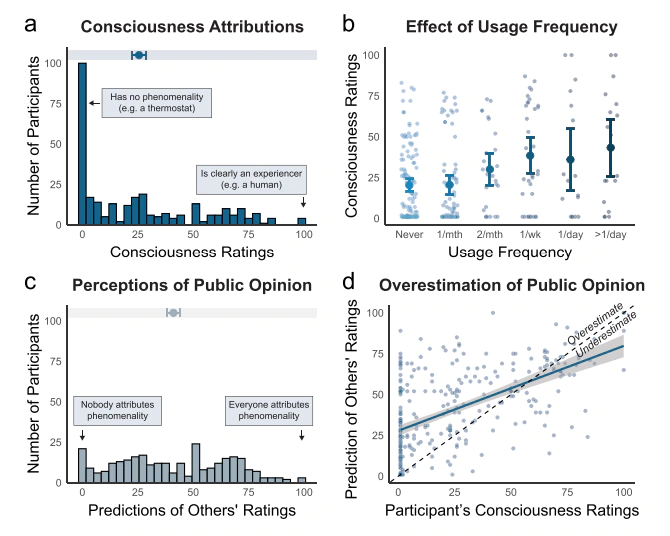
According to a press release, where first study author Clara Combatto is a professor of psychology, over two-thirds of participants (67%) surveyed seem to believe that ChatGPT is conscious, meaning that it should have some sort of feelings and memories, just for good measure.
The remaining 33% attributed AI to have no conscious experience whatsoever.
To come to this conclusion, the British researchers recruited 300 people in the U.S. online, and asked them a series of questions about whether they thought LLMs have the capacity for consciousness or other subjective human states, such as emotion, planning, and reasoning.
Alongside those questions, participants are also asked on how often they used ChatGPT.
Participants were also asked to rate responses on a scale of 1 to 100, where 100 would mean absolute confidence that ChatGPT was experiencing consciousness, and 1 absolute confidence it was not. The more frequently people used tools like ChatGPT, the more likely they were to attribute some consciousness to it.
Published in the journal Neuroscience of Consciousness, the paper, which is co-authored by University College London cognitive neuroscientist Stephen Fleming, suggests not only that a majority of users think the popular large language model (LLM) is conscious, but that the more people use it, the more likely they develop that feeling.
Combatto concluded that people who frequently use the chatbot seemed to have developed a theory of mind, or a conception of AI as a thinking and feeling entity, spontaneously throughout their time engaging with it.
"These results demonstrate the power of language," Combatto said, "because a conversation alone can lead us to think that an agent that looks and works very differently from us can have a mind."
The findings show a lot on how people's mind and perception change as AIs become smarter.
Advances in AI has been so great, that it makes it difficult for people to distinguish between uniquely human behaviors and those that can be replicated by machines.
Should Artificial General Intelligence (AGI) arrive in full force—AI that surpasses human intelligence—the boundary between human and computer capabilities shall diminish entirely.
Read: AI-Powered 'Sentient' Chatbots Are The 'Most Powerful Technology Since The Atomic Bomb'
At this time, AI experts and those in the technology and science industry still think that AI is just an AI, and that they overwhelmingly reject the idea that even the most powerful AI models are conscious or self-aware in the same way that humans and other animals are.
While the models do improve as time passes, and have become increasingly impressive that even even began showing signs that may resemble consciousness, researchers are still against that idea.
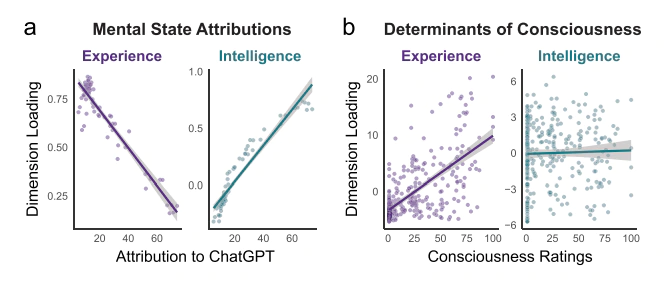
The researchers said the experimental design revealed that non-experts don't understand the concept of phenomenal consciousness, as a neuroscientist or psychologist would.
So here, the key finding is that, most people believe LLMs show signs of consciousness, and this is proving that "folk intuitions" about AI consciousness can diverge from expert intuitions, researchers said in the paper.
They added that the discrepancy might have "significant implications" for the ethical, legal, and moral status of AI.
The findings also highlights the urgent needs for future AI safety measures.

"While most experts deny that current AI could be conscious," Combatto said in a press release, "our research shows that for most of the general public, AI consciousness is already a reality."
"Alongside emotions, consciousness is related to intellectual abilities that are essential for moral responsibility: the capacity to formulate plans, act intentionally, and have self-control are tenets of our ethical and legal systems," Combatto explained.
"These public attitudes should thus be a key consideration in designing and regulating AI for safe use, alongside expert consensus."
It's worth noting that despite the findings show that more than half of LLM-powered chatbot users think that the technology they're interacting with is conscious, more research is needed to really determine how widespread this belief may be.
But regardless, it's certain that an increasing number of people start to think that LLMs have become sentient.
Before this research, another research claims that GPT-4, the LLM that powers ChatGPT, has passed the Turing test, which is a test that judges whether an AI is indistinguishable from a human according to other humans who interact with it.














































































































































































































































































