In less than a decade, the computing power of GPUs has grown 20 times - representing a growth of 1.7x per year, far outstripping Moore’s law.
Just when most think we have the fastest and the most powerful computer, Nvidia has unveiled several updates to its deep-learning computing platform, including an increasingly powerful GPU and supercomputer.
In a 2018 GPU Technology Conference in San Jose, Nvidia CEO Jensen Huang unveiled the DGX-2, a supercomputer for researchers who are "pushing the outer limits of deep-learning research and computing" to train Artificial Intelligence (AI).
The computer is the world's first with 2 petaflops of performance.
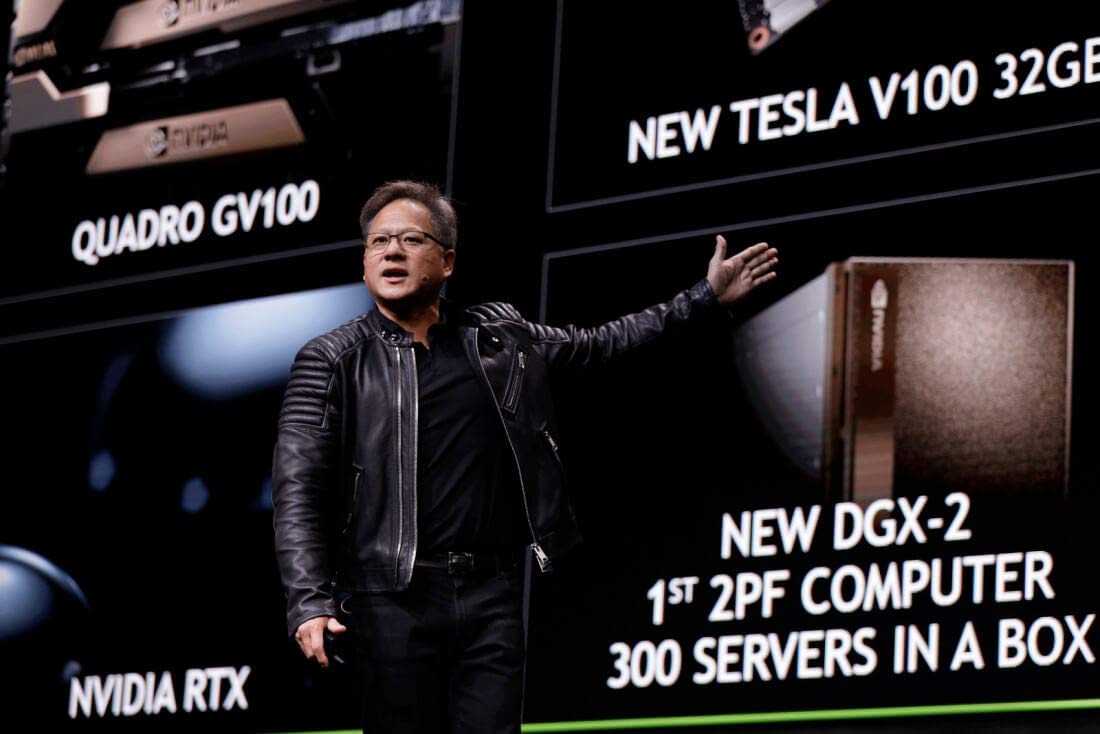
To make this possible, the DGX-2 uses revamped V100 GPUs which doubled the previous capacity, making them sport 32GB of memory. The server is powered by 16 of those Dual Xeon Platinum cards, all packed together by the company's NVSwitch technology.
In total, it has a total of 81,920 CUDA Cores with 512GB HBM2 memory and a 14.4TB/s aggregate bandwidth and 300GB/s GPU to GPU.
With the processing power of 300 servers, the DGX-2 which weighs about 350 pounds, occupies 15 racks of datacenter space, while being 60 times smaller and 18 times more power efficient.
In comparison, highend computers have about one thousand teraflops. What this means the DGX-2 is more than two thousand times more powerful. It's also more powerful than the DGX-1, and about 20 times more powerful than previous most powerful supercomputers.

This supercomputer is dedicated for AI research and deep learning. With more powerful computers, researchers should be able to train smarter AIs more quickly than ever before.
What this means, researchers and developers can create smarter AIs, improving fields like speech recognition, face recognition, computation, translation and much more. As the company stated, this technology allows AI to create natural-sounding speech and text, and that researchers will need less time to train such networks.
For example, what took six days to train an AI with two GTX 580s, could be done in under 18 minutes using one DGX-2.
"Deep neural networks are getting deeper and smarter and able to do more things," Huang said. "As they grow in size and complexity, so do the computing needs to train them."
Previously, Nvidia announced that it's bringing its open source Deep Learning Architecture (NVDLA) to ARM's Project Trillium platform, which focuses on mobile AI. Nvidia relies on ARM designs for its Jetson and Tegra systems, and the announcement allows both Nvidia and ARM to work together to improve the capabilities on upcoming chip platforms.