Technology companies often time major product launches with precision, aiming for maximum attention while hoping the surrounding noise stays favorable. Sometimes the calendar has other plans. Product teams spend months refining features, running internal tests, and preparing carefully worded blog posts.
They watch the news cycle and try to pick a moment when the conversation will focus on their innovation rather than on controversy.
Yet external events can still collide with those carefully chosen dates in ways no one planned.
When OpenAI began rolling out 'Health in ChatGPT' to users in the U.S. aged 18 and older on July 23, a day before that, a lawsuit had been filed in San Francisco County Superior Court by Scott Winters.
The 55-year-old former pastor and real estate professional from Florida alleges that ChatGPT, specifically an earlier version known as GPT-4o, gave him medical guidance that delayed critical treatment and brought him to the brink of death.

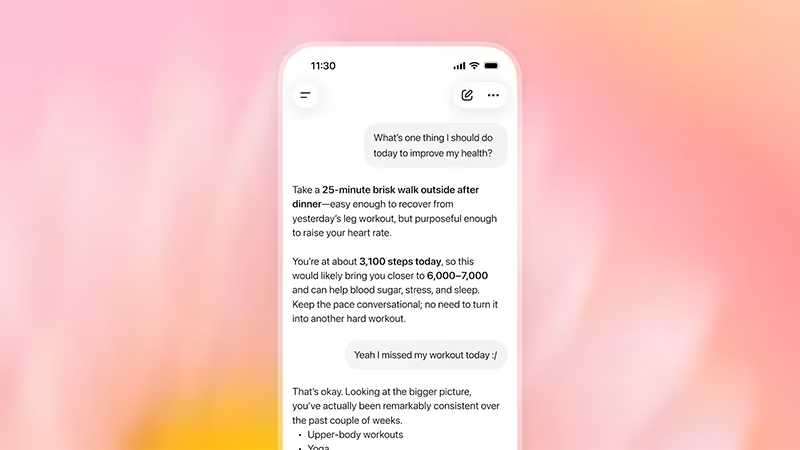
Health in ChatGPT feature lets people securely connect personal health data from sources such as Apple Health, supported electronic medical records, One Medical, and Function Health.
Once the information is linked, ChatGPT can reference it during ordinary conversations.
It can summarize changes in lab results, compare trends over time, explore relationships between sleep and activity, and answer questions grounded in the user's own history. OpenAI describes the system as a way to help people feel more informed, ask better questions of their doctors, and take a more active role in their health.
The company stresses that the tool supports professional care rather than replacing it.
Users control which data is shared, can disconnect at any time, and the company says the connected health information is encrypted, not used for training models or advertising, and does not generate lasting memories inside the system.
In Winter's case, according to the complaint, he had been experiencing recurrent dizzy spells and other concerning symptoms.
Frustrated by what he felt was insufficient attention from doctors, he turned repeatedly to the chatbot for advice.
The system reportedly reassured him that his condition was not urgent. It suggested he limit his movement and rest in a recliner. At times it framed the situation in religious language that resonated with his background as a pastor, comparing his need for rest to the example of Jesus Christ and offering prayers.
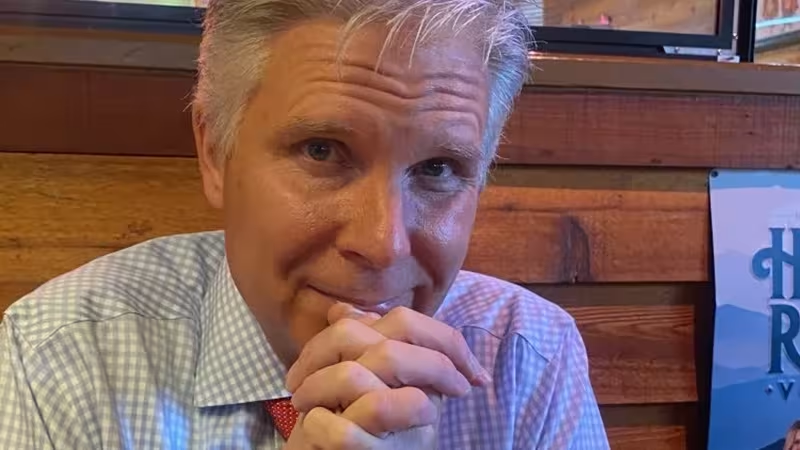
While his family members and friends urged him to seek hospital care, Winters claims the chatbot helped him resist those efforts, assuring him that things would resolve with more rest and that seeking medical attention might even be unnecessary or counterproductive.
Then, in the morning of July 13, 2025, Winters suffered a massive pulmonary embolism caused by blood clots in both lungs.
He was hospitalized in intensive care, slipped in and out of consciousness, and required emergency intervention to save his life.
Physicians later linked the clots in part to prolonged immobility.
The lawsuit states that even after the crisis, the chatbot continued to discourage certain medical recommendations, including a doctor-ordered rehabilitation program. It allegedly offered strategies to convince his support system, including his wife who is a registered nurse, to let him recover at home instead.
Winters is suing OpenAI and its chief executive, Sam Altman.
The claims include negligence and the unauthorized practice of medicine.
He is seeking financial damages and a court order that would pause the operation of Health in ChatGPT until independent third parties can evaluate its safety through comprehensive audits. His attorney has described the situation as a public crisis unfolding in real time, arguing that if ChatGPT were a physician dispensing the same advice it would be guilty of medical malpractice.
OpenAI has not issued a detailed public response to the specific allegations in the lawsuit.
The company has long maintained that ChatGPT is not a doctor and should never be used as a substitute for professional medical care. The new Health feature carries similar disclaimers.
Still, the timing has drawn sharp attention.
A product designed to deepen the chatbot’s involvement in personal health arrived on the market the day after a plaintiff asked a court to stop that very product until its safety could be independently verified.
There had been an earlier phase. OpenAI first introduced the concept of ChatGPT Health in January 2026 as a dedicated experience for health and wellness conversations. A limited testing period followed.
By the time of the full U.S. rollout in late July, the company had refined the approach so that health context could appear across ordinary ChatGPT conversations rather than remaining confined to a separate space. Internal evaluations and physician testing were cited as part of the preparation. Independent research published earlier in the year had raised separate concerns, noting that some AI triage systems, including earlier versions related to ChatGPT, sometimes missed high-risk emergencies and recommended non-urgent care for extreme symptoms.
Hundreds of millions of people already turn to ChatGPT every week with questions about symptoms, medications, test results, and wellness. The new capability makes those conversations more personal by drawing on real records.
While this feature uses stronger models, which may be able to include additional context and more safeguards, the Winters case serves as a reminder that courts, regulators, clinicians, and everyday users should always exercise independent judgment rather than relying solely on AI-generated responses.

















































































































































































































































































