The world of digital assets has always moved faster than the assumptions that keep it secure.
What once felt permanent, the quiet trust placed in familiar cryptographic tools, now sits under a longer shadow as computing power itself begins to change shape in fundamental ways.
Quantum computers operate on principles far removed from the classical machines that built the internet and the early blockchain era. Instead of processing bits that are strictly zero or one, they use qubits capable of existing in superpositions of states and becoming entangled with one another.
This allows certain mathematical problems to be solved dramatically faster.
And this can become a problem for the cryptographic algorithms that secure cryptocurrencies.
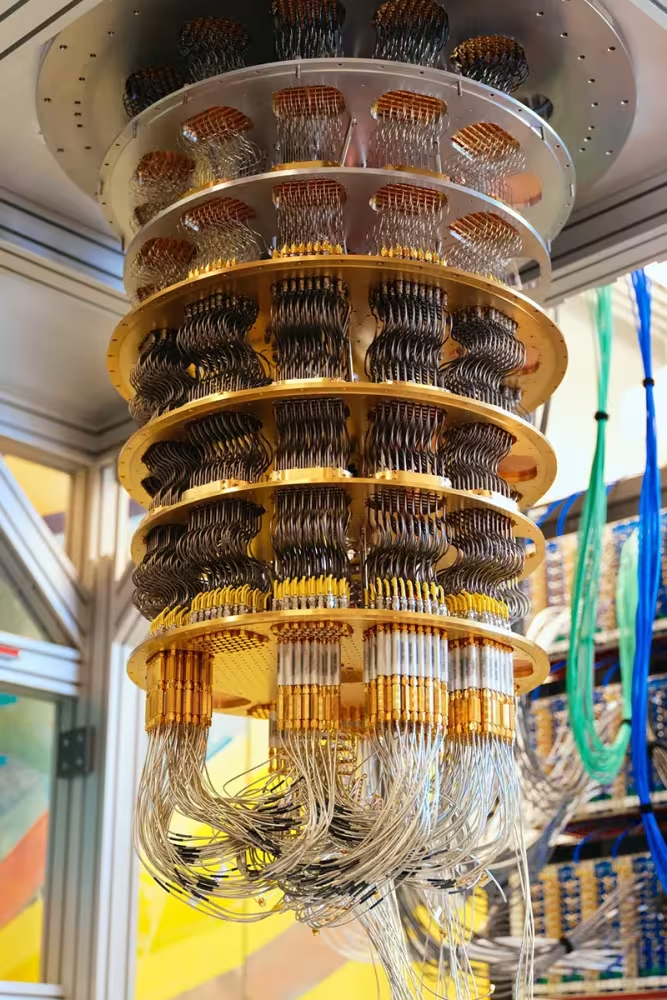
One of the most relevant algorithms in question is Shor, which can efficiently solve the discrete logarithm problem that underpins elliptic curve cryptography.
Ethereum and most EVM chains rely on ECDSA signatures built on that math.
Once a public key appears on chain through an ordinary transaction, a sufficiently powerful quantum machine could, in theory, recover the corresponding private key.
Estimates for when such machines might arrive vary widely, with some recent analyses pointing toward the late 2020s or early 2030s and research steadily lowering the resource requirements needed for an attack.
Hash-based schemes remain far more resistant, which is why post-quantum cryptography has become an active area of standards work and research.
The practical risk is often described as "harvest now, decrypt later": adversaries can record exposed public keys and signatures today and wait for the hardware to catch up. Protocol-level upgrades on a live network take years of coordination, testing, and consensus.
Ethereum has published roadmaps that include account abstraction paths and gradual migration strategies precisely because existing externally owned accounts cannot simply be rewritten overnight. In the meantime, individual users face a gap.
Funds secured by keys whose public counterparts have already been revealed remain theoretically exposed until they are moved to a new account structure that does not rely on vulnerable cryptography.
That gap is the reason a device like the PQ1 exists.
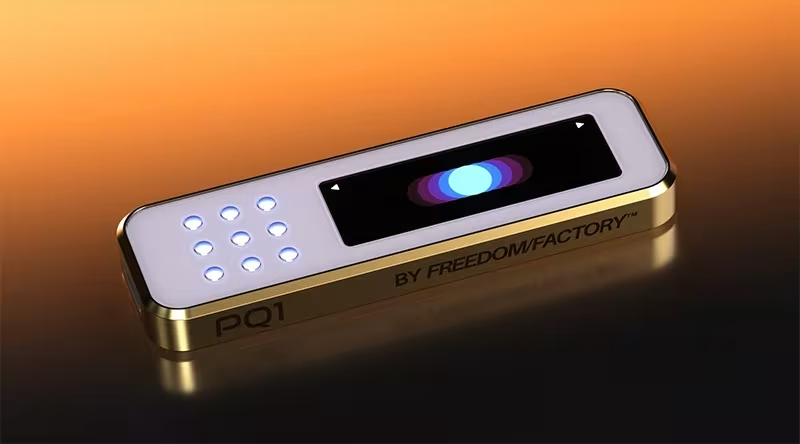
In a press release, Freedom Factory said the device is designed so that people can begin signing with quantum-resistant methods today, using tools that already work on the current Ethereum stack rather than waiting for a full network hard fork.
The PQ1 is a compact, air-gapped hardware wallet built around post-quantum signatures for Ethereum and other EVM-compatible chains. It generates and verifies transactions with SPHINCS+C10, a compressed parameter set of the hash-based SPHINCS+ scheme that NIST standardized as SLH-DSA.
Security relies on the strength of SHA-256 rather than elliptic curves, so it is not vulnerable to Shor's algorithm in the same way.
Signatures are delivered through ERC-4337 smart accounts, which means the verification logic lives at the account level and no base-layer protocol change is required.
The seed is XOR-split across two independent EAL6+ secure elements sourced from different vendors, reducing the chance that a single chip compromise yields usable key material.
Firmware and hardware schematics are fully open source with reproducible builds, and the device displays a short bootloader hash on startup so users can verify what is running. Local clear signing aims to replace blind hex dumps with human-readable summaries of what a transaction will actually do, covering a wide range of tokens and DeFi interactions across multiple L2s.
Community discussion has noted both the ambition and the remaining work.
Some observers point out that already-exposed ECDSA keys still need funds migrated into the new smart accounts before they gain protection, and that external audits of the contracts were still in progress at launch.
Others have highlighted the open hardware approach, including published schematics and even a DIY build path, as a meaningful departure from closed consumer devices.
The company positions the PQ1 as more than a firmware update solution: it is intended to secure the assets themselves rather than only the device update channel.
Here are the core specifications:
- Cryptography: SPHINCS+C10 (hash-based, NIST SLH-DSA related), no ECDSA fallback.
- Key storage: Dual independent EAL6+ secure elements with XOR-split seed.
- Connectivity: Fully air-gapped by default, USB-C used only for signing.
- Account model: ERC-4337 smart accounts.
- Openness: Full open-source firmware, hardware schematics, and reproducible builds.
- Additional features: On-device clear transaction decoding, planned paymaster and vault tools.
- Size: Approximately 0.8 cm × 2.35 cm × 7.6 cm.
- Other: Water-resistant (not submersible), multi-chain EVM support.
Freedom Factory, the team behind earlier projects such as ethOS and the dGEN1, lists support from Balaji Srinivasan and Vitalik Buterin among its backers.
Pre-orders are open on the company site, with devices expected to begin reaching users later this year.
Whether the PQ1 becomes a widely adopted migration tool or simply an early signal of the direction hardware must travel, it makes the conversation concrete.
The underlying cryptographic assumptions that have carried crypto this far are no longer treated as permanent. The device represents one practical response to that reality, giving holders a way to migrate before the broader Ethereum ecosystem completes its own transition.

















































































































































































































































































