Saudi Arabia, officially the Kingdom of Saudi Arabia, is a country in Western Asia that mostly consists of arid desert, lowland, steppe, and mountains.
But it compensates what it lacks using its abundance of natural resources.
Since petroleum was discovered in 1938 and followed up by several other finds in the Eastern Province, Saudi Arabia has since become the world's second-largest oil producer, and the world's largest oil exporter. It also controls the world's second-largest oil reserves and the fourth-largest gas reserves.
And Aramco, which is Saudi Arabian's public petroleum and natural gas company, has since become one of the most valuable companies in the world worth trillions of dollars in market capitalization. Aramco has become the main source of revenue for the state.
But not for much longer, in terms of sustainability for the longer future. As the world starts to realize the benefits of renewables and among other reasons, the government is brainstorming on things for the benefit of the kingdom.
In the many ways it's venturing and planning, include the development of 'Mukaab.'
A gateway to another world: #TheMukaab will be the world’s first immersive, experiential destination. Large enough to hold 20 Empire State Buildings, the global icon will feature innovative technologies to transport you to new worlds.#NewMurabbahttps://t.co/5R4DqQdPyS pic.twitter.com/vr9M8cTI1I
— Public Investment Fund (@PIF_en) February 16, 2023
The government promises a futuristic city the world has never seen before, but apparently, many Muslims around the world is not liking that idea.
First announced by Saudi Arabia's Public Investment Fund (PIF), Makaab is targeted to be something that can significantly transform Saudi Arabia's capital, Riyadh.
The Saudi Arabian government announced plans for a massive new proposed structure in the capital, where a gigantic building is set to transform the city's downtown into everything that is fascinating to its citizens.
The Mukaab, as the government is calling it, is meant to be the centerpiece of the downtown, in a region of the city called New Murabba.
It is meant to be built around the concept of sustainability by featuring green areas and walking and cycling paths that will enhance the quality of life by promoting healthy lifestyles and community activities.
The development is planned at the intersection of King Salman and King Khalid roads.
According to the Saudi Arabian government, Mukaab is hollow, and that its volume can contain 20 Empire State Building of New York, thanks to its humongous 400 meters width, 400 meters length, and 400 meters height.
The cubic-shaped structure is inspired by "Najdi architectural style", in reference to Najd, the central Arabian ancestral homeland of the ruling Al-Saud dynasty, and is meant to be one of the largest buildings in the world.
Inside will house a museum, a technology and design university, a multipurpose theater and more than 80 entertainment and cultural venues.

It's also designed to incorporate a holographic technology to offer “a new reality” to consumers as they shop and dine.
Around it, facing outwards, is the living space.
In all, the Mukaab, which occupies a total area of 19 square kilometers, is designed to have a floor area of more than 25 million square kilometers. This is capable to create spaces for 104,000 residential units, 9,000 hotel rooms, 980,000 square meters of retail space, 1.4 million square meters of office space, 620,000 square meters of leisure assets and 1.8 million square meters of community facilities.
Because of its immensely huge structure and its purpose, the Mukaab is meant to have its own transport system, and should be only a 20-minute drive from the airport.
The mega project has been described as the government's dream project.

Hearing the news about the Saudi Arabian government building new structures and buildings isn't anything new.
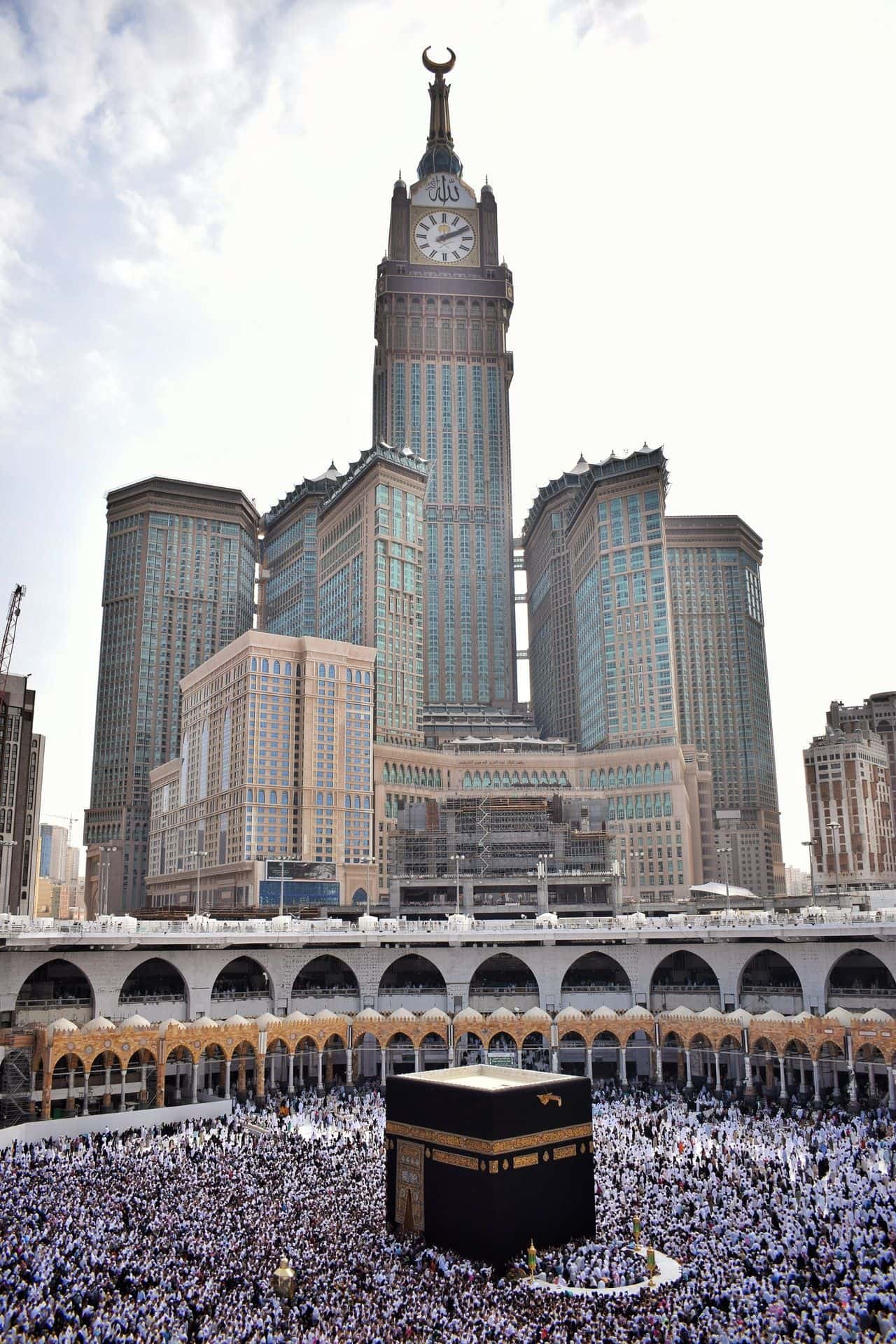
From Abraj Al Bait, which has become one of the tallest buildings in the world, Saudi Arabia also has a megaproject called NEOM, which is developing a 170 kilometer-long megacity called 'The Line.'
The kingdom also works on other projects, like the entertainment megaproject called the 'Qiddiya,' the luxury and ecotourism called the 'Red Sea Project' and 'Amaala,' a proposed large-scale public park and urban district called 'King Salman Park,' the proposed Burj Khalifa defeater 'Jeddah Tower,' and more.
The Saudi Arabian government is no stranger to doing extravagant things in a pursuit to diverse its income sources away from petroleum and gas.
But this time, some said that crown prince Mohammed bin Salman Al Saud is going a bit too far.
This is because Mukaab is planned to have a shape of a cube.
And not just some cube, because the cube resembles the Kaaba at Islam's most important mosque, the Masjid al-Haram in Mecca, Saudi Arabia.
Kaaba is the most sacred site in Islam, as it's the qibla, where it's the direction of prayers for all Muslims around the world.
The Mukaab here, clearly takes inspiration from the 'House of God'.
As the video went viral after being posted to social media by PIF, even Saudi Arabia's own citizens have mixed responses to the $800 billion project.
While some welcomed the announcement, others reacted angrily to it.
By making it resemble a cube, and by making the Mukaab far bigger and "interesting" that the Kaaba, many said that the Saudi Arabian government wants to piggyback Kaaba's influence in Islam, and commercialize from it, or maybe derived the whole kingdom away from Islam.
And by making it like a work of science fiction, the government even market the gargantuan structure as "a gateway to another world."
"'Kaaba' of entertainment!!" one of the many online commenters said.
The person also mentioned prophetic narrations relating to the Najd region from which the "horn of Satan" will emerge.
In short, Saudi Arabia is trying to transform Saudi Arabia, the birthplace of Islam, into one of "the most livable" places on Earth.
At this time, Saudi Arabia is experiencing a serious regional competition from neighboring United Arab Emirates, with Dubai in particular, and also from Qatar's Doha capital.
In recent years, both places have tried to position themselves as regional tourism and investment hubs.
And Saudi Arabia, like both United Emirates and Qatar, is also known for its wealth, and that the government doesn't really like being in second place in a race.
Before, Saudi Arabia has experienced extreme difficulties when it comes to tourism, since the country has two of the holiest cities for Muslims. This changed back in 2019, when the government launched a brand-new tourist visa that lets tourists explore the country. It's a landmark moment for the kingdom, which hopes to welcome 100 million tourists a year by 2030.
And this Mukaab structure, is exclusively devoted to capitalism, said a journalist.
In response to the haters, Another Saudi nationals have accused those deriding the plans as "Saudiphobes" and described the accusations as "preposterous".
They said that "cubical buildings are very known in Arabia." So "If every cubic shaped building is 'a new kaaba' then you will find millions of kaabas in Riyadh."






















































































































































































































































































