More than twenty-five years after helping create Wikipedia, Larry Sanger has been indefinitely banned from editing the English-language encyclopedia.
The decision marks one of the most symbolic moments in Wikipedia's history, placing one of its founders outside the very community that grew from the project he helped launch in 2001.
Beyond the immediate controversy, the episode has reignited discussions about editorial neutrality, community governance, and the responsibilities that come with managing one of the internet's most influential sources of knowledge.

When Wikipedia first appeared online, it was intended to solve a problem.
Jimmy Wales had founded Nupedia, an online encyclopedia built around expert-written articles that went through a lengthy peer review process before publication. While academically rigorous, the process proved too slow to produce content at the pace required by the rapidly expanding internet.
Larry Sanger, a philosopher who served as Nupedia's editor-in-chief, proposed using wiki software to allow contributors to create and improve articles collaboratively.
The experiment quickly surpassed expectations.
Wikipedia officially launched on January 15, 2001, and within months had attracted thousands of volunteer editors from around the world. The project soon eclipsed Nupedia and would eventually become the largest encyclopedia ever assembled.
Sanger has long maintained that he co-founded Wikipedia alongside Jimmy Wales and that he coined the name by combining the words "wiki" and "encyclopedia."
During the project's formative period, he was deeply involved in writing editorial guidelines, welcoming contributors, resolving disputes, and helping establish many of the principles that shaped Wikipedia's early development.
Although Wales and Sanger shared the same vision in the beginning, their perspectives gradually diverged as the encyclopedia expanded.
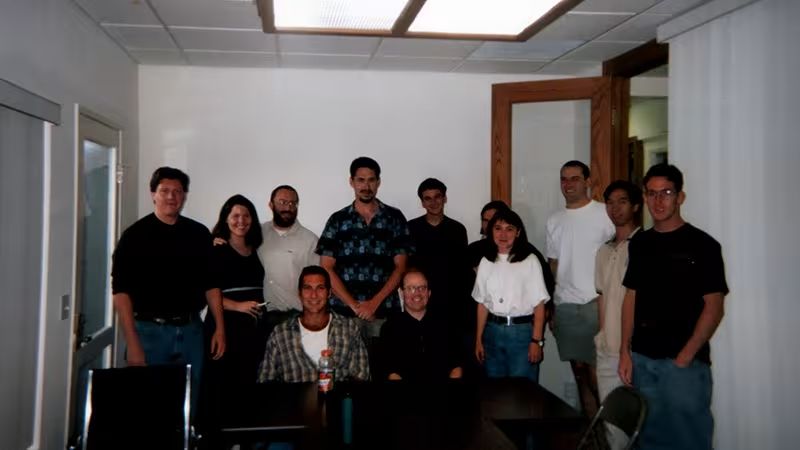
Sanger favored a stronger role for subject matter experts and believed professional expertise should carry greater weight in editorial decisions.
Instead, under Wales, Wikipedia evolved toward a decentralized model built around volunteer consensus, where articles are developed through discussion, sourcing, and agreement among contributors rather than authority derived from credentials.
Sanger left the project in 2002 after funding for his position ended.
In the years that followed, he became one of Wikipedia's most prominent critics, arguing that the encyclopedia had drifted from its original aspirations of neutrality.
He has repeatedly claimed that politically sensitive topics can be shaped by editorial groupthink, that experienced administrators exercise disproportionate influence over discussions, and that ideological bias has become increasingly difficult to challenge within the platform's governance structure.
Wikipedia's volunteer community has consistently disputed those claims.
Editors point to policies requiring verifiability, reliable sourcing, and a neutral point of view, arguing that disagreements are settled through open discussion and community consensus rather than centralized editorial control.
Supporters of the current model also note that Wikipedia's openness allows errors to be identified and corrected more rapidly than many traditional reference works, even if contentious topics often require lengthy debate before consensus is reached.
The latest dispute emerged after Sanger introduced an initiative known as WikiProject Intellectual Diversity.
According to Sanger, the proposal was intended to encourage broader ideological representation among contributors and promote renewed discussion about neutrality on controversial subjects. He argued that greater diversity of perspectives could strengthen Wikipedia's credibility and improve public confidence in its editorial processes.
The proposal quickly generated significant debate among experienced editors.
While some participants viewed it as a legitimate attempt to broaden discussion, others argued that it risked becoming an organized effort to influence Wikipedia's internal decision making through external coordination.
Following weeks of community discussion, editors concluded that Sanger had violated Wikipedia's policies regarding off-site canvassing.
Under those rules, contributors are prohibited from recruiting people outside Wikipedia to influence editorial debates or internal consensus.
Editors cited Sanger's social media activity, interviews, podcast appearances, and public invitations encouraging participation in the initiative as evidence that he had crossed that line.
The resulting community consensus imposed an indefinite ban on Sanger's ability to edit the English-language encyclopedia.
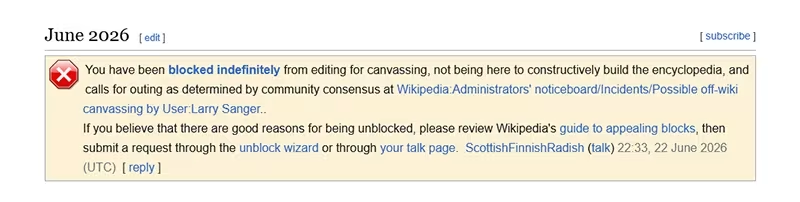
Wikipedia editors emphasized that the decision was based on conduct rather than viewpoints, stating that the action reflected enforcement of longstanding community rules rather than punishment for criticizing the encyclopedia itself.
Sanger has rejected that explanation.
In public statements following the decision, he argued that the process reflected deeper structural problems within Wikipedia and demonstrated an unwillingness to tolerate meaningful criticism from those seeking reform.
He has maintained that the encyclopedia has become increasingly resistant to challenges directed at its internal governance and editorial culture.
Wales has continued to defend Wikipedia's community-driven model while acknowledging that maintaining neutrality remains an ongoing challenge. His position reflects one of Wikipedia's defining principles, namely that the encyclopedia belongs to its volunteer community rather than its founders. In practice, that means no contributor, regardless of historical significance, receives authority beyond what the community itself grants.
The controversy arrives at a time when Wikipedia occupies a far more influential position than it did during its early years.
Once regarded primarily as a convenient online encyclopedia, it has become a foundational layer of the modern internet.
Search engines routinely surface Wikipedia articles near the top of search results, knowledge panels often draw upon information originating from Wikimedia projects, journalists frequently consult Wikipedia as a starting point for research, and countless educational resources reference its articles.
Wikipedia's significance has expanded even further with the rapid development of generative artificial intelligence.
Many AI developers have relied on publicly available information from across the web, including Wikipedia, during various stages of model development or evaluation. Although individual AI systems differ in how they use public content, Wikipedia remains one of the internet's largest openly licensed collections of human-curated knowledge.
Its articles are continuously updated, heavily referenced, and translated into hundreds of languages, making the encyclopedia an important component of the digital information ecosystem.
That influence means debates surrounding Wikipedia increasingly extend beyond the encyclopedia itself.
Questions about editorial neutrality can affect how information is presented through search engines, digital assistants, educational platforms, and AI-powered services that summarize or reference publicly available knowledge.
As these technologies become more deeply integrated into everyday life, discussions about how foundational information is created, reviewed, and governed carry broader implications than they once did.
The episode involving Sanger therefore reflects larger tensions facing collaborative knowledge platforms.
Open communities must balance broad participation with safeguards against coordinated influence. They must remain transparent while protecting established editorial processes. They must also preserve public trust at a time when misinformation, synthetic media, and AI-generated content are reshaping expectations about the reliability of information found online.
Wikipedia's volunteer model has proven remarkably resilient for more than two decades, producing millions of articles across hundreds of languages while operating without a traditional editorial newsroom.
At the same time, its growing importance means decisions once viewed as internal community matters increasingly attract international attention because they may shape one of the internet's most widely consulted sources of information.
There is also an undeniable historical irony.
Wikipedia became famous for promoting the idea that anyone could edit.
More than twenty-five years later, one of the people who helped transform that idea into reality can no longer participate in the encyclopedia he helped create.














































































































































































































































































