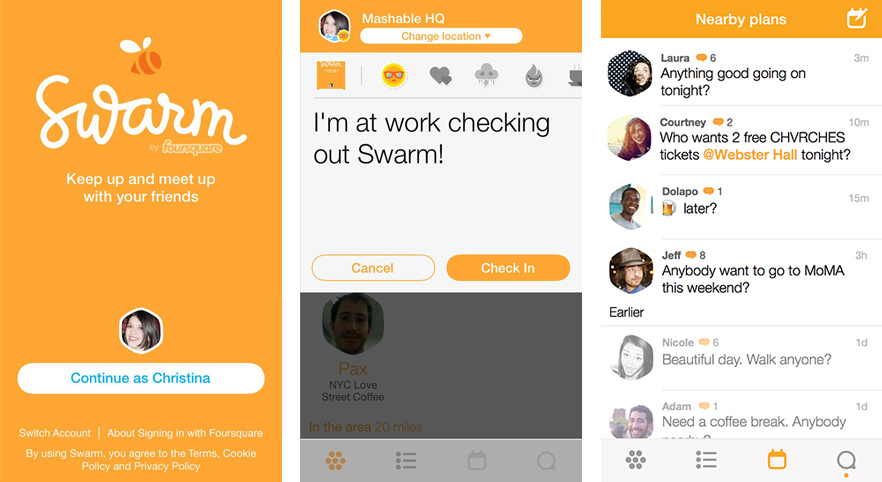
 Foursquare, the location-based social network, is splitting its core app into two separate apps giving their own experiences. One that provides recommendations, and another acts as a "social heat map" where users check-in and see nearby friends.
"The point of the company, this whole thing, was never to build an awesome check-in button," said Foursquare CEO Dennis Crowley.
To deliver more experience without bulking an app, Foursquare is breaking itself in two. The new app from Foursquare is called Swarm. The app takes out Foursquare's check-in feature and adds ambient location sharing, something no one has ever expressed any demonstrated interest in.
The app takes inspirations from the instant messengers (IM), where users can see when their friends are online and offline. Swarm shows which friends are in the area and opens up the opportunity to start a conversation. While the new Swarm app is taking the service to a new level, Foursquare redesigns its Foursquare core app from the ground up. The biggest change is Foursquare is removing the check-in feature, and make it focus on discovery and exploration only.
"Swarm, the Swarm brand, and the Swarm functionality are all the product of five years' learning, hard work, and development," said Foursquare's spokesperson. "The brand is taken from the original Foursquare badge set, and the app was developed coming from that."
What about mayorships, badges and the rewards point system? They won't be available in Swarm, but the app does have similar features in place. After seeing that its old approach to mayorships, a Foursquare feature that made the old app a hit with its users, is no longer working, the company has released an updated feature dubbed Mayors 2.0. With the new feature, instead of competing with over 50 million users for a mayorship at one location, Foursquare whittled the competition down to just you and your friends.
When Foursquare was first launched in 2009, the company needed the check-in button the social app is known for, to get as much data as possible from its users. The company has collected millions of users, hundreds of millions in funding, and billions of shared data. However, this method was no longer effective since the early 2014 that in fact, it was holding the company back. It was said that both the technology and the data have finally come of age.
By having all that data, Foursquare is ready to move on, giving services beyond just a simple check-in. Crowley decided it was time to do something radical.
The new Foursquare is delivering a new search experience. To compete with Yelp, it's showing different results. Rather than offering the best place for a lunch, for example. Foursquare that already have user's data, knows where users have been and what they've liked before. The result is a search experience tailored specifically to the user in an almost predictive manner.
And since Foursquare’s knows exactly where you are, how long you stay, and the route you take to get from one place to the next, it no longer relies on check-ins to keep track of your taste.
Foursquare is confident with the new move that Crowley seems to be keen on talking more about how powerful Foursquare can be without the check-in, rather than how great Swarm is with that included.
Foursquare's move in splitting its services is seen as a way Facebook has done in "unbundling" itself with its Creative Labs division. However, Swarm is more like giving the company a way to shed more of its excess baggage while making a harmless bet. On the other hand, Facebook is slightly different. Products like Messenger offers possibilities at viability, and clarifying the mission the Facebook's core product; more like separating its baggage into smaller faster jets rather than piling it up in a big slower cargo ship.




















































































































































































































































































