The field of AI video generation is transitioning out of its initial experimental phase and moving into a practical tools era.
Early iterations of generative video technology impressed audiences with short aesthetic clips, but video creators routinely ran into technical friction when attempting to integrate these tools into actual production pipelines.
Common challenges included severe limitations on clip length, high computational rendering costs, visual distortion during camera shifts, and a complete lack of control over precise object details.
Instead of focusing merely on higher resolution visuals, recent technical updates across the industry are addressing these fundamental functional bottlenecks to create reliable media tools for daily workflow integration.
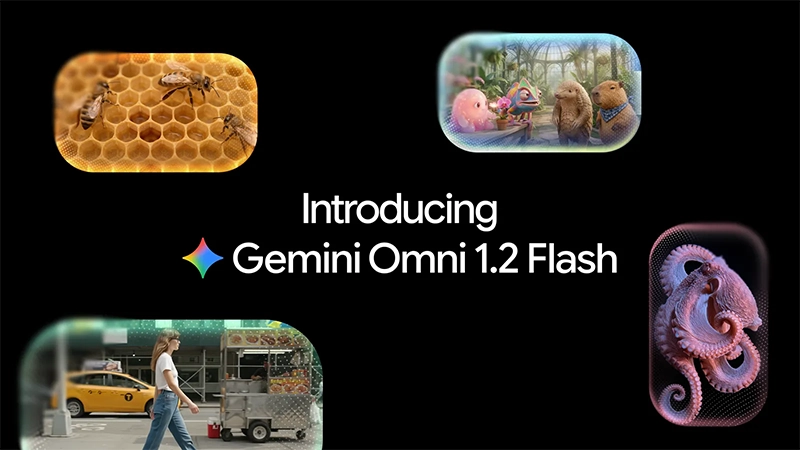
Building directly on the foundation established by its predecessor, 'Gemini Omni 1.2 Flash' tackles these main friction points by extending native clip generation lengths up to 15 seconds.
Previous iterations capped output at around 10 seconds, which often forced creators to stitch together multiple short fragments to form a coherent thought or commercial scene.
The extended runtime enables users to construct complete narrative sequences, product demonstrations, and social media videos in a single generation step.
Additionally, the system provides granular duration controls, allowing users to select exact clip lengths between 3 and 15 seconds in one second increments to maintain tight pacing across video edits.
Iterative editing has also received a fundamental rework to fix a primary pain point in historical AI video workflows.
Previously, if a generated video contained a minor flaw or required a single adjustment, creators had no option except to run a completely new generation from scratch, hoping the model would randomly hit the desired outcome.
The current update introduces conversational statefulness, enabling step by step modifications on existing outputs.
Through follow up text instructions, users can alter specific elements within a clip, such as changing the environment, replacing a product model, shifting the weather, or modifying the target aspect ratio, all while preserving the main character, lighting, and overall composition of the original scene.
Maintaining visual continuity across moving camera shots and subject rotations has seen significant improvement through enhanced multimodal reference controls.
Users can anchor their video generation using a combination of inputs, including reference photos, three second motion clips, and audio tracks. By referencing these input anchors, the system maintains accurate brand colors, facial features, and clothing patterns across complex camera maneuvers like orbital pans, steady tracks, or high speed FPV drone passes.
This multi-input guidance reduces visual morphing, frame tearing, and spatial drift, while updated audio processing delivers cleaner lip sync alignment and multi speaker handling.
Despite these structural advancements, several technical weaknesses and operational limitations remain present across the platform.
While the 15 second runtime is an improvement, it remains restrictive for creators needing sustained long-form clips without stitching multiple scenes together.
Physics adherence in high-complexity environments can still fail, resulting in occasional spatial distortions, unexpected object collision handling, or unnatural fluid movements.
Additionally, audio reference inputs are currently gated behind explicit allowlisting in the API, and complex character continuity can still degrade during extreme camera pans or rapid environment switches.
Regional access restrictions and strict safety filtering also create intermittent generation blocks for certain video-to-video editing workflows across specific territories.
To make high volume creation economically viable for developers and media teams, base API pricing has been lowered by approximately 30% compared to version 1.1, settling standard 720p output at $0.07 per second of generated video.
To optimize budgets further, creators are encouraged to adopt a tiered drafting workflow. Ideas can be sketched and modified at lower resolutions like 360p or 720p using chat based edits, and only after the scene structure and visual details are completely finalized does the system render the final cut up to 1080p or 4K resolution.
The model is accessible through both enterprise developer tools and consumer applications, including Google Cloud Vertex AI, Google AI Studio, Google Vids, and select Gemini subscription tiers.
Every generated output automatically embeds an imperceptible digital watermark via SynthID to track content origin and maintain transparency. External creative suites such as Runway, Invideo, Picsart, and Photoroom are also connecting their platforms to the API, demonstrating how generative video is rapidly morphing into standard digital infrastructure.