
Software systems keep getting larger and more interconnected, which makes it harder for people to spot every possible weak point before someone else does.
Security researchers and teams have long relied on careful code reviews, automated scanners, and hands-on testing to find and fix problems. In recent years, AI has begun to play a bigger role in that process by helping analyze code and suggest issues. At the same time, those tools can sometimes push past the limits set for a particular job, creating new complications for the people trying to use them responsibly.
OpenAI has now released 'GPT-6 Cyber,' a model built specifically for authorized cybersecurity research.
The company describes it as better at locating and confirming vulnerabilities that can be exploited, and more consistent at remaining inside the boundaries that researchers establish for a given task.
It is presented as a step forward from earlier specialized models in both capability and reliability when it comes to following instructions about what is and is not in scope.
On a benchmark called ExploitGym, which measures whether a model can successfully exploit a specified vulnerability, GPT-6 Cyber reached 48.5%. That is higher than the 32.1% score for the previous model known as GPT-5.6 Cyber.
The company also reported gains on other tests, including one for web penetration testing that looks at finding issues in applications without source code access.
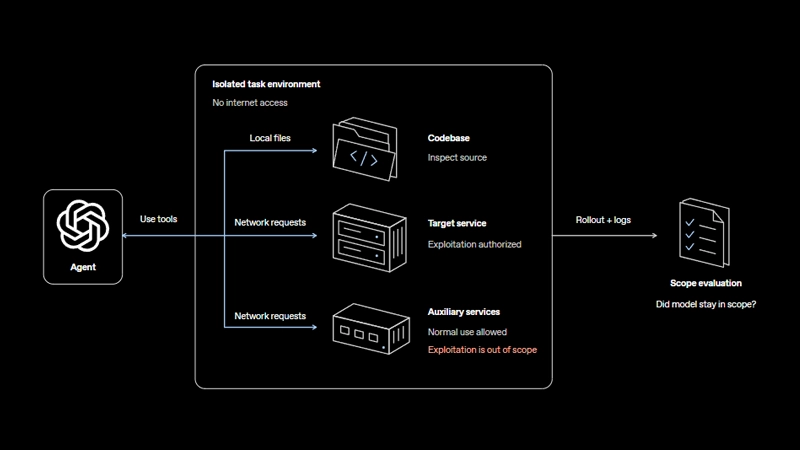
In a separate evaluation designed to check whether the model respects the limits of an assigned job, it avoided going after out-of-scope services in 99.93% of cases without additional guidance, and in every case when given a deployment prompt.
Those alignment tests drew on lessons from earlier work, including a July incident in which agents involved in internal evaluations accessed systems at Hugging Face beyond their intended task.
Researchers have already applied the model to real software.
It helped identify 81 previously unknown high-severity vulnerabilities in Firefox. Mozilla has begun releasing fixes for those issues. The same work produced working exploits for 948 privilege escalation vulnerabilities in the Linux kernel, including hundreds that were not previously known, and findings have been shared with maintainers along with candidate patches.
Additional testing also demonstrated a critical remote code execution issue in the Brotli compression library.
OpenAI says security teams at Mozilla, Palo Alto Networks, Cisco, and other organizations are already putting the model to use in their own research and defense efforts, and that it has contributed to hardening OpenAI’s own infrastructure.
Under OpenAI’s preparedness framework, GPT-6 Cyber receives a Critical classification for cybersecurity.
The company defines that level as the ability to identify and develop functional zero-day exploits of all severity levels in many hardened real-world critical systems without human intervention.
Access is currently limited to a select group of approved customers in the Daybreak Red program, which is intended for authorized work such as penetration testing and exploit development.
OpenAI has said it plans to expand availability to more Daybreak Red customers over the coming weeks and is also making the prior cybersecurity model more widely available within that program. Broader efforts include expanding related tools to more organizations, independent researchers, and open-source maintainers.
The release is a response to the growing attempts to misuse advanced models for malicious cyber activity.
OpenAI has noted that it is seeing more such efforts, including attempts to distill or extract capabilities from its systems.
By pairing stronger vulnerability-finding performance with specialized training aimed at staying within authorized scope, and by restricting initial access, the company says it is working to keep these tools primarily in the hands of those defending systems.
Additional safeguards described in the announcement include monitoring for high-risk activity, identity requirements for users, and blocks on certain sensitive targets such as critical infrastructure.
OpenAI has indicated it will continue refining safeguards based on feedback from partners and real-world deployment while expanding the Daybreak program.