
Image models tend to arrive in public as a short social post and a handful of sample frames, then only later as a model card, a price table, and a shutdown date for whatever they replace.
And now, it is the time for 'Nano Banana 2.1' to make the headlines.
Nano Banana, which is Google's product name for the image models in the Gemini family, was originally powered by Gemini 2.5 Flash Image. Nano Banana 2 moved that line to higher resolutions and wider aspect ratios. Nano Banana Pro, built on Gemini 3 Pro Image, stayed the more expensive tier.
Nano Banana 2.1, model ID gemini-nano-banana-2.1, is the update to the Flash line. Google's API page calls it a high-efficiency image generation and conversational editing model, an update to Nano Banana 2 that keeps Flash-level speed, and the more efficient counterpart to Nano Banana Pro.
The DeepMind model card says it is based on Gemini 3.6 Flash, with a knowledge cutoff of March 2026, though some domains remain limited to January 2025.
The announcement itself was brief.
Google, Google AI Studio, and the Nano Banana account described better visual design, mask-based editing, subject consistency, and more natural-looking images, and said the model was starting to roll out in the Gemini app, AI Mode in Search, Google AI Studio, Flow, Stitch, Google Ads, and the Gemini Enterprise platform.
The API page is more specific.
It lists improved visual quality and realism at 1K, 2K, and 4K, with 1K as the default. It says tiling artifacts on extreme ratios, 1:4, 4:1, 1:8, and 8:1, are fixed at 2K and 4K. Text rendering and infographic layout are described as more accurate. Multi-image fusion takes up to 14 reference images, with character consistency claimed for up to four characters and object fidelity for up to ten objects. Grounding with Google web search and image search is supported. Thinking is configurable at minimal, medium, and high, with medium as the default. Inputs can be text, image, video, or PDF. Outputs are image and text.
The API lists an input limit of 131,072 tokens and an output limit of 32,768.
The model card quotes a larger context window, up to 1 million tokens, and a larger text output, so the operational limit depends on which surface is being used.
Against Nano Banana 2, the documented changes are incremental rather than a new product category.
Both generate at 1K, 2K, and 4K and both can edit conversationally. Nano Banana 2 already supported the extreme aspect ratios, but Google now says those wide frames tiled at the higher resolutions, and 2.1 is the fix. Prompt adherence, multi-turn character consistency, and in-image text are the other areas Google names as improved.
Nano Banana 2 also offered a 0.5K output.
Pricing tables for 2.1 do not list that size. Thinking levels are called out as a control on 2.1. On the API, Google has deprecated gemini-3.1-flash-image and set a shutdown for October 29, 2026, with 2.1 named as the replacement.
That is a short window for anything still calling the older model string.
Price is the clearest numerical difference, and it is not uniform.
On the standard Gemini API tier, reported from Google's pricing page in coverage dated October 6 and 7, a 2.1 image costs about $0.0336 at 1K, $0.0504 at 2K, and $0.0756 at 4K.
The same sizes on Nano Banana 2 were about $0.067, $0.101, and $0.151, so image output is roughly half. Batch pricing is half again.
Input tokens move the other way, about $1.50 per million on 2.1 against $0.50 on Nano Banana 2, and text or thinking output is also higher.
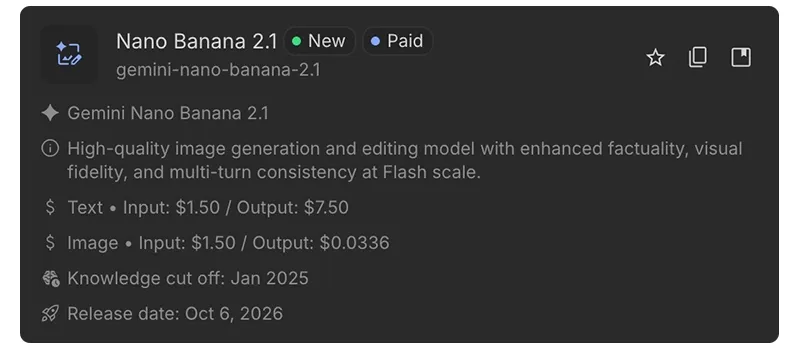
A short prompt and one image is cheaper. A long prompt, several reference images, or a high thinking setting narrows the saving. Nano Banana Pro remains far above both, about $0.134 for a 1K or 2K image and $0.24 at 4K.
Nano Banana 2 Lite still matches the 2.1 price at 1K only.
Google's own October 2026 evaluations, published on the model card, put 2.1 ahead of Nano Banana 2 with thinking on every listed test.
But what should be noted here is that, those tables need a caveat.
They are Google's raters on Google's tasks, and a higher preference score against Pro does not settle which model a given user will prefer. Independent write-ups have noted that Pro still often looks stronger on likeness and in-scene text, which matches how Google continues to position it, as the higher tier rather than the retired one.
Early public tests were mixed in the ordinary way.
Some users described clearer design language and better style following. Others said the images still read as generated, or compared them unfavorably with other companies' current image models. A few hours of public samples is not a benchmark.
The model card is also plain about what did not get solved. Small text is often blurry at 1K, and long paragraphs remain weak. Character consistency is not always held between a reference and the output. Mask and doodle edits can drop part of an instruction or fail to keep the ink. Edits sometimes preserve the pose of the input subject. Left and right can still be confused. World knowledge, 3D reasoning, and factuality are described as limited, and the general hallucination problem of foundation models is still listed. Search grounding does not remove that. Occasional slowness and timeouts are noted as well.
Later evaluations suggest that Nano Banana 2.1 is the best Nano Banana till date, but still ranks below OpenAI's image generators.
For anyone already on Nano Banana 2, the practical reading is narrow.
The new model is the same slot, Flash speed and a lower per-image price, with Google's evidence pointed at layout, text, wide frames, and consistency across references and turns.
The old model ID is scheduled to stop on October 29. Pro remains the separate, more expensive option when the internal scores and the price table are not enough to decide.

For developers, Nano Banana 2.1 is less a major generational leap and more a practical upgrade.
It is cheaper, faster, and better at high-resolution output, text, layouts, and reference consistency. With Nano Banana 2 scheduled to shut down on October 29, the upgrade is also becoming a deadline rather than a choice.
For users, the split is simple.
Nano Banana 2.1 is the cheaper Flash workhorse, while Nano Banana Pro remains the higher-end option. The bigger story is how quickly image models are moving from launch announcements to cheaper, incremental upgrades and eventual replacement.






















































































































































































































































































