In late September 2026, people scrolling through Google Earth and Google Maps began noticing that the satellite views of Gaza looked markedly different from the older images they remembered.
Neighborhoods in Rafah, Khan Younis, and parts of Gaza City that had once shown dense rows of buildings now appeared as broad stretches of rubble, cleared ground, and scattered makeshift shelters. Screenshots and side-by-side comparisons spread quickly on social media.
An Irish member of the European Parliament, Barry Andrews, posted about the updated views and described them as quite incredible for all to see, drawing millions of impressions within days. News outlets followed, publishing before-and-after frames that matched what users were already circulating.
Google did not issue a special announcement, things were rather quiet.
When asked, Google only said that its most recent imagery came from third-party satellite providers and had been available since June 2026, part of the regular updates it applies to maps.
Some of the southern Gaza tiles that drew the most attention had been captured as early as February.
Independent checks later confirmed that higher-resolution commercial imagery from the months after June showed further changes in certain areas, but the pictures going viral that week were the ones already sitting in Google’s public layers.
The images aligned with assessments already published by the UN Satellite Centre.
As of mid-June 2026, the agency reported that roughly 82% of structures across Gaza had been damaged, with about two-thirds of those damaged buildings assessed as destroyed.

The visual record made the scale easier to grasp at a glance: roads still traceable, but entire blocks of housing, schools, and other buildings reduced to debris.
Then, on October 3 and 4, Angelina Jolie posted a series of those Google Earth comparisons to her Instagram account, which has around 16 million followers.
She wrote that people could now open Google Earth and see what was done to Gaza, noting that whole neighborhoods had been reduced to rubble and that homes, schools, universities, hospitals, roads, and water systems had been damaged or destroyed.
What happens next matters.
People need shelter before winter.
Humanitarian aid needs to reach civilians at the scale required.
Hospitals need medical supplies.
And the conditions that allow civilians to rebuild their homes, schools, hospitals and communities need to be created.
The destruction is visible. The needs are known. What matters now is whether they are met.
She cited the same UN satellite figures on structural damage and added that 1.98 million people, or 94% of the population, needed shelter assistance and essential items as winter approached.
The post moved fast.
Within roughly eleven hours it had passed 800,000 likes; within a day reports placed the total above a million, and some accounts tracking it cited more than 1.5 million within 23 hours, along with tens of thousands of comments.
News sites in multiple countries covered the numbers and quoted the caption.
The earlier social-media circulation of the satellite views had already drawn attention; Jolie's post carried those same images to a much larger audience and kept the discussion going into the first week of October.
For Jolie, her posts are consistent with her long-running humanitarian work.
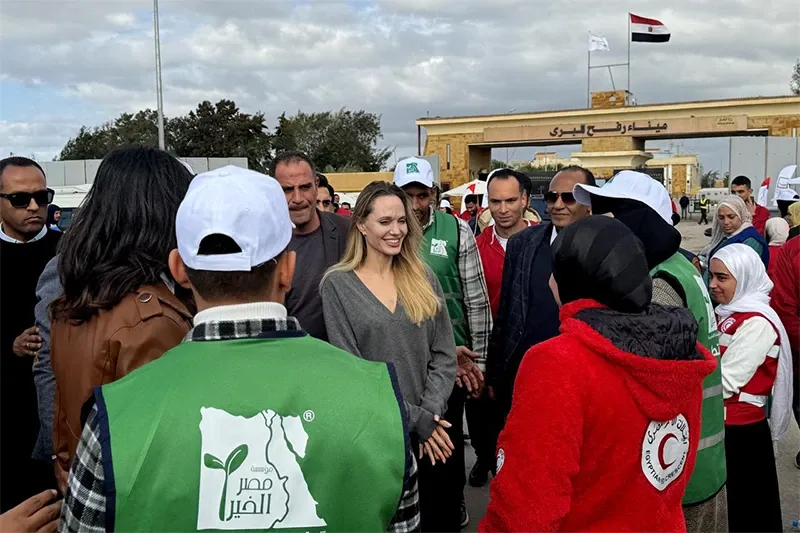
The actress has spent decades visiting communities affected by war and displacement, including a visit to the Egyptian side of the Rafah crossing in January 2026, where she met humanitarian workers and called for greater access for aid to Gaza.
The satellite images can show the destruction, but they cannot show what it means for families living among it.
Behind every destroyed building is a home, a school, a hospital, or a community that people depended on.
Jolie's posts brought those images to millions of people. What happens after people look, however, matters more: shelter, food, medical supplies, safe access for aid, and eventually the chance for people to rebuild their homes and communities.
Following her post, Children in Gaza have expressed appreciation for actress and humanitarian Angelina Jolie.
Three children, Celine, Sila and Aila, drew Jolie and wrote a message alongside the drawing:
Thank you for your kindness and support, you give hope to the children of Gaza, you are a hero in our hearts.






















































































































































































































































































