Passwords have protected online accounts for decades, but they have never truly answered the most important security question: is the person trying to sign in actually the account owner?
As cyberattacks become more sophisticated and phishing, stolen credentials, and social engineering continue to evolve, technology companies have been expanding beyond passwords with tools such as passkeys, security keys, and biometric authentication.
The challenge is finding a method that strengthens security while still allowing legitimate users to recover access when something goes wrong.
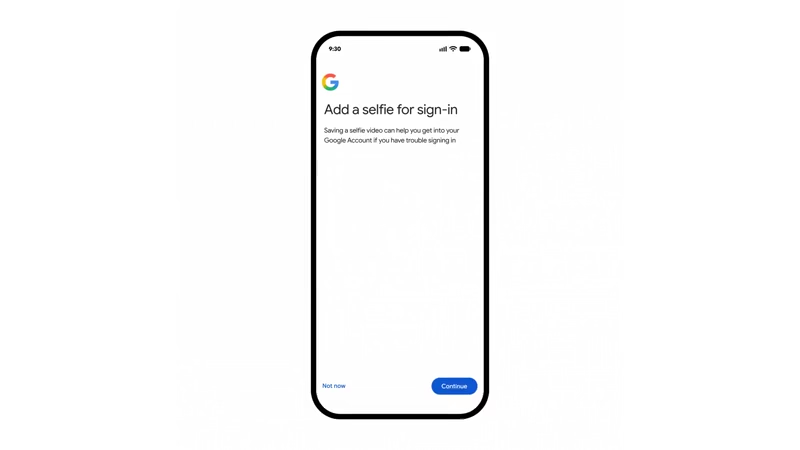
Google has introduced another option that aims to solve that problem by allowing eligible users to set up a selfie video as a backup sign in and account recovery method.
Rather than replacing passwords or passkeys, the feature adds another layer that can be used if someone is locked out of their account or no longer has access to their usual phone, computer, or other recovery methods.
To enable the feature, users record a short guided selfie video through their Google Account security settings.
During the recording, Google asks users to perform simple head movements so the system captures multiple angles of their face. If they later need to recover access, they record another guided selfie video, which is compared with the original recording to verify their identity.
Google says the system is designed to do more than compare facial features.
It also performs liveness checks by requiring users to complete guided movements, helping distinguish a real person from a photograph, replayed video, or certain types of deepfake attacks.
The company also combines this with its existing security systems that monitor suspicious sign in activity and other signals before granting access.
Privacy is likely to be one of the biggest questions surrounding the feature because it involves storing biometric information.
Google states that the reference selfie video is recorded only with the user's consent, encrypted while stored, and can be deleted at any time through the user's account settings.
According to the company, the video is used only for sign in purposes unless the user explicitly opts in to allow it to be used for additional purposes, such as improving facial verification technology.
The new option also comes with some limitations.
It must be configured before it is needed, meaning users cannot set up a selfie video after they have already been locked out of their account.
Google is also rolling out the feature gradually, and it is currently unavailable for some account types, including Google Workspace accounts, child accounts, and accounts protected by the Advanced Protection Program.
The introduction reflects a broader trend in digital identity, where passwords are increasingly becoming just one part of the authentication process rather than the primary safeguard. Many users already rely on fingerprint readers, facial recognition, passkeys, hardware security keys, or trusted devices. Google's selfie video joins that growing list as another recovery option rather than a replacement for existing methods.
The company continues to recommend setting up multiple recovery mechanisms to reduce the risk of permanently losing access to an account.
Public reaction has been mixed. Some users see the feature as a practical fallback for situations where a phone is lost, an authenticator is unavailable, or traditional recovery methods fail. Others remain cautious about providing additional biometric data to a technology company, even with encryption and user controls in place. Discussions across online communities have largely centered on privacy, data handling, and whether the added convenience outweighs the concerns associated with storing facial data.

















































































































































































































































































