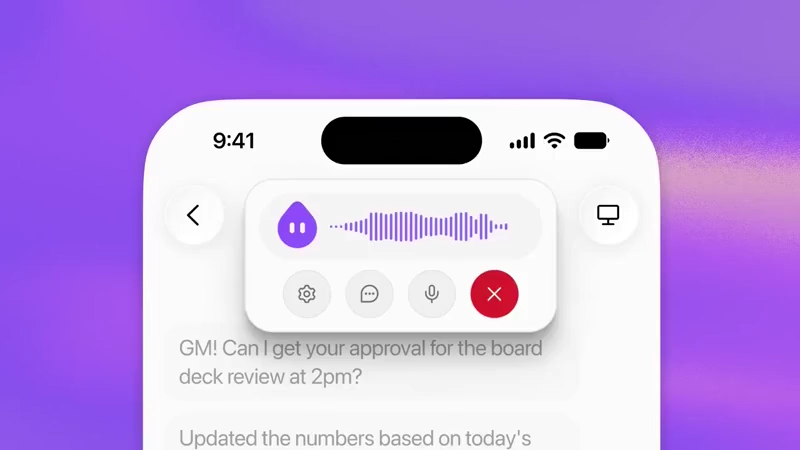
A board deck sits half finished in a chat window. Someone asks for approval at 2 p.m., then asks whether the numbers have been updated, then asks for a headcount slide pulled from another system. Nothing about that sequence is unusual.
What changed is the channel. The request no longer has to be typed.
Grok Bot is an autonomous AI agent ecosystem developed by SpaceXAI (formerly xAI). Instead of operating as a traditional chatbot that just outputs conversational text, Grok Bot gives users persistent, specialized AI teammates designed to run long-running, multi-step tasks autonomously in the background
And this time, it has moved into speech.
Users can now interact with Grok Bot using natural language, and typing is no longer the only option.
Grok Bot account posted a clip of that kind of work moving into speech.
A purple droplet icon hovered over an audio waveform while the conversation continued in the background. The bot in the demo was called Deckster. It kept the task open while a voice layer sat on top of the same thread. A follow-up note said the feature would reach desktop and mobile over the next couple of days, with a link to x.ai/bot.Grok Bot is not the main Grok chatbot.
The feature first launched as a public beta on August 11, 2026, for desktop and iOS, before arriving on Android in early September.
The product is built around assigned work. Users connect their tools, give the bot a task, and wait for something closer to a finished result than a suggested paragraph. Voice does not change that underlying design. It simply changes how the task is handed over.
The spoken interface is powered by Grok Voice, the speech-to-speech stack that xAI already uses across its APIs and other products. Coverage of the announcement pointed to Grok Voice Think Fast 2.0, a generation discussed in late July 2026.
That puts several pieces of the product's development into a relatively short timeline. In little more than a month, Grok Bot went from an internal prototype to a public beta capable of logging into connected tools, and then to a version that could accept spoken instructions while those tools remained available to it.
Public descriptions of the underlying voice stack emphasize low-latency turn-taking, bidirectional streaming, tool use during conversations, and support for multiple languages.
Those capabilities had already been appearing in developer-facing products and operational environments such as customer-support calls. Inside Grok Bot, they serve a more direct purpose: users can speak a request while the bot continues working across documents, spreadsheets, and connected applications.
For now, access remains tied to existing paid plans.




















































































































































































































































































