
People who use AI agents for real work have spent the last year learning a quiet lesson: a single default setting rarely fits every assignment. Collecting invoices, drafting a sales brief, ranking product work, and testing a market assumption are not the same kind of job, and they do not cost the same amount of compute.
That gap between what a task needs and what a system spends has become one of the more practical problems in agent design.
Perplexity Computer sits in that space as an agent that plans work, delegates pieces of it, and uses tools and connected apps rather than only answering a question.
It already routes jobs across models from different providers. Now, the company added effort controls in Computer's model selector so users can set how much of that machinery to apply without naming every model themselves.
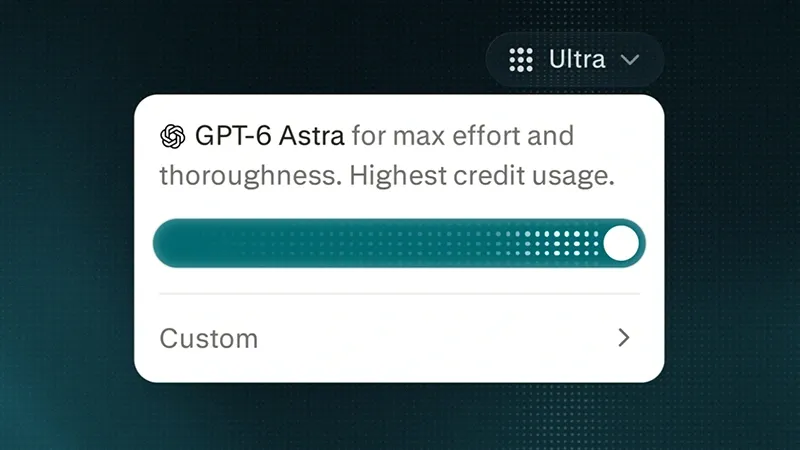
The interface uses four presets on a slider:
- Light is described for straightforward work such as gathering vendor invoices into a spreadsheet.
- Standard is framed as a balance of reasoning and cost, for example combining account notes and company updates into a sales brief.
- High is for more complex analysis, such as weighing customer requests against engineering estimates.
- Ultra is for open-ended problems, such as evaluating a new market under different growth assumptions. Lower settings use less expensive models. Credits still track the work actually performed, not only the label on the slider.
Behind each preset is an orchestrator model and a reasoning depth.
That orchestrator plans the assignment and hands parts of it to supporting agents, which can run on models from different providers. Users who want more control can leave the presets and choose a specific model, reasoning level, and speed setting.
The screenshot shared with the announcement showed a custom picker with names such as Claude Fable 5.1, Claude Opus 5, Claude Sonnet 5, GPT-6 Astra, GPT-5.6 Sol and GPT-5.6 Terra, GLM 5.3, Kimi K3, and Grok 4.6.
Perplexity said the matching of models to work draws on its history of answering large volumes of queries and on tests that compare quality against cost at different reasoning levels.
When a cheaper combination produces comparable results, the idea is that more of a user's credit budget remains available for tasks that benefit from deeper analysis.
The company also said it will keep adjusting the model-agnostic harness and the orchestrator and subagent pairings behind each effort level as frontier models change.
The feature is live on web. Android and iOS versions are listed as coming next, with desktop support mentioned in the same rollout notes.
Custom model selection remains available alongside the presets. Coverage on the day after the post mostly restated those four levels, the orchestrator-plus-delegation pattern, and the point that spend follows actual work.
It's worth noting that the slider is not a new model or a new reasoning system by itself. It is a control layer that determines how much capability Perplexity applies to a given assignment, while leaving the underlying model selection and orchestration to the system.
That distinction matters because choosing a model manually can be difficult when the task is still evolving.
A routine job may not need the most capable model, while a seemingly simple request can become more demanding once an agent starts gathering information, comparing sources, or coordinating multiple steps.
In that sense, the four presets function less like traditional model tiers and more like difficulty settings for autonomous work. They give users a way to tell Computer how much effort a task deserves without requiring them to understand which model should handle each part.
There are still practical questions around that approach. Users have raised concerns about tasks taking longer than expected, compute usage exceeding what they anticipated, and what happens when an agent goes down an unproductive path. Those issues become more important as agents move from answering individual prompts to performing work over longer periods.
For now, however, Perplexity is keeping the system relatively simple from the user's perspective. The presets determine the level of effort, Perplexity manages the model and agent assignments behind them, and credits are charged according to the work actually performed.
The broader idea is straightforward: instead of asking users to pick the strongest model every time, Computer is trying to make model selection part of the task itself. The user describes the job, chooses how much effort it deserves, and lets the system decide how to spend the available compute.




















































































































































































































































































