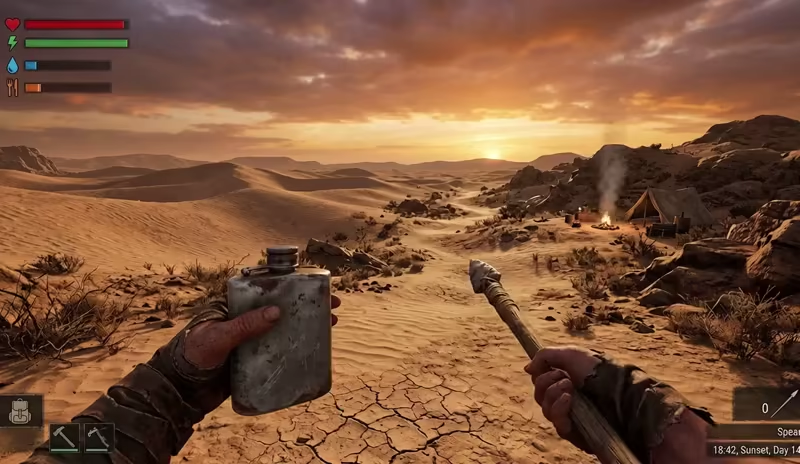
The rapid evolution of AI has moved far beyond simple text generation and static image rendering.
Recent developments in video synthesis have shown that models can capture motion, lighting, and temporal consistency with impressive fidelity.
However, the true frontier for interactive digital environments lies in real time simulation, where generated media responds dynamically to user input without predetermined scripts or clip lengths.
Runway introduces 'GWM Worlds 2' to mark a significant shift in how interactive software and environments can be created.
This new system generates continuous 720p video at 24 frames per second alongside high quality 48,000 Hz audio.
Rather than outputting pre rendered video files, the underlying model runs autoregressively, allowing streams to generate indefinitely while adapting instantly to user actions and camera movements.
At the core of this system is a structured framework known as WorldPrompt, which organizes the generated world into persistent elements and dynamic events.
The persistent layer defines the foundational context, such as scene layout, materials, lighting, subject attributes, and physical rules like gravity.
The event stream then processes ongoing interactions, including free form text commands for movement, object manipulation, dialogue, and per frame camera adjustments.
By splitting the environment into static rules and live events, the model can maintain spatial consistency while responding to overlapping inputs.
Achieving real time execution required transforming the traditional bidirectional generation pipeline into a causal, autoregressive architecture.
The model conditions each step on global context, current frame inputs, and past generated frames cached in a sliding window.
This setup allows characters to speak with synchronized lip movement, subjects to execute spatial navigation in first or third person perspectives, and users to manipulate visual environments live through custom key bindings or external agent controllers.
While the technical progress is evident, several research challenges remain before such real time generative worlds can fully replace traditional graphics engines.
Rapid camera rotations can still degrade geometry and texture quality, and long term memory across extended sessions continues to present limitations.
Nevertheless, the architecture provides a functional preview of how games, virtual simulation environments, and interactive software interfaces might eventually operate entirely through generative neural networks rather than traditional code execution.
Then there are some downsides.
GWM Worlds 2 still buys interactivity by giving up some of the picture. Runway is clear that this is a research preview, and that real-time generation trades fidelity for speed. Fast camera rotations can smear detail, texture, and geometry. Long-term memory is incomplete, so a room you leave and re-enter is not guaranteed to return with the same objects in the same places. Image references stop at the first frame or a prefilled clip. Free-form text looks like a general control surface, but dialogue and other stateful behavior often need an external harness that tracks what the world already contains and writes the next action.
Those are product-shaped limits: latency, cache length, and a control format that is more prompt than engine. They matter because the demo is sold as an endless session, and the failure modes appear exactly where a session stops being short.
However, a lot of what it cannot do is not unique to this model.
Pixel world models of this kind are, in practice, samplers of what the next frame should look like given recent frames and an action, not solvers of a physical state that keeps evolving whether or not anyone is watching.
That is why objects appear or vanish, why collisions look soft, why the same action can produce a different result a minute later, and why geometry drifts across a long rollout.
The reason these weaknesses cluster is the training target.
Offline video taught models to make a plausible clip. Real-time world models reuse that objective under a tighter budget: fewer steps, a sliding cache, causal decoding.
Plausibility is cheap. Persistence is not.
A sliding window cannot be a map of the whole scene. A genesis prompt can name gravity, but the weights still predict pixels that used to follow gravity in the data, which is not the same as integrating a force.
Hallucination concentrates where coverage is thin, unusual actions, rare materials, fast viewpoint change, so a model that accepts arbitrary text will look most confident in the regimes it has seen and most fluent when it is already leaving them. Compute makes the trade sharper. 24 frames a second at 720p with audio is a continuous inference load.
Extra memory, extra physics checks, or extra sensors all cost frames.
Until the hidden state of the world is stored and updated on its own clock, GWM Worlds 2 and its peers will keep looking like places people can enter, and like footage they can spoil, for the same reason.




















































































































































































































































































