The 'COVID-19' coronavirus has caught the world by storm.
What began in Wuhan, China, had then spread globally, infecting millions of people. Because of this, companies around the world shift their work to rely more on the web.
Employees switch to WFH, retailers started to conduct sales from the internet, the hospitality industry has turned to platforms to provide home delivery, and manufacturers digitized their supply chains to improve the accuracy of production lines. As a result, data travels through the internet more than ever before.
Hackers know this very well, and have since targeted those people. And because not everyone was quite ready for the shift, this trend resulted in more data records being compromised in 2020 alone, if compared to the past 15 years, combined.
According to a research by analysis firm Canalys, over the past 12 months, 31 billion data records have been compromised.
This is up 171% from the previous year, and constitutes to well over half of the 55 billion data records that have been compromised in total since 2005.
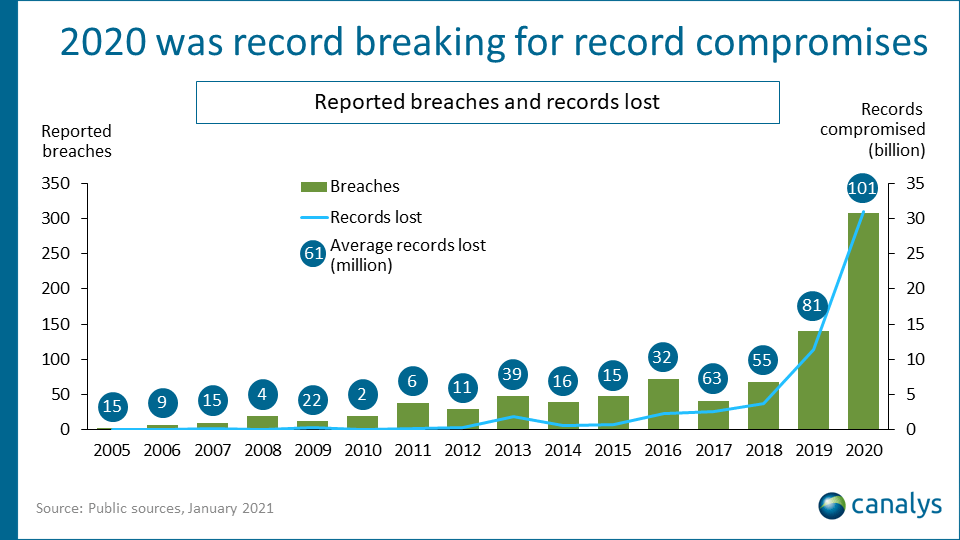
The researchers at Canalys referred to this incident as a "data breach crisis."
On their report, the researchers wrote:
This happened because when the world switched to digitizing their workspace, many had not put enough thought into security requirements.
With employees accessing company information from many different locations, and more data being stored and processed outside of the usual and traditional office environment, the fast-paced digitization of business, has opened up many new attack vectors for threat actors to exploit.
While companies do invest more on security since the pandemic, growing their spending by 10% to $53 billion, other business continuity and workforce productivity took precedence over security.
Canalys estimated that cloud infrastructure services grew 33% in 2020 to $142 billion, representing an increase of $45 billion in annual spend against 2019. Cloud software services increased more than 20% during the same period. Zoom’s reported revenue jumped over 300%, while Microsoft Office 365 and Salesforce maintained strong double-digit growth.
Notebook PC shipments also had a record year, surging 17%, and are forecast to grow further in 2021. Logitech’s webcam business also hit a record high, increasing 138% on a trailing four-quarter basis.
Sales growth of home Wi-Fi routers also grew, and exceeded 40%, as remote workers looked to improve their connectivity.
This is both good and bad. And the bad thing is that, many businesses have yet to consider security seriously.
"Prioritize cybersecurity and invest in broadening protection, detection and response measures or face disaster," said Canalys chief analyst Matthew Ball.
“Cybersecurity must be front and center of digital plans, otherwise there will be a mass extinction of organizations, which will threaten the post-COVID-19 economic recovery,” added Ball. “A lapse in focus on cybersecurity is already having major repercussions, resulting in the escalation of the current data breach crisis and acceleration of ransomware attacks.”
The sudden surge of cyberthreats happened because the pace of digital transformation was not matched by sufficient safeguarding of networks against cyberattacks, and this is "the stark reality facing organizations in 2021."






















































































































































































































































































