In the relentless machinery of Silicon Valley, the most consequential figures are rarely the ones whose names fill conference stages or earnings calls.
Power often moves through quieter channels, through relationships forged years earlier in rooms far from the spotlight, through networks that remain deliberately opaque even as the companies they touch prepare to rewrite the global economy.
As AI accelerates toward what many believe will be its most transformative phase, one of the sector's leading labs is racing toward a public listing that could redefine the scale of technology wealth.
Anthropic, the company behind the Claude models, has drawn extraordinary investor attention. Its private valuation already sits near a trillion dollars. Backers now speak of an October debut that might value the firm at two trillion dollars or more, potentially the largest initial public offering in history, driven by revenue that has climbed with startling speed.
Behind the technical achievements and the carefully cultivated image of safety conscious innovation sits a personal story that has only recently begun to surface.
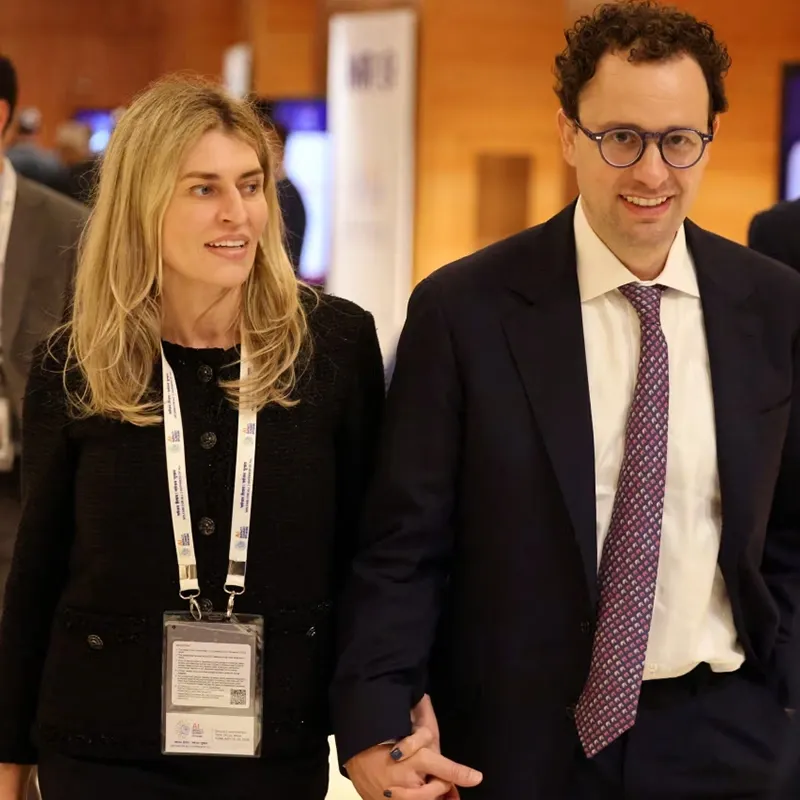
Dario Amodei, the company's chief executive and a co-founder who left OpenAI over differences in approach, has long maintained an unusually private personal life.
For years even basic details of his marital status remained difficult to confirm.
Public records and online searches offered little. Searches for his wife frequently returned images of his sister Daniela, another Anthropic co founder.
The company's own artificial intelligence system, when asked, could not reliably confirm whether he was married at all.
If that isn't mysterious enough, that carefully maintained distance has now been pierced by reporting that draws on both contemporary sources and older documents released under a transparency law.
The woman at the center of this revelation is Cami Clark, Amodei's wife since 2022.
She holds no formal title at Anthropic. She does not appear on organization charts. Yet people familiar with the company describe her as a constant presence and a trusted strategic voice.
She sits in the front rows at major events in Davos and Sun Valley. She joins conversations with investors. When Indian Prime Minister Narendra Modi invited leading AI executives to New Delhi earlier this year and security rules limited each leader to one accompanying guest, most brought colleagues. Amodei brought Clark.
She has helped shape the couple's personal investments and has been involved in evaluating outside opportunities that come their way.
Most consequentially in the company's early days, she introduced Amodei to Eric Schmidt, the former Google chief executive who became one of Anthropic's important early backers when the laboratory was still finding its footing in 2021.
Clark’s path to that position was neither conventional nor straightforward.

Born in 1979 in Reno, Nevada, she grew up in a blue collar household and never completed a college degree, though she studied architecture for a time.
At the age of 20, she married a Reno architect more than 40 years her senior. The marriage lasted roughly 3 years. She later filed for bankruptcy after a foreclosure.
She moved into the Bay Area, worked in business development, and began launching ventures of her own.
One of the earlier efforts was Eddice, a company she co-founded around 2009 with Michelle Capocefalo. It positioned itself as a women focused alternative in adult entertainment, described in its own language as a revolutionary or "free luxury porn" company with higher production values and an audience different from the industry's traditional core.
The project struggled to attract conventional capital.In March 2011 the two women were introduced to Jeffrey Epstein by the literary agent John Brockman.
Brockman emailed Epstein suggesting a dinner connection, describing the pair as raising money in Los Angeles for an adult film aimed at the female market and linking their website.
And this happened after Epstein was already a convicted sex offender.
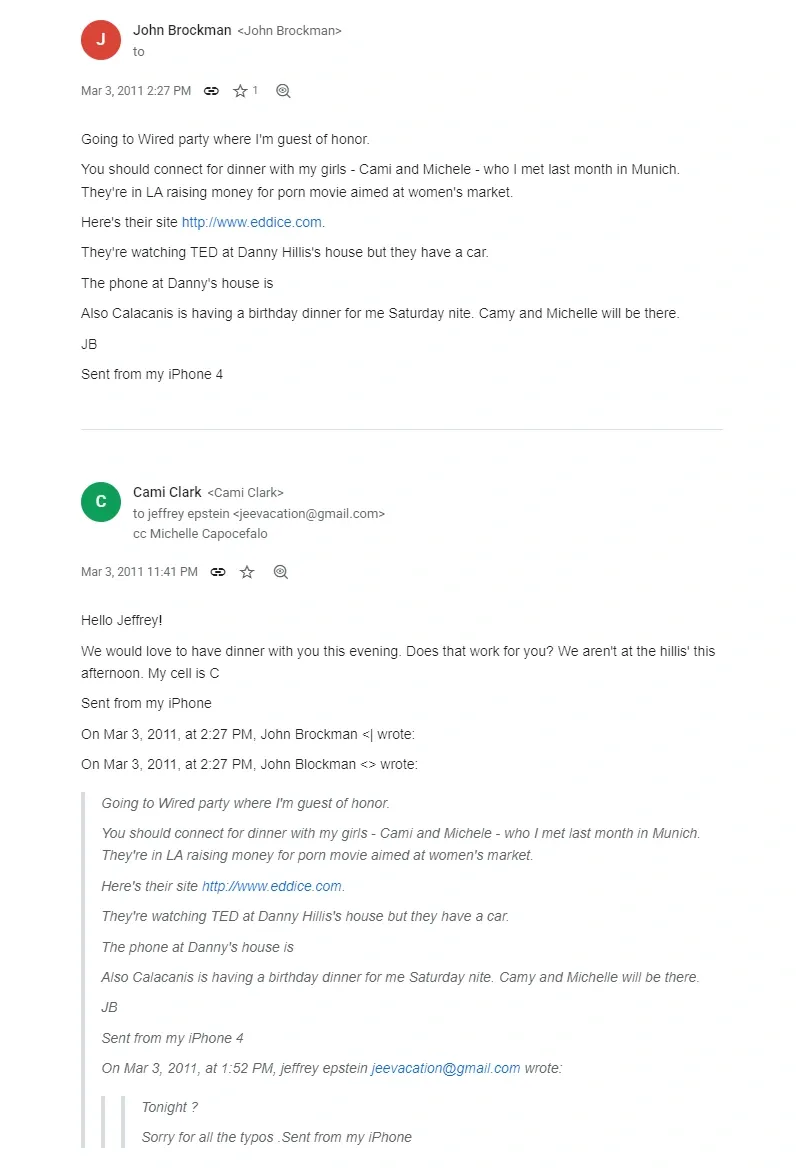
Clark responded the same day expressing interest in meeting that evening and provided her cell phone number.
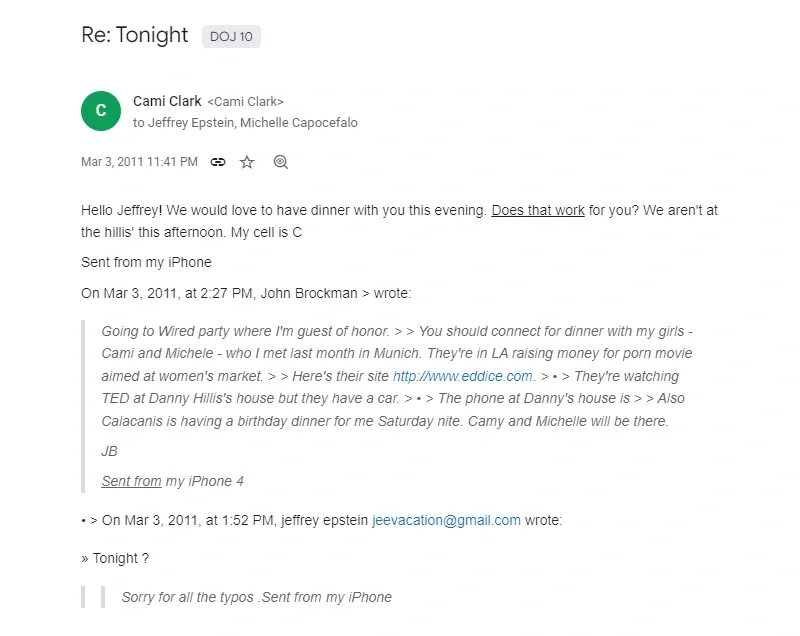
They met.
The following day she wrote that the meeting had been "fantastic" (with all capital letters) and shared funding requirements.

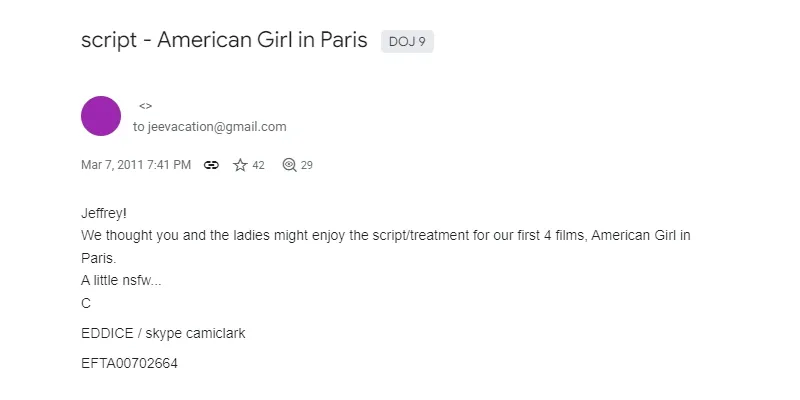
Days later she sent scripts and treatments for the company’s initial films, noting the material was not safe for work and suggesting Epstein and others might find them of interest.
Roughly a year later, in March 2012, she reached out again. When Epstein initially did not place her, she reminded him of the free luxury porn company and the earlier introduction at a TED related gathering.
Epstein acknowledged the recollection.
She pitched further investment, mentioning new hires from established media companies and progress on video content, and also raised a separate concept involving health data and a social dieting application.
Epstein declined the adult content opportunity, stating he could not do sex related television.
Correspondence continued intermittently for about two years and included an invitation to a housewarming gathering in Manhattan.
There is no indication in the released records that any investment was made.
Eddice described itself as a "revolutionary porn company," "free luxury porn company," or high-production adult film studio targeting female audiences. The tagline was "intellectually promiscuous."
The goal was sex-positive content with higher production values and a female perspective, as an alternative to the male-dominated mainstream adult industry. It combined:
- Planned short films/web series (examples referenced include treatments/scripts for titles like American Girl in Paris).
- A related culture, sexuality, and lifestyle blog/site.
- E-commerce integration (click-through from video content to curated retail/product purchases).
Michelle Capocefalo's portfolio described it as an entertainment + e-commerce platform developed from ideation through launch, involving business modeling, fundraising, and talent recruitment (technical, content, and retail).
The name “Eddice” came from Clark’s maternal grandmother, Eddice Munson.
Eddice ultimately raised only a modest sum and faded by around 2013. Clark later pursued other projects, including a women's health clinic concept that attracted investment from Schmidt, whom she had dated for several years before beginning her relationship with Amodei in 2014.
These details remained largely invisible until recently because online traces of Clark's earlier life had been systematically reduced.

Personal websites went offline. Professional profiles disappeared. Public references grew scarce.
The broader context for their sudden visibility is the Epstein Files Transparency Act, signed into law in November 2025.
The legislation required the Department of Justice to release unclassified records related to Epstein in searchable form, subject to protections for victims and certain legal exemptions. Large batches of documents followed, eventually numbering in the millions of pages. Independent tools made the email archives more navigable.
Full threads (including surrounding messages) are searchable on jmail.world.
Journalists examining those files encountered the exchanges involving Clark.
In mid-August 2026, the Wall Street Journal published a detailed account by Keach Hagey and Luke Jerod Kummer that placed her influence alongside the company's rising profile.
Parallel reporting from The Information examined the same material and the same trajectory from early ventures to the present.
The timing amplifies the resonance.
Anthropic is preparing for a public market debut (IPO) that would give ordinary investors their first real window into its finances while simultaneously testing how public markets price the AI boom.
Revenue has expanded at a pace few enterprise software companies have matched. Annualized figures that stood in the single digit billions not long ago have climbed into the tens of billions, with projections for the end of 2026 reaching well into the hundreds of billions according to some investor estimates.
Underwriters are expected to include major Wall Street firms.
A valuation approaching or exceeding two trillion dollars would mark a historic scale.
In that environment, every relationship that shaped the company's earliest capital and counsel invites scrutiny.
What emerges is a portrait of how influence actually operates at the frontier of technology.
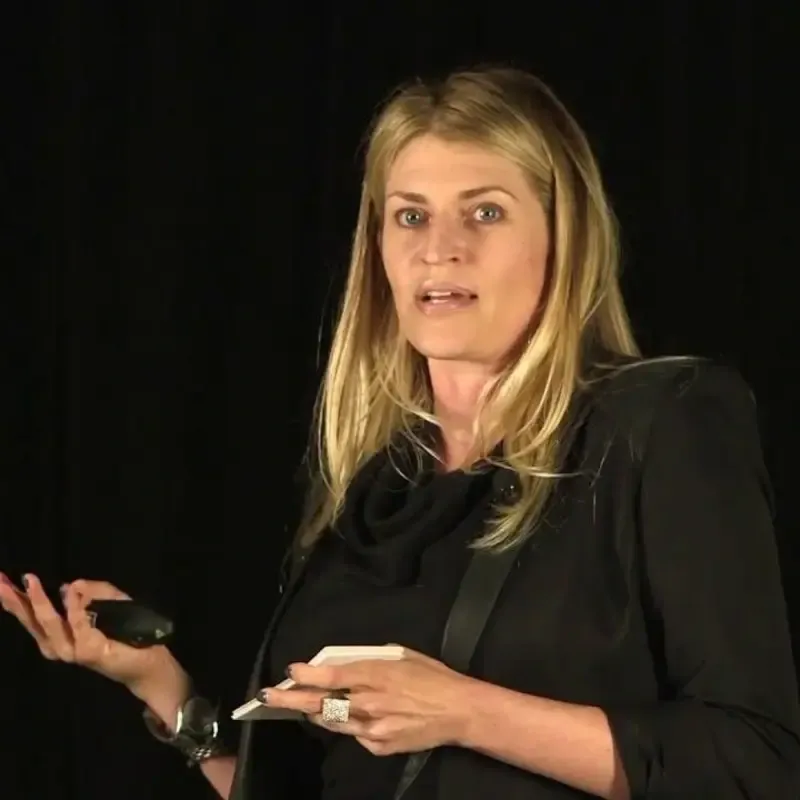
Long story short, Cami Clark, the wife of Anthropic CEO Dario Amodei, has long operated as one of the most influential yet deliberately low-profile figures in the company’s orbit.
After co-founding a short-lived "free luxury porn" startup called Eddice in the early 2010s and unsuccessfully pitching Jeffrey Epstein for investment, she later dated former Google CEO Eric Schmidt and, once she began dating Amodei in 2014, introduced the pair.
That connection helped deliver Schmidt as a key early investor when Anthropic launched.
Married since 2022, Cami holds no official title but functions as Amodei's closest strategic adviser, accompanying him to high-level meetings and investor gatherings while remaining almost invisible online.
Even Anthropic's own chatbot Claude has claimed uncertainty about Amodei's marital status.
The Wall Street Journal's reporting pulled this carefully managed private history into public view just as the company races toward a potentially multi-trillion-dollar IPO.
Formal titles and public narratives matter, yet so do the private networks that precede them by years, the introductions made in social settings, the willingness to pursue unconventional capital when conventional doors remain closed, and the later decision to maintain a low public profile even as the stakes grow enormous.

Cami Clark's story does not alter the technical work of Anthropic's researchers or the competitive race among frontier laboratories.
It does illuminate the human architecture surrounding one of the most closely watched companies of the decade.
As Anthropic moves toward the public markets the questions surrounding transparency, the durability of carefully managed reputations, and the long reach of past associations will travel with it.
The documents are now public. The reporting has begun. The listing, if it proceeds on the timeline investors anticipate, will place all of it under a brighter light than any private company ever experiences.






















































































































































































































































































